

Two days will never be enough to see all of Venice — but it’s exactly enough to fall for it. Here’s the hour-by-hour itinerary we’d hand a first-timer, built from the 2 days in Venice we actually spent getting happily lost.
Everyone tells you the same thing before you go: 2 days in Venice is plenty for a first visit. Then you step out onto the Grand Canal for the first time — a stage set someone forgot to strike — and two days suddenly feels impossibly short. There are 400-some bridges here, six historic districts, a lagoon full of islands, and roughly 1,200 years of history layered into every façade.
Here’s the good news. You can absolutely do Venice justice in two days, as long as you stop trying to “see it all” and trade the checklist for a couple of long walks, one great meal eaten standing up, and a boat ride at golden hour. We did exactly that, and it’s still one of our favorite 48 hours anywhere.
Below is the itinerary we’d give a first-timer — mapped morning to night, with the landmarks worth your time, the ones worth skipping, what it all costs, and the little pockets of history that make the whole place click.
Is 2 Days in Venice Enough?
Honestly? Yes — for the main island and a taste of the lagoon. Two days is enough to walk the great landmarks, eat well, ride a gondola, hop out to a colorful island, and still leave time to wander without a map. What two days won’t do is let you go deep on museums, day-trip to Verona or the Dolomites, or fully explore the outer lagoon. If those are on your list, add a third day (we’ve got ideas for that below).
The single most important decision is this: stay overnight in the city or on the lagoon islands. Venice completely transforms after the day-trippers and cruise crowds leave in the late afternoon. The early mornings and evenings — when the alleys go quiet and the light turns gold — are the Venice you came for, and you only get them if you sleep here.
Before You Go: Sort These Four Things First
A little prep turns a stressful first day into a smooth one. Handle these before you arrive:
- The access fee (or your exemption). On roughly 60 peak-season dates in 2026, day-trippers pay a “contributo di accesso” to enter the historic center — €5 if you register at least four days ahead, €10 later, applied between 8:30 a.m. and 4 p.m. If you’re staying overnight, you’re exempt — you just register for a free exemption code tied to your booking. Staying on Murano or Burano skips it entirely.
- Timed tickets for the big two. Book St. Mark’s Basilica and the Doge’s Palace online in advance with timed entry. Walk-up lines here can eat an hour or more of a two-day trip; a pre-booked slot walks you past most of it.
- A multi-day vaporetto pass. Buy a 48-hour ACTV travel card when you arrive (roughly €35). Single rides are about €9.50 each, so the pass pays for itself in three or four trips and saves you fumbling for tickets at every dock.
- The right bag. Venice is bridges and steps, all of them. A backpack or a soft duffel you can carry beats a big hard roller you’ll be hauling up and over stone arches.
Did You Know? Venice is built on water — literally. The city stands on millions of wooden piles driven deep into the lagoon mud, where the lack of oxygen has kept them from rotting for over a thousand years. Much of Venice is holding itself up on a petrified underwater forest.
Day 1: The Grand Canal, St. Mark’s & a Bacaro Crawl
Day 1 is the greatest-hits day: the arrival, the monumental heart of the city, and your first proper Venetian dinner eaten standing at a bar.
Morning — Arrive by Water and Meet the Grand Canal
However you get in from the airport, try to arrive by water at least once. We took the Alilaguna water bus, and even wrestling luggage on and off a crowded boat, gliding in past the palazzi beats any taxi from any airport on earth. Drop your bags, then don’t overthink the morning — point yourself toward the water and walk. Venice has no cars, so your feet and the vaporetto are the entire transport system. If you want a gentle orientation, ride the Line 1 vaporetto the length of the Grand Canal; it stops everywhere and doubles as the cheapest canal cruise in the city.

Late Morning — St. Mark’s Square & Basilica
Aim for Piazza San Marco, the “drawing room of Europe” and the true heart of the city. Cafés spill out with tiny tables, the campanile towers overhead, and pigeons wheel across the whole grand space. Stand in the middle for a minute before you dive into anything — it’s one of the great squares on earth.

Inside St. Mark’s Basilica, the gold mosaics glow as if the ceiling is lit from within — more than 8,000 square meters of them, built up over centuries. Pay the few extra euros to step up to the loggia and out onto the balcony above the main doors for a sweeping view over the square, and to see the original bronze Horses of St. Mark (the ones outside are replicas).
Did You Know? The body said to lie under St. Mark’s Basilica was smuggled out of Alexandria in 828 AD by two Venetian merchants who hid it in a barrel under layers of pork, knowing inspectors wouldn’t rummage through it. Venice founded its holiest church on a customs loophole — and made the winged lion of St. Mark the symbol of the Republic.

Midday — The Doge’s Palace & Bridge of Sighs

Right next door, the Doge’s Palace (Palazzo Ducale) is part Gothic fairytale, part seat of a thousand years of Venetian power. Wander the enormous Great Council Chamber beneath Tintoretto’s Paradise, climb the ceremonial staircase, then cross the Bridge of Sighs into the old prison cells. That contrast — gold-leafed council rooms on one side, damp stone cells on the other — is the whole story of the Republic in one building. Budget about two hours; a guided or “secret itineraries” tour is worth it for the hidden passages.

Insider Tip: Do the Basilica and Doge’s Palace back-to-back in the late morning while you’re fresh, then break for a long lunch during the hottest, most crowded midday hours. Venetians embrace riposo — the afternoon slowdown — and so should you.

Afternoon — The Rialto Bridge & Market
After lunch, wander northwest toward the Rialto Bridge, the graceful stone arch over the Grand Canal that has been the city’s crossing point for centuries. Cross it for the classic view of boats crisscrossing below, then duck into the Rialto Market, where Venetians have haggled over fish and produce for a thousand years. Late afternoon is quieter than the morning rush, and the surrounding lanes are packed with the bacari you’ll want tonight.

Did You Know? The Rialto was Europe’s Wall Street centuries before Wall Street existed. Merchants did business seated on benches — “banco” in Italian — and a moneychanger who went bust had his bench literally broken. “Banco rotto,” broken bench, is where we get the word “bankrupt.”
Evening — Cicchetti and a Bacaro Crawl
This is our favorite way to spend a first night in Venice. Skip the sit-down tourist menus and do a bacaro crawl instead — hopping between tiny wine bars for cicchetti, Venice’s answer to tapas. Point at what looks good behind the counter, order an ombra (a small glass of house wine) or a spritz, eat standing at the bar, and move on to the next. Most bites are €2–€4, so a memorable dinner costs less than one restaurant entrée. Start around 6–7 p.m. and follow the crowds spilling into the alleys around the Rialto.

For a full crawl route and exactly what to order, see our guide to cicchetti and bàcari.

Day 2: The Islands, the Backstreets & a Sunset Gondola
Day 2 trades the monuments for color, craft, and the quiet corners — the Venice that turns a good trip into a favorite one.
Morning — Escape to the Lagoon Islands
Start on the water. A vaporetto out to Murano and Burano is the best half-day in the lagoon. On Murano, watch a master glassblower turn a molten blob into a horse in ninety seconds; on Burano, wander lanes of candy-colored fishermen’s houses that look hand-tinted. Take Line 12 from Fondamente Nove and go early to beat the midday crowds. We based ourselves on Murano and loved the quiet evenings after the day boats left.

The full island plan is in our Murano & Burano day-trip guide, with deeper dives on the Murano glass factory and whether Burano is worth it.

Afternoon — Get Deliberately Lost
Back on the main island, give yourself one rule: put the map away. Venice is small enough that you can’t truly get lost — you’ll always hit water or a yellow sign pointing to “San Marco” or “Rialto” — but its magic lives in the quiet back canals of Dorsoduro and Cannaregio, away from the crowds. Duck into a neighborhood church, watch a boat unload crates of vegetables, stop for a gelato. This is when Venice stops being a checklist and starts being a place.

Evening — A Sunset Gondola Ride
Yes, it’s touristy. Do it anyway — and do it at sunset. A gondola ride was the single best hour of our trip: our gondolier was a second-generation Venetian who had rowed these canals for 35 years — he was retiring and passing his license to his son — and because ours was the last ride of his night, he gave us the grand tour, winding through silent side canals and out across the Grand Canal to the quiet mooring where he stores his gondola after dark. Rates are fixed by the city, so nobody’s haggling: about €80 for 30 minutes in the day and €100 after 7 p.m., per boat for up to five people, with extra time around €40 per 15 minutes. Board in a quieter neighborhood like Cannaregio or Dorsoduro to skip the queues near St. Mark’s.

Wondering whether it’s worth the money? We break down the real cost and how to do it right in our honest gondola-ride guide.
Did You Know? All those gondolas are black for a reason. In 1562 Venice passed a sumptuary law forcing every gondola to be painted plain black, to stop wealthy families from one-upping each other with flashier boats. Four hundred years later, the anti-showoff law is the look everyone photographs.

What 2 Days in Venice Costs
Venice has a pricey reputation, and it can be — but a lot of that is avoidable. Here’s a rough per-person guide (outside of lodging) so you can budget with your eyes open:
- 48-hour vaporetto pass: ~€35
- St. Mark’s Basilica + Doge’s Palace tickets: ~€35–€45 combined
- Cicchetti dinner (bacaro crawl): ~€15–€25
- Sit-down lunch or dinner: ~€25–€40
- Gondola ride: €80–€100 per boat (split it — that’s ~€20 a head for four)
- Coffee standing at a bar: ~€1.20 (vs. €6+ seated on Piazza San Marco)
- Access fee: €0 if you stay overnight
The biggest money traps are the sit-down cafés on St. Mark’s Square and defaulting to water taxis. Eat cicchetti, drink your coffee standing at the bar like a local, walk instead of boating short distances, and Venice gets a lot friendlier to your wallet.
Where to Base Yourself for Two Days
Neighborhood shapes your whole trip. San Marco puts you in the middle of everything, at a premium. Cannaregio and Dorsoduro are quieter, more local, and full of good bacari. And if you don’t mind a short boat ride, basing on Murano — like we did — gets you bigger, better-value rooms, calm evenings, and that access-fee exemption. Wherever you land, check how close it is to a vaporetto stop before you book. Our Venice Travel Guide breaks down each district in detail.
What We’d Skip
Two honest cuts to protect your two days. The orchestra cafés on Piazza San Marco — the ones with the live music and the eye-watering cover charge — are a lovely photo and a rough bill; have your coffee standing at a back-street bar instead. And don’t burn a half-day hunting for a “cheap” gondola; the price is fixed, so the only real choice is when you ride, and sunset wins every time. We’d also skip trying to cram in a big museum on a two-day trip — save the Accademia or the Peggy Guggenheim for a return visit.
If You Have a Third Day
Lucky you. A third day opens up the parts of Venice a rushed 48 hours misses: linger on Torcello and the outer lagoon, tour the art at the Gallerie dell’Accademia or the Peggy Guggenheim Collection, climb San Giorgio Maggiore’s bell tower for the best view back at San Marco (with far fewer crowds than the campanile), or day-trip by train to Verona or Padua. A third day is also when you can slow down and just live in a neighborhood for an afternoon — arguably the most Venetian thing you can do.
So, Is 2 Days in Venice Enough?
For a first visit centered on Venice itself — yes, comfortably. In 48 hours you can stand under the mosaics of St. Mark’s, cross the Bridge of Sighs, eat your way through a bacaro crawl, watch glass become art on Murano, and drift home on a gondola at sunset. You’ll leave with a short list of things you didn’t get to — and that’s the point. Venice is the rare place that’s better with a reason to come back. We’d go again tomorrow.
2 Days in Venice: FAQ
Is 2 days enough for Venice?
Yes, for the main island and a taste of the lagoon islands. Two days covers St. Mark’s, the Doge’s Palace, Rialto, a bacaro crawl, Murano or Burano, and a gondola ride. Add a third day if you want to slow down, visit museums, or day-trip farther out.
What should you not miss in Venice?
St. Mark’s Basilica and Square, the Doge’s Palace and Bridge of Sighs, the Rialto Bridge and market, a cicchetti crawl through the bacari, at least one lagoon island (Murano or Burano), and a sunset gondola ride.
How much does 2 days in Venice cost?
Outside lodging, budget roughly €120–€180 per person for two days — a 48-hour vaporetto pass (~€35), major-sight tickets (~€40), meals (cicchetti dinners are cheap; sit-down meals more), and a shared gondola ride. Staying overnight waives the access fee.
Do you have to pay the Venice access fee?
Only day-trippers, and only on about 60 peak dates in 2026 (roughly €5–€10, 8:30 a.m.–4 p.m.). If you stay overnight in Venice you’re exempt with a free registration, and staying on Murano or Burano avoids it entirely.
Is it better to stay in Venice or day-trip?
Stay overnight if you can. You’ll skip the access fee, get the city in the quiet early mornings and evenings after the day-trippers leave, and Venice at night is a completely different, calmer place.
How do you get around Venice in 2 days?
On foot for short distances and by vaporetto (water bus) for longer hops and the islands. Buy a multi-day travel card when you arrive — it pays for itself in about three rides. See our full guide to getting around Venice.
Nic’s Pick: The Hour We Still Talk About
I’ll be honest — I went into our gondola ride half-braced to feel like a tourist who’d just been fleeced. Instead it got me in the best possible way. We waited for sunset and found a gondolier down a quiet Cannaregio canal, and the moment we slipped out onto the Grand Canal with the whole sky turning gold, I teared up. He told us he’d rowed for 35 years, and this was his final season before he retired and passed his license to his son, just as his own father had passed it to him. If you do one splurge in Venice, make it this — and make it at golden hour.
Keep Exploring Venice
Ready to plan the details? These go deeper on everything above:
- Venice Travel Guide: What to See, Eat & Do — our full first-timer’s guide to the city.
- Getting Around Venice — vaporettos, walking, and what to skip.
- Cicchetti & Bàcari — how to eat and drink like a local.
- Is a Gondola Ride Worth It? — the real cost and how to do it right.
- Murano & Burano Day Trip — the best half-day in the lagoon.
- Best Time to Visit Venice — dodging crowds and acqua alta.
Have you been to Venice, or are you planning your first trip? Tell us in the comments how you’d spend 48 hours — and whether you’d splurge on the gondola.
Wear the trip. Take Venice home with our new Venice tee — plus a Tuscan companion for the rest of your Italy dreams. Printed on demand in the USA, free shipping, and 25% off right now:
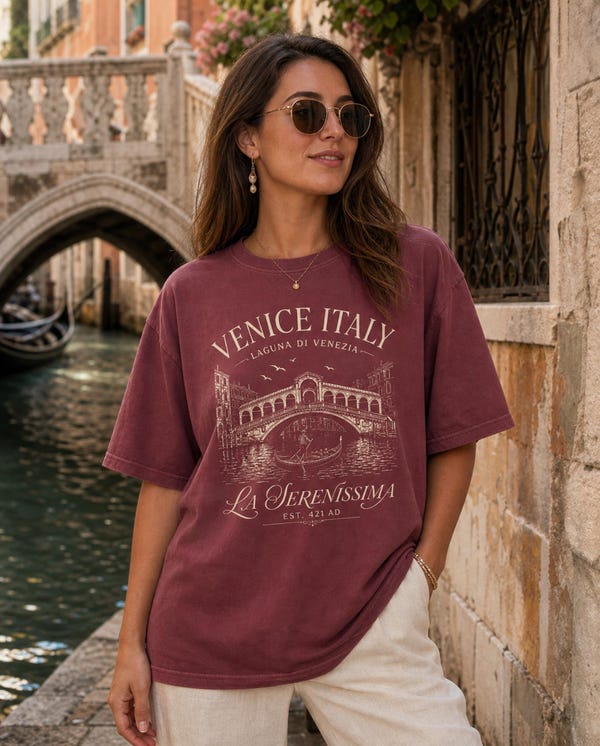

More from the shopBrowse the full travel collection — St. Augustine, Paris, Iceland, Venice and Tuscany on shirts, ceramic mugs and canvas totes, all original designs.

Ben & Nicole Mathews
We’re based in St. Augustine, Florida, sharing the places we’ve actually been — from our home turf to corners of the U.S. and abroad. Ben is an attorney and a retired Air Force JAG (22 years), and a private pilot, which is why aviation and military history shows up here too.