

A medium bomber has no business taking off from an aircraft carrier. Sixteen of them did it anyway, and that was only the second-strangest thing anyone asked this airplane to do.
At 8:20 on the morning of 18 April 1942, Lieutenant Colonel Jimmy Doolittle released the brakes on a twin-engine bomber sitting at the extreme forward end of the USS Hornet’s flight deck. He had 467 feet of deck in front of him. A B-25 is not supposed to leave the ground in 467 feet. The Navy had painted white lines on the deck to keep the left wheel and the nosewheel where they needed to be, because the right wingtip hung out over open water.
The sea was heavy enough that the bow was burying itself in spray. The plan had been to launch four hundred miles from Japan, in the evening, and land in China in daylight. Instead a Japanese picket boat had spotted the task force at 07:38, and the whole thing went ten hours early and 170 nautical miles farther out than anyone had intended — which meant that all sixteen crews knew, as they ran up their engines, that there was no longer enough fuel to reach the airfields waiting for them.
They went anyway. Every one of them got off the deck.
That is the story everybody knows about the B-25 Mitchell. It is not the most interesting one. Over the next three years this airplane would be cut apart with hacksaws on jungle airstrips and rebuilt into something its designers never drew, fitted with a gun borrowed from a tank, flown fifty feet above the water at Japanese destroyers, and named — alone among American aircraft at the time — after a general the United States Army had convicted at a court-martial and driven out of the service.
It is the most adaptable aircraft America built in the Second World War, and almost nothing it is famous for was in the original specification.


Shop this design on Etsy
WWII nose art — the pin-ups, cartoons and lucky cats crews painted on the noses of their aircraft — redrawn for shirts, stickers, prints and glassware. If you came for the aircraft, the artwork is over here.
The General They Convicted
Billy Mitchell spent the 1920s telling the United States military things it did not want to hear, in language calculated to make sure everyone heard them.
In July 1921 he got the chance to prove the central one. The Navy’s position was that aircraft could not sink a modern battleship. Mitchell was given the captured German battleship Ostfriesland as a target, and on 21 July 1921 his bombers put her on the bottom — using near-miss bombs that ruptured the hull below the waterline rather than the direct hits the rules anticipated. The Navy complained, with some justice, that he had broken the agreed test conditions. The photographs of a battleship going down went around the world anyway.

He kept pushing. He predicted air power would be the decisive arm of war within a decade. After inspecting Hawaii in 1924 he warned that Japan would one day open a war with a surprise air attack on Pearl Harbor — a prediction so specific that it reads today like something invented afterward.
Then, on 5 September 1925, after the Navy airship Shenandoah broke up in a storm and killed fourteen men, Mitchell issued a statement accusing the War and Navy Departments of “almost treasonable administration of the national defense.”
You cannot say that about your own service and stay in it. He was court-martialed, found guilty on 17 December 1925, and suspended from duty for five years without pay. President Coolidge softened it to half pay. Mitchell resigned on 1 February 1926 rather than serve the sentence, and died in 1936 at 56 — five years before the airplane carrying his name first flew, and fifteen years before most of what he predicted came true.
Did You Know? The B-25 is frequently described as the only American military aircraft named after a person. That overstates it. It is the first — the first time an American military aircraft design was named for an individual rather than given a bird, a place or a piece of weather. It is a distinction the Army handed to a man it had thrown out nine years earlier.
An Airplane With a Kink in Its Wing
The B-25 came out of North American Aviation’s NA-40, a design that did not win its competition, and its rebuilt successor the NA-62, which did. The first B-25 flew on 19 August 1940.
It had a problem. In flight it exhibited Dutch roll — an unpleasant coupled wallowing where the aircraft yaws one way and rolls the other, over and over, the sort of thing that makes accurate bombing impossible and crews airsick.
The fix is the reason you can identify a B-25 from a mile away. Engineers took the dihedral — the upward angle — out of the outer wing panels, leaving the inner sections angled up and the outer sections flat. The result is the shallow gull-wing kink in the leading edge that no other American bomber has. It is not a styling choice. It is a bug fix, visible from the ground, on nearly ten thousand airplanes.

What the B-25 Actually Was
- Crew: five — pilot, navigator/bombardier, turret gunner/engineer, radio operator/waist gunner, tail gunner. Strafer conversions changed this considerably.
- Engines: two Wright R-2600 Twin Cyclone radials, 1,700 hp each.
- Speed: about 272 mph at 13,000 feet.
- Range: roughly 1,350 miles.
- Bomb load: 3,000 lb.
- Defensive guns: twelve to eighteen .50-calibre machine guns depending on the variant — and on what the squadron had done to it.
- Built: 9,816, the most-produced American twin-engine combat aircraft of the war.
Those are unremarkable numbers. The B-25 was slower than a Mosquito, carried less than a B-17, and flew nowhere near as far. What it had instead was a combination that turned out to matter more than any single figure: it was rugged, it flew well on one engine, it could be landed on bad strips by tired pilots, and — crucially — there was room in the nose and structure in the airframe to bolt on almost anything.
That last quality is the whole story.

From the Shop
Lucky 13 Nose Art Desk Mat
The cat on the bomb, sized for a desk instead of a fuselage. Eighty years of aircrew superstition under your mouse.
Sixteen Bombers and a Carrier Deck
Four months after Pearl Harbor the United States needed to hit Japan and had no way to do it. Carrier aircraft lacked the range to strike the home islands and get the carriers back out of danger. Land bases in China were too far and too vulnerable.
The answer was to put Army medium bombers on a Navy carrier — fly them off, hit Japan, and continue west to airfields in unoccupied China rather than trying to land back aboard, which a B-25 cannot do.
Sixteen aircraft and eighty men — 52 officers and 28 enlisted — sailed on the Hornet. The aircraft were stripped: the lower turret came out, so did the radios, and extra fuel tanks went into every space that would take one. The famous detail is true — broomsticks were fitted in the tail cone to give the impression of guns that were not there.

They hit Tokyo, Yokohama, Yokosuka, Nagoya, Kobe and Osaka. The material damage was small. That was never really the point.
What It Cost
Because they launched 170 miles early, none of them made it to an airfield. Fifteen aircraft reached China and every one crashed or was abandoned in the air. The sixteenth, low on fuel and out of options, turned for the Soviet Union and was interned along with its crew.
Of the eighty men: 69 evaded capture, mostly with extraordinary help from Chinese civilians and soldiers. Three were killed. Eight were captured by the Japanese — three of them were executed, one died in captivity of disease, and four survived to the end of the war.
The Chinese who helped them paid a price that dwarfs the raid itself. The Japanese reprisal campaign through the coastal provinces that summer killed civilians in numbers that are still estimated rather than counted, and the figures run into the hundreds of thousands. Any honest telling of the Doolittle Raid has to carry that.
What It Bought
Doolittle came down in a rice paddy outside Quzhou, sat on the wreckage of his airplane, and told his crew chief he expected a court-martial for losing sixteen bombers and achieving very little.
He was promoted to brigadier general and given the Medal of Honor.
The reason is what happened inside the Japanese high command. Home islands that had been assured they were beyond reach had just been bombed. The argument for pushing the defensive perimeter further out won, and Admiral Yamamoto got the operation he wanted against Midway — where in June 1942, six weeks later, Japan lost four fleet carriers in a day and the initiative in the Pacific with them.
Sixteen medium bombers, minimal damage, and a strategic consequence out of all proportion to any of it.

From the Shop
Permission To Come Aboard Shirt
Sailor pin-up nose art, for an airplane that spent one famous morning on the deck of a carrier. Soft vintage-weight tee.
Pappy Gunn and the Airplane Nobody Ordered
The second act of the B-25 story happens in New Guinea and Australia, and it is largely the work of one furious man with a hacksaw.
Paul “Pappy” Gunn was a retired Navy chief and pilot who had gone out to the Philippines to run an airline. When Japan came into the war he flew American personnel out to Australia, and his wife and four children did not get out with him. They spent from January 1942 to February 1945 interned at Santo Tomas in Manila. Gunn spent that war knowing exactly where his family was and being unable to do anything about it.
What he did instead was rebuild airplanes.
The problem in the Pacific was that medium-altitude bombing against ships and jungle airstrips did not work. Bombs from 10,000 feet mostly missed moving vessels, and the targets that mattered were dispersed under trees. What the theatre needed was something that could come in at treetop height and put an overwhelming weight of fire straight ahead.
In August 1942 Gunn packed .50-calibre machine guns into the nose of an A-20 Havoc. General George Kenney, commanding Fifth Air Force and not a man overly troubled by paperwork, looked at the result and told him to do it to the B-25.
So they did. The bombardier’s position came out. Guns went into the nose, more guns went into blister packs on the fuselage sides, and the aircraft that emerged — eventually standardised as the factory-built B-25J strafer — carried up to eighteen .50-calibre machine guns, eight of them firing forward. Nothing about that was in the original design. It was field engineering that worked so well the factory copied it.
Did You Know? The nose guns were mounted so close to the crew that firing them all at once filled the cockpit with cordite smoke and, on some conversions, cracked the plexiglass. Crews reported the airplane visibly slowing when the forward battery fired — eight heavy machine guns pointed one way produce real recoil.
The Battle of the Bismarck Sea
The proof arrived on 2–4 March 1943. A Japanese convoy of eight transports and eight destroyers set out from Rabaul to reinforce Lae in New Guinea with roughly 6,900 troops.
Fifth Air Force and the RAAF met them with a coordinated attack in which the B-25 strafers had a very specific job: come in low, ahead of everyone else, and hose the decks with .50-calibre fire to silence the anti-aircraft crews. Then came the bombing — not from altitude but from fifty feet or less, releasing so the bomb either skipped across the water into the hull or struck at mast height.
All eight transports were sunk. Four of the eight destroyers went down. Of the 6,900 troops, about 1,200 reached Lae; roughly 2,700 were pulled out of the water and taken back to Rabaul, and about 2,890 men were killed. The Allies lost one B-17, three P-38s and thirteen aircrew.

After Bismarck Sea the Japanese did not attempt to reinforce Lae by sea again. An airplane designed to drop bombs from medium altitude had just closed a shipping route by flying at wave height with machine guns.
From the Shop
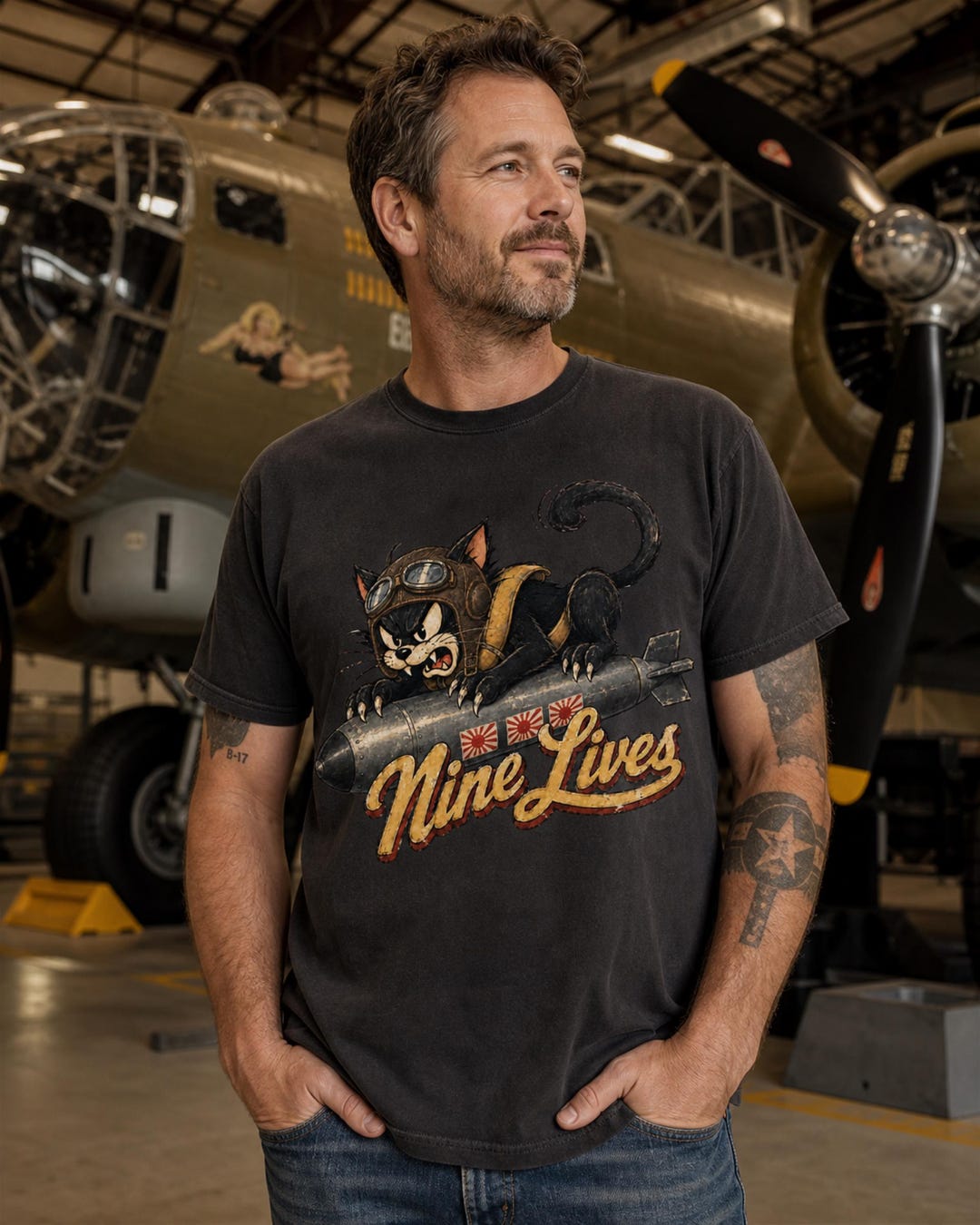
Nine Lives Nose Art Shirt
A cat with more lives than it should have, which is the right patron saint for a medium bomber that kept coming home in pieces.
The 75mm Cannon
Then somebody decided the strafer needed a bigger gun, and the B-25 became the platform for the largest gun ever fitted to an American production aircraft.
The B-25G carried a 75mm M4 cannon in the nose — a weapon descended from the same 75mm gun the Army was putting in the Sherman tank. The B-25H carried a lighter version of it plus four nose machine guns instead of two.
It was loaded by hand. The navigator, wedged in behind the pilot, manhandled 15-pound rounds into the breech, which is why the practical rate of fire was around four rounds on a firing pass. The pilot aimed the entire airplane and fired the gun.
Opinions on how well it worked vary sharply and honestly. Against a stationary target — a barge, a moored ship, a bunker — a 75mm shell delivered accurately is decisive. Against anything that moved, four hand-loaded rounds per pass was a poor trade for the weight and the space, and many units in the Pacific eventually took the cannon out and put more machine guns in the hole. The gun is remembered more than it was used.

Did You Know? Firing the 75mm decelerated the aircraft noticeably and shook the airframe hard enough that crews reported rivets working loose and instruments failing. There are accounts of gunners bracing themselves against the structure before each shot. This was a field gun in an airplane, and it behaved like one.
The Loudest Airplane in the War
This is the part B-25 crews mention that almost never appears in the specifications.
The Wright R-2600s sat close to the fuselage with their exhaust stacks pointed more or less at the cockpit and the crew positions. The B-25 was ferociously, physically loud — loud enough that a great many of the men who flew it came home with permanent hearing damage, and loud enough that it is a recognised part of the type’s reputation rather than an occasional complaint.
Warbird crews still describe the sound as the defining characteristic of flying one. If you have ever stood near a B-25 running up at an airshow, you already know: it is not a note so much as an assault, and it is why people who love this airplane love it a little differently from the way they love a Mustang.

From the Shop
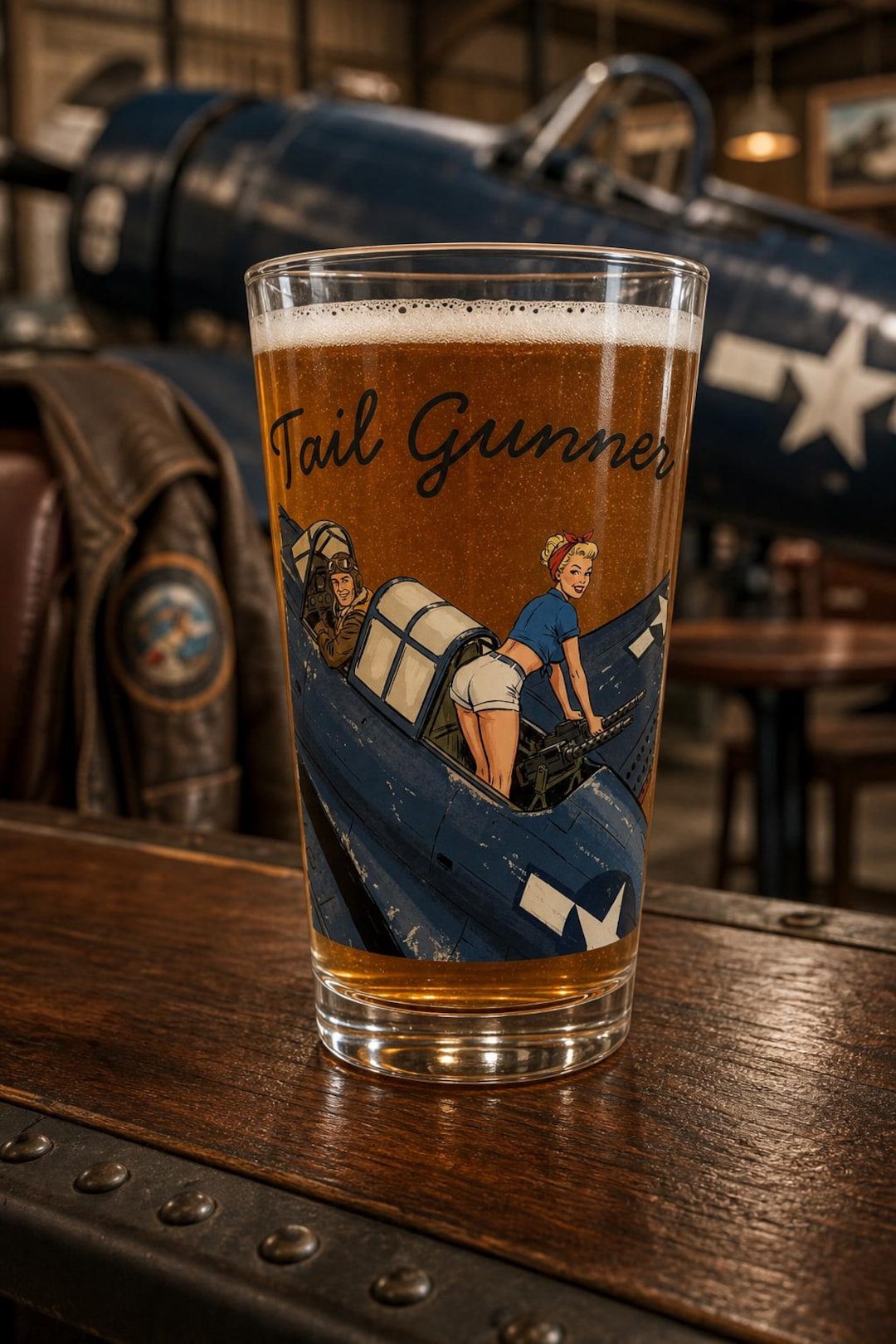
Tail Gunner Nose Art Pint Glass
The loneliest seat on the airplane, wrapped around a 16oz pint glass. For the shelf under the squadron patch.
Catch-22 Was a B-25
Joseph Heller joined the Army Air Forces at nineteen in 1942 and went to Corsica in May 1944 as a bombardier in B-25s, with the 488th Bomb Squadron of the 340th Bomb Group. He flew 60 missions over France and Italy and finished his tour that October. He described the airplane as stable, dependable and dull green.
On 15 August 1944, over Avignon, flak forced violent evasive manoeuvring. The g-load pinned Heller against the nose dome and tore his headset off. His side gunner, Sergeant Carl Frankel, was hit and badly wounded, and Heller got to him and kept him alive. If you have read Catch-22, you have read a version of that afternoon; it is the raw material for the scene the whole novel keeps circling back to.
Did You Know? The 340th Bomb Group — Heller’s group — lost more B-25s to a volcano than to the Luftwaffe in the spring of 1944. When Mount Vesuvius erupted in March that year, hot ash fell on their airfield at Pompeii and destroyed or wrecked dozens of aircraft on the ground, melting plexiglass and stripping fabric control surfaces. Nobody was killed. The group simply had to be re-equipped.
Eight days later his group bombed Pont-Saint-Martin in Italy, a mission that killed around 130 civilians. Heller spent the rest of his life writing about what it feels like to be a small component of a machine making decisions you cannot see the reasons for.

The most influential American novel about the absurdity of war was written by a man who flew this airplane, from an airfield on Corsica, in the nose.

The Morning a B-25 Hit the Empire State Building
On the foggy Saturday morning of 28 July 1945, a B-25D on a routine flight from Bedford, Massachusetts to Newark lost its way over Manhattan in cloud that had the tops of the buildings in it.
It struck the north face of the Empire State Building between the 79th and 80th floors at around 9:40 in the morning. Fourteen people were killed — three on the aircraft and eleven in the building, most of them staff of the Catholic War Relief Services offices who had come in on a Saturday. One engine went straight through the building and out the far side; the other fell down an elevator shaft.
And then the strangest thing in the whole story happened. An elevator operator named Betty Lou Oliver, badly burned in the initial explosion, was put into an elevator to be taken down for treatment. The cables, damaged by the impact, gave way. She fell seventy-five storeys to the sub-basement.
She survived. Compressed air in the shaft and the coiled cable piling up beneath the car slowed the fall enough. She holds the Guinness record for the longest survived elevator fall, and she lived until 1999.
The building was open for business on Monday.

Where to See a B-25 Mitchell
Here the B-25 is generous in a way most warbirds are not. More than a hundred survive, and around 45 of them are still airworthy — an extraordinary number for a seventy-year-old twin-engine bomber, and it means you can realistically plan a trip around seeing one fly rather than seeing one parked.

Static, in museums:
- National Museum of the U.S. Air Force — Dayton, Ohio. B-25D 43-3374, in the WWII Gallery. Free admission, and the same visit gets you the B-17, the B-2 and an F-117.
- National Naval Aviation Museum — NAS Pensacola, Florida. B-25J 44-29035, painted as a Marine Corps PBJ-1, which is what the Navy and Marines called the B-25.
- Pima Air & Space Museum — Tucson, Arizona. B-25J 43-27712, The Spirit of Al Penn.
Airworthy, and worth chasing:
- Miss Hap — American Airpower Museum, Farmingdale, New York. The fourth B-25 ever built, later Hap Arnold’s personal aircraft and later still Howard Hughes’s.
- Photo Fanny — Planes of Fame, Chino, California. Flew in the 1970 film of Catch-22, which is a pleasing loop.
- Yellow Rose — Commemorative Air Force, San Marcos, Texas.
- Rosie’s Reply — Yankee Air Museum, Ypsilanti, Michigan.
- Grumpy — Historic Flight Foundation, Spokane, Washington.
- Apache Princess — Fantasy of Flight, Polk City, Florida.
And the one to watch for: on Doolittle Raid anniversaries the surviving flyers are gathered in one place, and the results are remarkable. In April 2010, seventeen airworthy B-25s took off from the field behind the museum at Wright-Patterson to mark the 68th anniversary. That is more B-25s in the air at once than most people will ever see, and those gatherings still happen — check the museum’s calendar before you book anything.
Little-Known B-25 Facts
- The Marines flew it off islands, not carriers. The Navy and Marine Corps operated the B-25 as the PBJ, mostly in the Pacific, and no B-25 ever landed back on a carrier — the Doolittle aircraft only ever went one way.
- The Soviets were the largest foreign operator. 866 went to the Soviet Air Force under Lend-Lease, where they were used heavily as long-range night bombers. Over 700 went to the RAF, and Canada, China, the Netherlands, Australia, Brazil and Indonesia all flew them.
- Indonesia kept them flying until 1974, nearly three decades after the war and fourteen years after the USAF flew its last B-25 mission on 21 May 1960.
- The nose was interchangeable in the field. Glass bombardier nose, solid strafer nose, cannon nose — squadrons swapped between them based on what the next mission needed.
- Nose art thrived on it. The B-25’s big flat fuselage sides were a canvas, and the Pacific strafer groups — the Air Apaches above all — ran some of the most elaborate painted aircraft of the war.
- It was designed for a crew of five and routinely flew with fewer. Strafer conversions deleted the bombardier entirely; the guns in his old position needed no one to aim them but the pilot.
- 9,816 built makes it the most-produced American twin-engine combat aircraft of the war — more than the P-38, more than the A-20, more than the B-26.

B-25 Mitchell: Frequently Asked Questions
Why is the B-25 called the Mitchell?
It is named for Brigadier General William “Billy” Mitchell, the air power advocate who was court-martialed in 1925 after accusing the War and Navy Departments of “almost treasonable administration of the national defense.” He resigned in 1926 and died in 1936. The B-25 was the first American military aircraft design named for a person.
Did B-25s really take off from an aircraft carrier?
Yes, once. Sixteen B-25s launched from the USS Hornet on 18 April 1942 for the Doolittle Raid, the lead aircraft with 467 feet of deck. They could not land back on a carrier and were never intended to — the plan was to continue to airfields in China.
What happened to the Doolittle Raiders?
All sixteen aircraft were lost. Of the 80 airmen, 69 evaded capture, three were killed, and eight were captured — three of whom were executed and one died in captivity. One crew landed in the Soviet Union and was interned. Chinese civilians who sheltered the crews suffered a devastating Japanese reprisal campaign.
Did the B-25 have a cannon?
Yes. The B-25G and B-25H carried a 75mm M4 cannon in the nose, derived from the gun used in the Sherman tank — the largest gun ever fitted to an American production aircraft. It was hand-loaded by the navigator and managed about four rounds per firing pass, and many Pacific units removed it in favour of more machine guns.
How many guns did a B-25 strafer have?
Up to eighteen .50-calibre machine guns, with eight firing forward. The configuration started as a field modification by Paul “Pappy” Gunn under General George Kenney in the Southwest Pacific and was later built that way at the factory as the B-25J.
Why does the B-25 wing have a bend in it?
To fix Dutch roll. Early aircraft wallowed in flight, and engineers cured it by removing the dihedral from the outer wing panels — leaving the inner wing angled up and the outer wing flat. That shallow gull-wing kink is the easiest way to identify a B-25 in a photograph.
How many B-25s were built and how many still fly?
9,816 were built. More than a hundred survive worldwide and roughly 45 remain airworthy — one of the largest flying populations of any WWII bomber.
Was Catch-22 about the B-25?
Yes. Joseph Heller flew 60 missions as a B-25 bombardier with the 488th Bomb Squadron, 340th Bomb Group, from Corsica in 1944. The Avignon mission of 15 August 1944, in which his gunner was badly wounded, is the direct source of the novel’s central scene.
Where can I see a B-25 Mitchell?
Static examples are at the National Museum of the U.S. Air Force in Dayton, the National Naval Aviation Museum in Pensacola and Pima Air & Space in Tucson. Airworthy aircraft fly from the American Airpower Museum in New York, Planes of Fame in California, the Commemorative Air Force in Texas, the Yankee Air Museum in Michigan and Fantasy of Flight in Florida, among others.
The Bottom Line
The B-25 is not the fastest, the biggest, or the most beautiful aircraft of the Second World War. On paper it is a competent medium bomber and nothing more. Its specifications explain none of what it did.
What made it matter is that it could be turned into whatever the war needed next. It was asked to fly off a carrier deck it was never designed for and it did. It was asked to become a low-level gunship by men with hacksaws on jungle airstrips, and not only did it work, the factory copied the field modification. It was asked to carry a tank gun, and it carried a tank gun. It closed a shipping lane at wave height. It flew for the Soviets, the British, the Dutch, the Chinese and the Marines, and Indonesia was still flying it in 1974.
And it carries the name of a man the United States Army convicted and pushed out for saying, too loudly and too early, most of the things this airplane went on to prove. Billy Mitchell never saw one fly. He would have been insufferable about it, and he would have been entitled.
Forty-five of them still fly. Go and stand near one when it starts up — there is no other way to understand why the men who flew this airplane talk about it the way they do.
Keep Reading
- B-17 Flying Fortress: Daylight Bombing, the 25-Mission Math, and Why It Mattered — the other half of the American bombing story, and a very different way to go to war.
- How to Read WWII Nose Art: What the Pin-Ups, Cartoons & Symbols Meant — what the crews painted on those big flat fuselage sides, and why.
- WWII Bomber Nose Art: The Story of Lucky 13 & America’s Greatest Aircrews — one design, and the men who flew behind it.
- D-Day from the Air: Every Aircraft That Flew the Invasion of Normandy — the medium bombers in the biggest air operation ever mounted.
- SBD Dauntless: The “Slow But Deadly” Dive Bomber That Won Midway — the battle the Doolittle Raid helped bring about.
- B-1B Lancer: The Bomber Carter Cancelled and Reagan Revived — the supersonic bomber that ended up doing close air support instead.
Have you seen a B-25 fly — or better, heard one? Tell us where in the comments. With forty-five of them still airworthy, this is one of the few WWII bombers most people can still get to in person.
More from the shopBrowse the full WWII aviation & nose art collection — tees, prints, glassware and gifts, all original designs.

Ben & Nicole Mathews
We’re based in St. Augustine, Florida, sharing the places we’ve actually been — from our home turf to corners of the U.S. and abroad. Ben is an attorney and a retired Air Force JAG (22 years), and a private pilot, which is why aviation and military history shows up here too.