

The English Channel was still dark when the first engines lit off. June 5th, 1944, somewhere after midnight — and already the most complex air operation in history was underway. Before a single American or British boot touched the beaches of Normandy, thousands of aircraft had been flying for days, weeks, months. Bombing railroads. Photographing beaches. Flying deception patterns to confuse German radar. And in the small hours of June 6th, thousands of paratroopers were already in the dark air over France, crammed into transports and gliders, trusting their lives to canvas, aluminum, and a set of navigation lights blinking through the clouds. Together, these were the D-Day aircraft that made the invasion of Normandy possible.
This is the story of every aircraft that flew the Invasion of Normandy. Not just the famous ones — the Mustangs and the Thunderbolts. Every airframe. Every mission. Every aircraft type that made D-Day possible.
The Air War Before the Beach War: The Transportation Plan
D-Day didn’t begin on June 6th. It began in April 1944, when the Allied air forces launched what became known as the Transportation Plan — a systematic campaign to destroy every railroad, bridge, and marshaling yard within range of Normandy. The goal was simple and brutal: when the invasion happened, the Germans would be unable to move reinforcements by rail. They’d be forced onto roads. Slowed down. Paralyzed.
The aircraft that flew this campaign were the heavy bombers — and they flew it at enormous cost.
Boeing B-17 Flying Fortress
The B-17 was the backbone of the U.S. Eighth Air Force based in England, and in the weeks before D-Day, it was working overtime. Flying in massive formations called “combat boxes,” B-17s hit rail yards at Rouen, Metz, and Cologne. They hit airfields and fuel depots. They hit coastal gun batteries on the morning of June 6th itself — though with mixed results, as we’ll discuss.

The B-17 carried up to 8,000 pounds of bombs and was famous for its ability to absorb punishment. Crews flew 25-mission tours — a number chosen because statisticians calculated that was roughly the survival threshold. Many didn’t make it.
On D-Day morning, the 8th Air Force dispatched 1,350 B-17s and B-24s to bomb the beach defenses just before the landings. Cloud cover was so thick that bombardiers were ordered not to drop unless they had visual confirmation of targets — to avoid hitting Allied troops. Most bombs fell harmlessly miles inland. The beach defenses were largely untouched when the first waves hit the water.
Consolidated B-24 Liberator
The B-24 looked ungainly next to the graceful B-17 — its twin-tail and high-mounted Davis wing gave it an almost industrial silhouette. But it was faster, had longer range, and could carry a heavier bomb load. The Eighth Air Force operated both types, and both flew the pre-invasion bombing campaign.

The B-24 also served a critical secondary role: maritime patrol. In the Atlantic and Bay of Biscay, specially configured B-24s (operating as PB4Y-1s in U.S. Navy service) hunted U-boats and kept the sea lanes to Britain open. Without them, the logistical pipeline that fed the entire Allied war machine in Europe might have collapsed.
The B-24 actually outnumbered the B-17 in total production — 18,482 Liberators were built versus 12,731 Flying Fortresses. Yet the B-17 got all the Hollywood glory. The reason? The Memphis Belle. The 1944 documentary about the crew’s 25th mission made the B-17 a cultural icon that the B-24 never matched.
Martin B-26 Marauder
The B-26 arrived in Europe with a terrible reputation. Its high wing loading and demanding handling characteristics had killed so many crews in training that pilots nicknamed it the “Widowmaker” and the “Flying Prostitute” (no visible means of support, they said, referring to the short wings). Early operations were disastrous.

But by 1944, crews who had mastered the Marauder had turned it into one of the most accurate medium bombers in the European Theater. The Ninth Air Force’s B-26 groups pounded bridges along the Seine — so thoroughly that by D-Day, every bridge over the Seine between Paris and the English Channel had been destroyed or severely damaged. German reinforcements trying to reach Normandy would have to detour for days.
On D-Day morning, 11 B-26 groups — 432 aircraft — flew over Omaha and Utah beaches, bombing in a line just ahead of the landing craft. Unlike the high-altitude B-17s blinded by cloud cover, the B-26s came in lower and some found their targets. On Utah Beach, the bombing contributed to the remarkably light casualties. On Omaha, results were mixed — but the attempt was there.
Douglas A-20 Havoc
The A-20 Havoc was a fast, twin-engine attack bomber that served in both the U.S. Army Air Forces and the RAF (where it was called the Boston). In the pre-D-Day campaign, Havocs flew night intruder missions — hunting German trains, convoys, and airfields in the dark. They were fast enough to evade most German night fighters and accurate enough to put bombs through railyard switches and engine sheds.

On D-Day itself, A-20s flew smoke-laying missions along the beaches, creating cover for landing craft, and attack missions against German gun positions and troop concentrations just behind the beaches.
FROM THE SHOP
We created SunSpun Creations to turn some of these aviation and military history stories into shirts, prints, and gifts. If this story connects with you, these related designs are a place to start.

Still Coming Home — B-17 Flying Fortress Tee
For the crews who flew 25 missions and somehow made it back. This shirt honors the men of the Mighty Eighth — the ones who flew through flak, fighters, and 30,000 feet of frozen sky. Because they were still coming home.
The Eyes of the Invasion: Reconnaissance Aircraft
Before you bomb something, you have to know where it is. And before you land 150,000 troops on a beach, you need photographs of every bunker, every wire obstacle, every tank trap. That work fell to the reconnaissance pilots — and they were some of the most skilled, and most alone, men flying in World War II.
Lockheed F-5 Lightning (Reconnaissance P-38)
The F-5 was the photo-reconnaissance variant of the P-38 Lightning. With guns removed and cameras installed in the nose, F-5s flew unarmed at high speed and high altitude over enemy territory, photographing everything. They relied entirely on speed and altitude for survival — no guns, no escort, just the twin Allison engines and a pilot who knew how to use them.

In the months before D-Day, F-5s photographed every inch of the Normandy coast. Every beach obstacle. Every pillbox. Every gun emplacement. Allied planners built scale models of the beaches from these photographs. The troops who landed on June 6th had seen detailed maps of the terrain — maps that existed because of these unarmed pilots who flew alone into the Reich.
To keep the Germans guessing about the actual landing site, Allied photo-reconnaissance aircraft flew missions over the Pas-de-Calais region at twice the rate they flew over Normandy. Every Normandy photo sortie had to be “balanced” by two missions elsewhere. The ratio was mathematically precise — because if German intelligence noticed a concentration of photo activity over one area, the deception was blown.
Supermarine Spitfire PR (Photo Reconnaissance)
The PR Spitfire was the RAF’s answer to the reconnaissance mission — a Spitfire stripped of armament, fitted with extra fuel tanks and cameras, and painted in a distinctive “PR Blue” color optimized to blend with the sky at altitude. The blue was so specific that the RAF commissioned a shade called “PRU Blue” that became standard.

PR Spitfires could reach 40,000 feet and outrun almost any German interceptor. Their cameras could photograph a 6-foot object from 30,000 feet. Squadron Leader Frederick “Freddie” Cotton, the pioneer of modern aerial reconnaissance, had proven before the war that a single, fast, unarmed aircraft could gather more intelligence than an entire bombing raid. By D-Day, his doctrine had been validated thousands of times over.
de Havilland Mosquito (Photo Reconnaissance Variants)
The Mosquito was built from wood — balsa, birch, spruce — which sounds like a terrible idea for a combat aircraft. It turned out to be one of the most versatile aircraft of the war. In its photo-reconnaissance configuration, the Mosquito PR Mk I and subsequent variants carried cameras and extra fuel, and flew missions that the Germans simply couldn’t intercept. The Mosquito was faster than most German fighters at operational altitude.

Mosquitoes covered targets that even the F-5 couldn’t reach efficiently, and their twin-engine configuration gave them better range than the single-engine PR Spitfire. On the night of June 5th-6th, Mosquitoes were already over Normandy, photographing the beaches in the darkness to confirm that conditions were right for the landing.
D-Day, June 6th: Air Superiority Over the Beaches
By June 6th, the Allies had achieved something that would have seemed impossible just two years earlier: near-total air supremacy over the invasion area. The Luftwaffe, bled white by two years of attritional combat and short on both aircraft and trained pilots, was able to mount only token resistance. The fighters that flew cover over the beaches on D-Day did so almost without opposition — but they flew, and flew hard, because the alternative was unthinkable.
North American P-51 Mustang
The P-51 Mustang changed the war. That’s not hyperbole — it’s a documented historical fact. Before the P-51 arrived in the European Theater in late 1943, the Eighth Air Force was taking catastrophic losses on deep-penetration bombing raids. The existing fighters couldn’t escort the bombers all the way to Germany and back. Crews were dying by the hundreds.
The Mustang, powered by the Rolls-Royce Merlin engine, had the range to fly all the way to Berlin and back while still being able to fight. It was fast, maneuverable, and lethal. By spring 1944, P-51 groups were given a new order: don’t just escort the bombers. Seek out the Luftwaffe. Hunt them down. Destroy them in the air and on the ground. The deliberate campaign to gut the Luftwaffe’s experienced pilot corps made D-Day possible.

On D-Day itself, the Luftwaffe managed to put only two fighters over the Normandy beaches — a pair of FW 190s flown by pilots Josef “Pips” Priller and his wingman Heinz Wodarczyk. They made a single strafing pass at low level and flew back to their base. It was the Luftwaffe’s entire D-Day showing over the beaches. Meanwhile, the Allies flew over 14,000 sorties that day.
Republic P-47 Thunderbolt
If the P-51 was a precision instrument, the P-47 Thunderbolt was a sledgehammer. At nearly 14,000 pounds, the “Jug” was the heaviest single-engine fighter of the war. It was also one of the most rugged — P-47s came back with cylinders blown, tails shot away, and entire sections of fuselage missing. The radial engine could keep running after absorbing damage that would have killed a liquid-cooled engine like the P-51’s Merlin.

On D-Day, P-47 groups flew close air support and interdiction missions — hitting gun batteries, rail lines, tank columns, and troop concentrations in the Normandy battle area. Armed with eight .50-caliber machine guns and up to 2,500 pounds of bombs or rockets, a flight of four Thunderbolts could ruin any German convoy’s day.
The P-47 could survive dives at nearly 500 mph — faster than the speed of sound at sea level. Test pilot Harold Comstock pushed one to Mach 0.83 in a test dive in 1943 and barely recovered. The aircraft that pulled out was a different shape than the one that went in — the dive had permanently deformed the wing surfaces. He walked away. The plane flew again.
Lockheed P-38 Lightning
The P-38’s distinctive twin-boom silhouette made it instantly recognizable — which was both a blessing and a curse. Friendly fire incidents had plagued early Allied air operations because gunners on the ground couldn’t always tell Allied fighters from German ones. Before D-Day, all Allied aircraft operating over the invasion area were painted with distinctive black and white “invasion stripes” — three white and two black stripes around the fuselage and wings. The order was painted on as many as 11,000 aircraft in the 24 hours before the invasion.

P-38s flew patrol and interdiction missions over the beach area, and their twin-engine configuration made them slightly less vulnerable to ground fire than single-engine fighters — a useful feature when you’re flying 50 feet off the deck strafing a column of German trucks.
Hawker Typhoon
The Typhoon was the RAF’s ground-attack specialist, and it was the most feared Allied aircraft by German armored forces. Armed with four 20mm cannons and up to eight 60-lb rockets, a Typhoon attack was devastating to tanks, armored vehicles, and gun positions. RAF Typhoon squadrons flew in rotating “cab ranks” over the battle area — a constant overhead presence that could be called in by forward air controllers on the ground within minutes of a ground commander identifying a target.

On D-Day, Typhoons flew constant sweeps ahead of and behind the landing beaches, hitting gun positions, headquarters, and any armored vehicle that tried to move in daylight. German tank commanders learned quickly that moving in the open during daylight was a death sentence.
Supermarine Spitfire (Fighter Variants)
The Spitfire was more than a symbol — it was a first-rate fighting machine in continuous development throughout the war. By D-Day, the Spitfire Mk IX and Mk XIV were match for anything the Luftwaffe could put in the air over Normandy. RAF and Allied Spitfire squadrons (including Canadian, Australian, New Zealand, Polish, Norwegian, Czech, and Free French units) flew continuous patrols over the beaches and the English Channel, keeping the Luftwaffe away from the fleet and the landing zones.

The multinational nature of the Spitfire force is one of D-Day’s underappreciated stories. The aircraft with the roundel over Normandy might have been flown by a Norwegian pilot who’d escaped the German occupation, a Czech who’d fled through North Africa, or a Polish airman whose country had ceased to exist. They all flew the same aircraft. They all flew for the same outcome.
FROM THE SHOP

Dead Men Still Stand for the Flag — Skeleton Soldier Tee
They didn’t fight because they wanted to die. They fought because some things are worth dying for. This shirt honors the ones who stood in the breach — at Omaha, at Utah, over the skies of France — and didn’t come home. Dead men still stand for the flag.
FROM THE SHOP
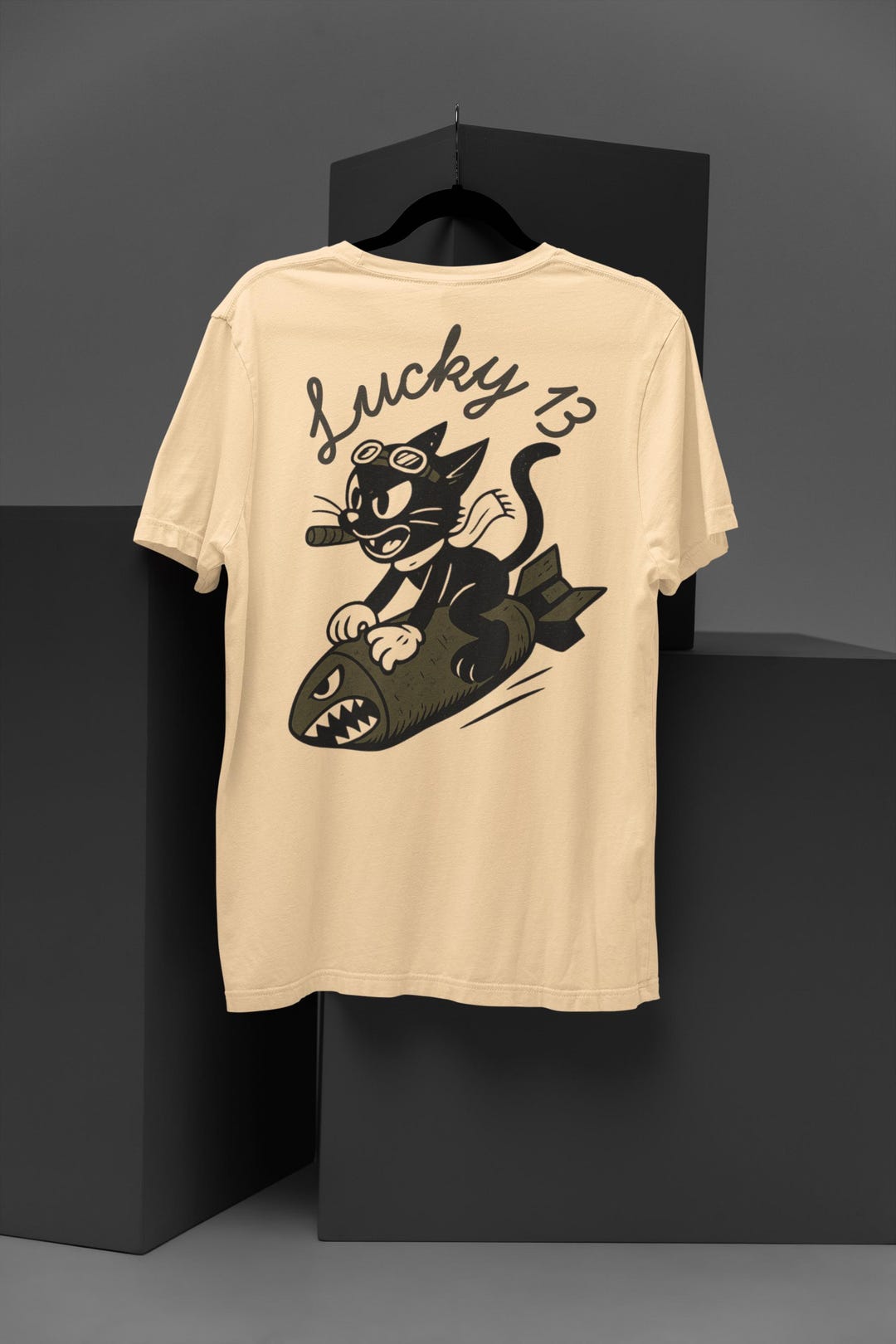
Lucky 13 — WWII Bomber Nose Art Tee
Bomber crews bet their lives on a little nose-art luck. Wear theirs.
Into the Dark: The Airborne Invasion
While the bombers were in the air over the beaches, and while the gliders were being loaded in English fields, the paratroopers of the 82nd and 101st Airborne Divisions (U.S.) and the 6th Airborne Division (British) were already in France. The airborne invasion began after midnight on June 5th-6th — hours before the first landing craft hit the beaches. The aircraft that carried them are a story unto themselves.
Douglas C-47 Skytrain (and RAF Dakota)
The C-47 was the aircraft that dropped the paratroopers. Derived from the Douglas DC-3 commercial airliner, the C-47 was slower, lower, and far more vulnerable than any of the fighters or bombers. It had to fly straight and level at low altitude — around 500-700 feet — slow enough for paratroopers to jump, and it had to do this in the dark, through cloud, and through withering German anti-aircraft fire.

The C-47 force for D-Day was enormous: 1,004 aircraft from the IX Troop Carrier Command flew the paratrooper drops, organized into 45 serials. They flew with navigation lights off in the dark, separated by altitude and timing to avoid midair collisions. Cloud banks over the Cotentin Peninsula scattered formations. Some drop zones were missed by miles. Paratroopers landed in flooded fields, in the wrong villages, on rooftops, in trees.
The dispersion turned out to be a benefit in disguise. German commanders couldn’t figure out where the main airborne effort was — because it was everywhere. Small groups of paratroopers were causing chaos across a 20-mile area. German units spent the critical early hours of D-Day chasing ghosts while the seaborne force came ashore.
To add to the confusion, the Allies dropped thousands of small dummy parachutists called “Ruperts” over areas away from the real drop zones. These small straw-and-canvas figures were equipped with rifle simulators that went off when they hit the ground, sounding like a firefight. German units reported paratrooper landings in areas that had no paratroopers at all — and moved to respond, leaving real objectives undefended.
Waco CG-4A Glider
The Waco CG-4A was the primary American combat glider of the war, and flying one was an exercise in committed trust. The pilot sat in a plywood and fabric cockpit with no engine, no parachute (no room, and nowhere safe to bail out anyway), and his job was to land a 7,500-pound aircraft loaded with soldiers, jeeps, or artillery pieces onto a field he’d never seen, in the dark, at 60 mph, and stop before hitting a hedgerow.

The CG-4A could carry 13 fully equipped soldiers or a 75mm howitzer with its crew, or a jeep, or a quarter-ton truck. The nose of the aircraft hinged upward to allow vehicles to drive in and out. On D-Day, 517 Wacos were launched in Operations Detroit and Chicago (for the 101st) and Operations Elmira and Galveston (for the 82nd), delivering artillery, anti-tank guns, and reinforcements to the scattered airborne units.
Glider pilots were unique among World War II aviators in one critical respect: after landing, they fought as infantry. There was no ride home. A C-47 crewman who dropped paratroopers could fly back to England. A glider pilot who landed in Normandy picked up his rifle and fought with whatever unit was nearest. Glider pilots received combat infantry badges for their service — the only aviators to do so routinely.
Airspeed Horsa Glider
The British Horsa was larger than the Waco — significantly larger. Where the CG-4A carried 13 soldiers, the Horsa carried up to 25. It could also carry a Bren carrier, a 17-pounder anti-tank gun, or other heavy equipment. The British 6th Airborne Division used Horsas almost exclusively, and the most famous mission of D-Day — the assault on Pegasus Bridge — was carried out by three Horsas in one of the most precise airborne operations ever executed.
Major John Howard’s D Company, Oxfordshire and Buckinghamshire Light Infantry, landed in three Horsas within 47 meters of the Caen Canal bridge at Bénouville at 0016 hours on June 6th. The glider pilots had used stopwatches and GPS coordinates — except there was no GPS. They used stopwatches, landmarks seen in moonlight, and an altimeter. The accuracy was so extraordinary that it remains a case study in military airborne operations today.

The Horsa that crash-landed at Pegasus Bridge hit so hard that the pilot, Staff Sergeant Jim Wallwork, was thrown through the cockpit windshield and knocked unconscious. He woke up under the nose of the aircraft while the soldiers he’d carried were already fighting for the bridge. The bridge was captured in under 10 minutes. The Allies held it until relieved by paratroopers later that morning.
Armstrong Whitworth Albemarle and Handley Page Halifax (Glider Tugs)
The British used a variety of aircraft as glider tugs — the aircraft that towed the Horsas to their release points. The Albemarle was a twin-engine medium bomber that, by 1944, had found its highest calling as a glider tug and paratrooper transport. The Halifax, a four-engine heavy bomber, could tow the larger Hamilcar glider — a behemoth capable of carrying a Tetrarch light tank.

General Aircraft Hamilcar Glider
The Hamilcar was the largest Allied glider — 68 feet long, with a wingspan of 110 feet. It was designed to carry the one thing the airborne forces desperately needed and couldn’t drop by parachute: tanks. The Tetrarch light tank, weighing nearly 8 tons, could be carried fully fueled and ready to fight. On D-Day, Hamilcars of the 6th Airborne delivered anti-tank guns and light armored vehicles to reinforce the British airborne perimeter east of the Orne River.

Landing a fully loaded Hamilcar carrying an 8-ton tank was done entirely by feel. The glider had no powered controls and no braking system beyond a spoiler in the fuselage. The pilot used drag and approach angle to manage speed. If he came in too fast with a tank aboard, the landing gear collapsed and the tank went through the nose. If he came in too slow, the glider stalled. The tolerances were brutal.
The Night Bombers and the Deception Aircraft
Not all of the aircraft over Normandy on the night of June 5th-6th were carrying paratroopers or bombs. Some of the most critical missions were being flown by aircraft that weren’t attacking anything — they were lying.
Short Stirling and Avro Lancaster (Operation Taxable and Operation Glimmer)
As the real invasion fleet crossed the Channel, two squadrons of RAF bombers — flying Stirlings and Lancasters — were executing one of the most elaborate electronic deception operations in history. Operations Taxable and Glimmer used aircraft equipped with “Window” (aluminum foil chaff) to create false radar returns simulating large convoy formations heading toward the Pas-de-Calais.

The aircraft flew precise racetrack patterns, dropping Window bundles at calculated intervals, with each circuit moving slightly toward the French coast. German radar operators saw what appeared to be two massive invasion fleets approaching — one toward the Pas-de-Calais, one toward Cap d’Antifer. The real invasion was heading to Normandy, 100 miles away. German radar was watching ghosts.
To make the deception more convincing, motor launches equipped with radar reflectors and loudspeakers played recordings of anchor chains, engine noise, and sailors’ voices at sea level below the chaff corridors. German E-boat patrols that went to investigate found only empty sea and fog. The deception held until the real landings were already underway.
de Havilland Mosquito (Night Fighter and Pathfinder)
The Mosquito flew in two additional critical roles on D-Day night. As a night fighter, Mosquito NF variants — equipped with AI Mk VIII or X radar — provided night air defense over the fleet and the beaches, hunting any Luftwaffe aircraft that attempted to attack during the pre-dawn hours. As a pathfinder, Mosquitoes of No. 8 Group (Pathfinder Force) marked targets for the heavy bombers with pyrotechnic markers, ensuring that when the bombers released, they were over the right target.

Short Sunderland and Consolidated B-24 (Maritime Patrol)
While all eyes were on the French coast, RAF Coastal Command and the U.S. Navy’s patrol squadrons were conducting a very different mission in the waters around the British Isles and the Bay of Biscay. The Sunderland flying boat and the long-range B-24 Liberator (in maritime patrol configuration) flew anti-submarine patrols to ensure that no German U-boat could penetrate the Channel or attack the invasion fleet.

German naval command ordered every available U-boat to attack the invasion fleet. Allied air patrols and naval forces sank or drove off all of them. Not a single ship in the invasion fleet was sunk by a U-boat on D-Day. The maritime patrol aircraft that kept the sea lanes clear were as essential to the invasion’s success as any Mustang or Thunderbolt.
FROM THE SHOP

Lucky Strike Skull — WWII Bomber Nose Art Tee
The nose art was tradition, superstition, and defiance all at once. Paint something on the plane. Make it yours. Maybe it helps. Maybe it doesn’t. Either way, you’re climbing back in tomorrow. This shirt captures that spirit — the grinning skull, the bomber jacket, the attitude of men who flew into hell and joked about it.
FROM THE SHOP

Watch Out for Gremlins — WWII Nose Art Tee
When an engine quit over the Channel, the crews blamed the gremlins.

American Flag Skeleton Soldier Can Cooler — Military Tribute Koozie
A patriotic tribute to the troops who flew and fought on D-Day and beyond. Keep your drink cold and the colors flying.
Little-Known Aircraft of D-Day
North American B-25 Mitchell
Famous for Doolittle’s raid on Tokyo in 1942, the B-25 served in a supporting role in the European Theater, primarily with Commonwealth air forces. RCAF and RAF units flew B-25s in the pre-invasion bombing campaign against transportation targets in northern France and Belgium.

Avro Lancaster (Strategic Bombing)
RAF Bomber Command’s primary heavy bomber, the Lancaster, was principally a night bomber — but in the weeks before D-Day, Lancaster squadrons were diverted from strategic bombing to hit coastal gun batteries along the Normandy coast. The 617 Squadron — the famous Dambusters — used their precision bombing skills to attack specific gun positions with 12,000-lb Tallboy bombs, rendering batteries that had previously survived conventional attack.

Westland Lysander (Special Operations)
The Lysander was slow and looked antique by 1944 standards — but it did something no other aircraft could do. It could land in a field 300 yards long, in the dark, pick up a passenger, and be airborne again in under a minute. Lysanders of No. 138 and 161 Special Duty Squadrons flew agents of the SOE (Special Operations Executive) in and out of occupied France throughout the war. In the weeks before D-Day, they were dropping agents and picking up intelligence at a frantic pace.

Lysander pilots who flew SOE agents into France were called “Moon Squadrons” because they could only operate around the full moon, when there was enough natural light to find the landing fields. The agents they dropped were often civilians — nurses, teachers, housewives — who’d been trained for months and parachuted or landed into occupied Europe carrying false papers and radios. Many were captured and killed. The Lysander pilots who delivered them lived with that knowledge.
Piper L-4 Grasshopper (Artillery Spotting)
At the other end of the size and speed spectrum from the Thunderbolts and Lancasters was the Piper L-4 Grasshopper — essentially a militarized version of the Piper J-3 Cub. These tiny, 65-horsepower fabric planes flew artillery observation missions, directing naval gunfire onto German positions. They flew low and slow over the battlefield, completely unarmed, relying on their very smallness for survival.

Artillery spotters in L-4s were directly responsible for some of the most effective fire support on D-Day. An L-4 could circle above a German gun position, talk a destroyer’s guns onto it, and watch the rounds fall. Naval gunfire directed by airborne observers destroyed German artillery positions that would have been slaughtering the landing troops on the beaches.
Major Carlos “Cannnonball” Alvarado flew an L-4 Grasshopper off the deck of a tank landing ship (LST) on D-Day morning, spotting for the naval gunfire support groups. He flew in circles just above the cliffs of Normandy while battleships and cruisers fired based on his radio calls. The L-4 had no armor, no weapons, and could be brought down by a rifle shot. Alvarado survived. Many of the German gunners he directed fire onto did not.
FAQ: D-Day Aircraft
How many aircraft flew on D-Day?
The Allies flew approximately 14,674 sorties on June 6, 1944. This included bombers, fighters, transports, reconnaissance aircraft, glider tugs, maritime patrol, and artillery spotters. It was the largest single-day air operation in history to that point.
What happened to the gliders after they landed?
Most combat gliders were not recovered. The wood-and-fabric construction didn’t survive landing intact, and even the ones that did were difficult to retrieve from the combat zone. Some Wacos were repaired and used for subsequent glider operations in Market Garden (September 1944). Most were eventually stripped for parts or abandoned. The glider pilots fought as infantry until evacuated.
Did the Luftwaffe fight on D-Day?
Minimally. The Luftwaffe was so depleted by 1944 that it could put only a handful of aircraft over Normandy on June 6th. The most famous Luftwaffe response was the strafing pass by Priller and Wodarczyk — two aircraft making a single run over the beaches before retreating. German fighters and bombers attacked the fleet at night, with limited results. The Luftwaffe’s failure on D-Day was a direct consequence of the Allied air campaign that had preceded it.
Why did the bombers miss on D-Day?
The heavy bombers dispatched to soften the beach defenses before the landings were hampered by cloud cover and by a standing order not to bomb unless they had visual confirmation of the target. The fear of hitting Allied troops was so great that bombardiers held their release, then dropped blind — with a built-in delay that pushed the bombs miles inland. At Omaha Beach particularly, the German defenses were untouched when the first wave arrived. It was one of the critical failures of the D-Day air campaign, though the overall air operation was a massive success.
The Bottom Line
D-Day from the air was not one operation — it was dozens, running simultaneously, executed by thousands of crews who’d trained for months and were now betting their lives that the plan would hold together. Some of it worked perfectly. Some of it went spectacularly wrong. The paratroopers scattered across the wrong fields. The bombers missed the beaches. The weather barely cooperated.
But the overall result was never seriously in doubt — not because the plan was perfect, but because the Allies had achieved something the Germans couldn’t counter. They owned the sky. And on June 6, 1944, owning the sky meant winning the beach. That fact — that the air campaign of spring 1944 had essentially guaranteed the outcome before the first landing craft dropped its ramp — is the part of D-Day history that gets the least attention. The infantry on the beach were heroic, and their story deserves to be told. But those men landed in an environment shaped entirely by the airmen who had come before them.
If this one grabbed you, there’s more military aviation history on the blog worth digging into. The SR-71 Blackbird story covers the most audacious reconnaissance program in history — and the men who flew it. The Operation Rolling Thunder and F-105 Thunderchief post is the story of 100 missions over North Vietnam and what it cost. And if you want to go back to the basics of how military pilots were made, the Stearman Pilot Maker post covers the aircraft that trained more WWII aviators than any other.
Follow along on Instagram at @bentheretravel for more military aviation, travel, and history content.
Read Next
- B-17 Flying Fortress: Daylight Bombing, the 25-Mission Math, and Why It Mattered
- P-51 Mustang: The 117-Day Dare That Won the War in the Air
- WWII Bomber Nose Art: The Story of Lucky 13 & America’s Greatest Aircrews
- Lil Bastard: The WWII Gremlin Origin Story Pilots Still Tell
- The Pilot Maker: 1776 to a WWII Cockpit in Three Grandfathers
A Note from Ben
I have stood on the bluffs above Omaha Beach. I’ve walked through the American cemetery at Colleville-sur-Mer, where 9,388 crosses and Stars of David stand in rows that seem to go on forever. When we visited Normandy, the bomb craters still littered Pointe du Hoc — decades later, the ground itself still hasn’t healed over what the bombers and the Rangers did there. I served on active duty as an Army medic — the 101st Airborne was one of my assignments — and I retired from the Air Force Reserve as a lieutenant colonel JAG officer. And I’ll tell you: standing on that bluff, looking out at that gray beach, it is very, very hard to understand how anyone made it to the top.
That 101st connection makes this one personal. The museum on post has a great collection from the division’s history — including the story behind one of D-Day’s strangest sights: the paratroopers who shaved their heads into mohawks and streaked their faces with war paint before they jumped into Normandy. They were the “Filthy Thirteen,” a demolition section of the 506th led by Jake McNiece, whose Choctaw heritage inspired the look — part tribute, part defiance, on the eve of the most dangerous night of their lives.

The aircraft in this post weren’t just machines. They were the reason that any of those men on the beach made it off. The air supremacy that seems like a given in hindsight was purchased, brutally and expensively, by thousands of aircrew in the months before June 6th. They bought it one mission at a time, over flak batteries in the Ruhr and fighter airfields in France and railyards in Belgium. By the time the boats hit the beach, the price had been paid in full.
I write about these aircraft because I think the machines and the men who flew them deserve to be remembered together. The history is fascinating on its own merits — the engineering, the tactics, the doctrine. But underneath all of it is something simpler: young men, most of them in their early 20s, who climbed into unheated metal tubes and went toward the flak because someone had to. That’s the part I never want to lose in the technical details.
— Ben

Ben & Nicole Mathews
We’re based in St. Augustine, Florida, sharing the places we’ve actually been — from our home turf to corners of the U.S. and abroad. Ben is an attorney and a retired Air Force JAG (22 years), and a private pilot, which is why aviation and military history shows up here too.