

Most beaches sort themselves out one of two ways. Either the sand is white and the water is warm, or the sand is gray and the water is cold. Diamond Beach in Iceland decided to ignore both rules. The sand is volcanic black — actual ground basalt — and scattered across it, like somebody spilled a jewelry case, are chunks of glacial ice the size of microwaves. Some are clear as cut crystal. Some are streaked with thousand-year-old air bubbles. The Atlantic keeps polishing them, the tide keeps moving them, and twice a day the whole composition resets.
It’s one of the strangest beaches on Earth, and the reason it exists is even stranger: every diamond on that sand was, until recently, part of a glacier that’s been there since before the Vikings. The ice didn’t drift in from somewhere far away. It came from a few miles up the road, broke off, floated through a lagoon, sailed under a bridge, hit the ocean, and got rolled back onto shore. The whole pipeline runs in real time. Stand there long enough and you’ll watch ice cubes the size of refrigerators shoot past you on the current.

The strangest plumbing system in Iceland
Diamond Beach has a proper Icelandic name — Breiðamerkursandur — but nobody calls it that, including most Icelanders. The name people actually use comes from the way the place looks: hundreds of clear, jewel-like ice fragments scattered across a sheet of black sand. The diamonds are real ice. The setting is real. The geology behind it is what makes the whole thing work.
The chain starts at Vatnajökull — Europe’s largest ice cap by volume, covering roughly 8% of Iceland’s entire surface area. From the southern edge of Vatnajökull, a tongue of ice called Breiðamerkurjökull creeps downhill toward the sea. As the glacier melts back (and it’s been melting back faster every decade), it carves a basin in front of itself. That basin filled with meltwater starting in the 1930s, and now there’s a giant lagoon there: Jökulsárlón.
Big chunks of ice break off the glacier face — that’s calving — and float around in Jökulsárlón for anywhere from a few days to a few years. The lagoon is full of icebergs that look small from shore and are actually enormous. About 90% of any iceberg sits underwater, which is the part of the physics lesson everyone forgets until you see one rolled onto a beach and realize the visible piece is the size of a car and the part you couldn’t see was the size of a bus.
Eventually those bergs find their way to the lagoon’s narrow outlet — a short river called Jökulsá, which is somehow only about 1,500 feet long. It’s one of the shortest rivers in Iceland, and it’s the only thing connecting Jökulsárlón to the open ocean. The icebergs ride that current, pass under a bridge on the Ring Road (Highway 1), get kicked around in the surf zone, and either drift out to sea or get tossed back onto the black sand on either side of the river mouth.
That black sand stretch is Diamond Beach. The ice that washes up there isn’t sea ice. It isn’t winter ice. It’s glacier ice — old, dense, often hundreds or even a thousand-plus years old — and you can pick it up, examine it, and watch it melt in your hand.
Did You Know?
Glacier ice is so dense it’s nearly clear. The blue-tinted icebergs you see in Jökulsárlón got that color because the ice was compressed under enormous pressure for centuries, squeezing out almost all the trapped air. With no air bubbles to scatter light, the ice absorbs every wavelength except blue — which is why it glows that unreal turquoise color in person.
That ice is older than your country
Here’s the thing nobody mentions in the Instagram captions. The ice on Diamond Beach didn’t form last winter. It’s not even from the last century. The icebergs calving off Breiðamerkurjökull right now are made of snow that fell on Vatnajökull hundreds to over a thousand years ago. Some estimates from researchers studying ice cores at Vatnajökull put the deepest ice at well over 1,000 years old. By the time it reaches the snout of the glacier and breaks off into the lagoon, it has been compressed, refrozen, and slowly migrating downhill for most of recorded European history.
That diamond you just photographed in your hand? It might have started as snow that fell while Vikings were settling Iceland in the 870s. It might be older. The trapped air bubbles inside some of the clearer pieces are literal time capsules of Earth’s atmosphere from before the Industrial Revolution. Climate scientists drill ice cores out of Vatnajökull specifically because the layered ice records past atmospheric chemistry — CO2 levels, volcanic events, even nuclear test fallout — like rings in a tree.
So when the ice melts back into the Atlantic, that’s not just water. That’s the planet’s archived weather, finally going home.
The lagoon is younger than your grandparents
This is the detail that genuinely surprises people. The icebergs are ancient. The lagoon they float in didn’t exist until basically the day before yesterday.
Jökulsárlón, the photogenic glacier lagoon you see in every Iceland documentary, only began forming around 1934-1935. Before that, Breiðamerkurjökull came almost all the way down to the ocean. There was no lagoon — just glacier, then beach, then sea. As the glacier started retreating in the early 20th century, meltwater pooled in the basin it left behind, and within a few decades it grew into the deepest lake in Iceland. As of the most recent surveys, Jökulsárlón is over 248 meters (814 feet) deep in places. That’s deeper than Iceland is tall in most spots.
The lagoon is also growing every year. As the glacier keeps retreating, the basin keeps expanding. By some estimates Jökulsárlón roughly doubled in size between the 1970s and the early 2000s, and it’s still growing. There’s a real chance that within a few generations Vatnajökull will have pulled back far enough that the calving slows dramatically, the lagoon stabilizes, and the icebergs at Diamond Beach become a much rarer sight than they are now. Today’s Iceland tourists are watching a geographic feature that didn’t exist when their great-grandparents were born — and may not exist in the same way for their great-grandchildren.
Did You Know?
The Jökulsá river — the one that connects the lagoon to the ocean — is so short and so deep that the Icelandic government had to actively reinforce it. As the lagoon grew, the river was widening at a rate that threatened to eventually take out the Highway 1 bridge that crosses it. Engineers have done shoreline reinforcement work multiple times to slow the river’s expansion.
Why the sand is jet black (it’s not what you think)
If you’ve never been to Iceland, your first instinct is probably that the sand is dark because it’s wet, or because of some kind of pollution, or because of the cold. None of those. Diamond Beach is genuinely, deeply, naturally black — even when it’s bone dry — because the entire shoreline is made of pulverized basalt.
Iceland is a volcanic island sitting directly on the Mid-Atlantic Ridge, where the North American and Eurasian tectonic plates are actively pulling apart. The country’s geology is roughly 90% basalt — dark, iron-rich volcanic rock that erupts as lava and then gets ground down over millennia by glaciers, rivers, and surf. By the time you’re walking on it at Diamond Beach, that basalt has been weathered into fine grains that look almost like coal dust under a magnifying glass.
The contrast is the whole reason this place became internet-famous. White ice. Black sand. Steel-gray Atlantic. There’s almost no other beach on Earth where the natural color palette is that ruthless. That’s why every photographer who comes to Iceland makes a point of stopping. The picture takes itself. You almost can’t shoot a bad frame here.
To see what that basalt looks like before the glaciers and the surf finish grinding it down, drive about 100 km west along the south coast to Reynisfjara — the black-sand beach near the village of Vík. Same volcanic rock, different stage of the same long process. The cliffs there are made of columnar basalt: lava that cooled so slowly and evenly it cracked into near-perfect hexagonal columns, like a stone version of pencils stacked on end. The Diamond Beach sand is essentially what these cliffs become after a few hundred thousand years of getting beat up by the North Atlantic.


What it’s actually like to stand there

We pulled into the Diamond Beach parking lot off Highway 1 — Iceland’s Ring Road — on a gray, windy morning — which, if you’ve spent any time in Iceland, you’ll recognize as just “morning.” The walk from the car to the beach is short, maybe five minutes across loose sand and gravel. You hear the surf before you see the ice. And then you crest the small rise and the whole composition opens up at once: a ribbon of black sand running as far as you can see in either direction, the cold dark Atlantic on one side, and scattered everywhere across the sand are these glowing, glassy chunks of ice.
The sizes are wild. Some pieces are the size of an ice cube. Some are the size of a coffee table. Some are the size of a Mini Cooper. They’re all the same thing — chunks of glacier that calved off Breiðamerkurjökull, drifted through Jökulsárlón, exited under the Highway 1 bridge, got worked over by the surf, and ended up here, polished into something that looks almost manufactured. The big pieces have a kind of internal glow because the glacier ice is so dense and so pure that it transmits light like quartz.
The other thing that surprises you is how loud it is. Not the ocean — Iceland’s south coast surf is loud everywhere. The ice itself is loud. As waves push pieces around, they grind against each other. As water seeps into hairline cracks and refreezes (or melts back out), the ice makes small popping and ticking sounds. Pick up a clear chunk and hold it to your ear and you can sometimes hear ancient air bubbles releasing. It’s somewhere between a beach and a glacier and a recording studio.

The thing nobody warns you about (sneaker waves)
Diamond Beach sits on what Icelanders call a sneaker wave coast. The South Atlantic surf here doesn’t come in like a regular beach — predictable rhythm, set after set. It comes in irregular, and occasionally a wave will run twenty or thirty meters further up the sand than the previous dozen. Those rogue waves have killed multiple tourists at and around Reynisfjara — the other famous black sand beach further west — and Diamond Beach is no different. A sneaker wave doesn’t just get you wet. The water is just above freezing, the surf is powerful enough to knock an adult flat, and the rip current pulling back into the Atlantic is brutal. People have died here for getting too close to the water for a photo.
The rule is simple and not negotiable: never turn your back on the ocean. Don’t stand between an iceberg and the surf. Don’t sit on a piece of ice that’s anywhere near the wet sand line. The ice itself is also unstable — large pieces can shift or roll without warning, and a refrigerator-sized chunk of ice doesn’t have to be moving fast to crush a leg. Treat the ice like you’d treat a parked car on a hill. Beautiful. Photogenic. Don’t sit underneath.
Did You Know?
Iceland posts laminated safety signs at the Reynisfjara beach parking lot specifically because of sneaker wave deaths there. Diamond Beach has fewer signs but the same physics. The Atlantic at this latitude is around 40°F (4°C) year-round. Cold-shock incapacitation can begin within seconds of full immersion, well before hypothermia even becomes the issue.
From the Shop
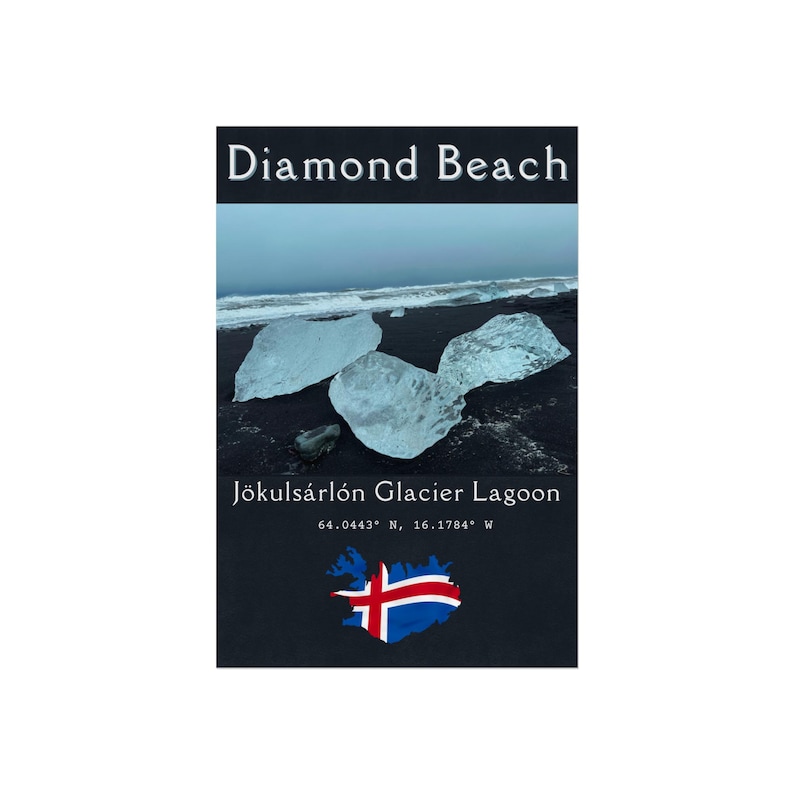
Diamond Beach Iceland Print
A Nordic-style poster of the same black sand and glacier ice this whole post is about. Looks the way Diamond Beach feels on a gray morning when the surf is dragging an iceberg back out to sea.

Jökulsárlón Glacier Lagoon Travel Poster
The lagoon up the road from Diamond Beach — the one that didn’t exist a century ago. Nordic coastal wall art for anyone who liked the part about a body of water younger than your grandparents.

Reynisdrangar Black Sand Beach Print
The basalt sea stacks at Reynisfjara — the same volcanic rock family that ends up pulverized into Diamond Beach’s black sand. A south-coast-of-Iceland piece for anyone who got hooked on the geology side of this post.
Diamond Beach Iceland FAQ
Where exactly is Diamond Beach?
Diamond Beach is on Iceland’s south coast, right on Ring Road (Highway 1), just across from the Jökulsárlón glacier lagoon parking area. It’s about a 4.5-hour drive east of Reykjavík. There’s a free parking lot on the ocean side of the highway, marked but easy to miss in poor weather. If you’ve reached the bridge over the Jökulsá river, you’re essentially there.
Why is it called Diamond Beach?
Because the chunks of glacier ice that wash up on the black volcanic sand catch the light and look like scattered diamonds. The official Icelandic name is Breiðamerkursandur, which roughly means “the broad woodland sand” — a holdover from medieval times when the area was actually forested. “Diamond Beach” is a tourism nickname that stuck.
When is the best time to see the ice?
There is ice on the beach year-round — the glacier never stops calving — but the volume and size of the icebergs varies. Late summer through winter generally produces the biggest pieces, and winter light gives the most dramatic photos. Summer brings smaller, more numerous pieces and easier access. There’s no “off-season” for the ice itself, only for the weather you’ll experience while looking at it.
Is Diamond Beach safe to visit?
Yes, with respect for the ocean. The beach itself is open and free to walk on. The dangers are sneaker waves, unstable ice, and freezing water — all of which are manageable with common sense. Stay well back from the surf line, don’t climb on the icebergs, and don’t turn your back on the Atlantic. Tourists die at Iceland’s south-coast beaches every year, almost always for the same reasons: getting too close to the water for a photo.
Can I take a piece of ice home?
You can, but it won’t make it. Glacier ice melts at exactly the same rate as any other ice, and any piece small enough to carry will be a puddle within an hour. The pieces are also under no protection (the beach isn’t a national park), so taking one isn’t illegal — it’s just pointless.
How does Diamond Beach connect to the glacier lagoon?
They’re the same system. Icebergs calve off Breiðamerkurjökull glacier, float in Jökulsárlón lagoon, exit through the short Jökulsá river under the Highway 1 bridge, get pushed around by the Atlantic, and either drift out to sea or get washed back onto the black sand of Diamond Beach. Most visitors do both stops in the same morning since they’re literally across the road from each other.
The bottom line
Diamond Beach is one of the most photographed places in Iceland, and somehow the photographs still don’t quite prepare you for what it actually feels like to stand on it. The sand is darker than you expect. The ice is bigger than you expect. The whole place sounds like it’s working — surf and ice grinding and ancient air popping out of melting glaciers in real time.
The best part, for me, is the timeline. The basalt under your boots got there from volcanic eruptions tens of thousands of years ago. The ice in your hand fell as snow centuries before electricity. The lagoon they came through is younger than most of the houses in your neighborhood. And the glacier feeding the whole pipeline is going to be a different shape every time you visit. There aren’t many beaches anywhere on Earth where you can read that much geology in a single ten-minute walk.
If you’re driving the Ring Road, you don’t skip this stop. You don’t even rush it. Pack a hat, watch the surf, and let the place do its weird, slow, half-billion-year-old thing while you stand there and pretend you’re not freezing.
If you liked this one…
If Iceland’s south coast pulled you in, the rest of our Iceland coverage will probably scratch the same itch. The Ring Road Adventure Guide covers the full loop and the stops worth slowing down for. The Driving in Iceland deep-dive walks through F-roads, weather, fuel logistics, and the small operational stuff that makes the difference between a great trip and a stranded one.
If you’re plotting your next trip somewhere completely different, our Venice Travel Guide covers what to actually see, eat, and do in the lagoon city, and the Murano glass factory write-up is one of our favorite half-day side trips out of Venice. Closer to home, the St. Augustine Travel Guide is a good one for anyone who wants old forts, sea breezes, and the oldest continuously occupied European-founded city in the U.S., and our Hidden Gems in Pittsburgh roundup is the locals-only stuff most tourists never find.
More from the shopBrowse the full travel wall art collection — canvas prints and posters of Iceland’s south coast, Paris and Eilean Donan.

Ben & Nicole Mathews
We’re based in St. Augustine, Florida, sharing the places we’ve actually been — from our home turf to corners of the U.S. and abroad. Ben is an attorney and a retired Air Force JAG (22 years), and a private pilot, which is why aviation and military history shows up here too.