

The first stealth aircraft in history was built out of a Soviet math paper nobody in Moscow thought was worth classifying — and for most of a decade, the men who flew it could not tell their own families it existed.

In the first hours of January 17, 1991, the sky over Baghdad was the most heavily defended airspace anyone had flown into since Hanoi. Roughly 3,000 anti-aircraft guns and around 60 surface-to-air missile batteries ringed the city. When the shooting started, the tracer fire went up in curtains — that green, boiling horizon everyone watched live on CNN.
The gunners were firing at nothing. Not because nothing was there, but because the thing that was there did not show up on their screens. Somewhere above all that, a black airplane shaped like a badly cut gemstone was flying a straight, level, unhurried run to its target, and the crews below had no idea it was overhead until buildings started coming apart.
That airplane was the F-117 Nighthawk. It was subsonic. It carried no radar, no missiles, no gun, and no defensive systems of any kind. It handled so poorly in early testing that test crews hung the name “Wobblin’ Goblin” on it — a nickname the pilots who actually flew it have been trying to shake ever since. And it did something no aircraft before it had ever done: it made a modern integrated air defense network functionally blind.
This is the story of how that happened — the rejected Soviet equation, the shape everyone said could not fly, the base that officially did not exist, the one night stealth stopped working, and why, eighteen years after the Air Force officially retired it, F-117s are still flying over Nevada in 2026.

Shop this design on Etsy
WWII nose art — the pin-ups, cartoons and lucky cats crews painted on the noses of their aircraft — redrawn for shirts, stickers, prints and glassware. If you came for the aircraft, the artwork is over here.
A Soviet Math Paper the Kremlin Let Walk Out the Door
In 1962, a Soviet physicist named Pyotr Ufimtsev published a paper at the Moscow Institute of Radio Engineering with a title that guaranteed almost nobody would read it: Method of Edge Waves in the Physical Theory of Diffraction. It was dense, abstract, and to the Soviet defense establishment, useless. There was no computer in the world at the time that could do anything practical with it. They let it go out unclassified.
Ufimtsev had worked out something profound anyway. Radar return, he showed, is not really a function of how big an object is. It is a function of the object’s edges — the geometry of its surfaces and the seams between them. Get the edges right, and a large object can return less energy than a small one.
In 1971 the Air Force’s Foreign Technology Division at Wright-Patterson translated the paper into English, where it sat in the technical literature like a loaded weapon nobody had noticed. A few years later a Lockheed radar specialist named Denys Overholser found it.
Overholser later described Ufimtsev, without much exaggeration, as the man who made stealth possible. Working with a retired Lockheed mathematician named Bill Schroeder, he turned the paper into a computer program the Skunk Works called ECHO 1 — software that could predict the radar cross section of a shape before anyone built it.
Did You Know? Ufimtsev eventually moved to the United States and spent years teaching at UCLA. The man whose math built the American stealth fleet ended up lecturing to American engineering students, and has been fairly gracious about the whole thing.
The Hopeless Diamond
Here is the catch, and it is the reason the F-117 looks the way it does. ECHO 1 could only model flat plates. The computing power of the mid-1970s could not handle a curved surface. So if you wanted an airplane whose radar signature you could actually calculate in advance, you had to build the airplane entirely out of flat panels.
That is what faceting is. Every one of those angled panels is oriented to bounce radar energy away from the transmitter instead of back at it — the aeronautical equivalent of a room full of mirrors, all tilted so that none of them ever reflects a flashlight back into your eyes.

The 1975 design that came out of this looked so improbable that Lockheed engineers named it the Hopeless Diamond, a joke on the Hope Diamond and a fairly honest assessment of its flying qualities. It was not a shape derived from aerodynamics. It was a shape derived from radar physics, and then handed to the aerodynamicists as a problem to be solved.
When Lockheed tested a pole-mounted model at the radar range, the story that came back was almost too good. The technicians thought the mount was broken. A bird landed on the model during a test run and the bird produced a bigger return than the airplane.
Skunk Works chief Ben Rich made the point to Pentagon officials the way engineers make points: he rolled a ball bearing across a conference table and told them that was the size of the target they were now looking at.
Have Blue: Two Airplanes That Both Crashed and Still Won
DARPA funded a pair of technology demonstrators in 1976 to find out whether the diamond could actually fly. The program was called Have Blue, and the aircraft were roughly two-thirds the size of what would become the F-117.

The first one flew at Groom Lake on December 1, 1977, with Lockheed test pilot Bill Park at the controls. Both Have Blue aircraft were eventually lost — one on a hard landing in 1978, the other to an engine fire in 1979. Both pilots got out. Park was hurt badly enough on the first that he never flew again.
Losing both prototypes sounds like a failed program. It was the opposite. Before they were lost, the two aircraft proved the central claim: a faceted, radar-absorbent airplane could be flown by an ordinary squadron pilot and could not be tracked by the radars sent up against it. That was all the Air Force needed to hear.

The production program that followed was code-named Senior Trend. The first pre-production aircraft flew on June 18, 1981, again at Groom Lake, with Hal Farley in the seat. Initial operational capability came in October 1983 — five years before the American public was told the airplane existed.
What the F-117 Actually Was
Strip away the mythology and the F-117 is a strange, narrow machine built around one job: put two laser-guided bombs on a defended target at night without being detected. Everything about it serves that and nothing else.

- Size: 65 ft 11 in long, 43 ft 4 in wingspan — a little longer than an F-15, with a much smaller wing.
- Engines: two non-afterburning General Electric F404 turbofans, about 9,040 lbf each. No afterburner, ever.
- Top speed: Mach 0.92 — roughly 594 knots. It never went supersonic, on purpose.
- Weapons: a 5,000-pound internal bay, normally two GBU-27 or GBU-10 laser-guided bombs. It could carry the B61 nuclear weapon and never did operationally.
- Radar cross section: commonly quoted at around 0.001 square meters — the ball bearing.
- Defenses: none. No radar warning receiver in the conventional sense, no chaff or flare dispensers in the original fit, no guns, no air-to-air missiles.
The design choices all cascade from stealth. It carries no radar, because a radar antenna is a superb reflector even when it is switched off, and because a transmitting radar is a beacon that announces you. Instead the pilot found and marked targets with IRADS — a forward-looking and downward-looking infrared system that fed a laser designator. It stayed subsonic because supersonic flight means a sonic boom, a heat signature, and an afterburner plume, all of which defeat the point.

The exhaust is the detail most people miss. Those slotted, flattened outlets at the back — pilots called the arrangement the platypus — spread hot gas into a thin sheet and mix it with cool air before it leaves the airframe, so an infrared-guided missile has much less to lock onto. The canopy glass is coated in a fine gold film, because otherwise a radar beam would fly straight into the cockpit, rattle around the pilot’s helmet and instruments, and come back out. And nearly a ton of radar-absorbent material is layered over the whole thing.

Did You Know? The F-117 has no meaningful natural stability. Its shape is so aerodynamically compromised that it is only flyable because a quadruple-redundant fly-by-wire computer makes hundreds of corrections a second that the pilot never feels. Without the computers it is not a difficult airplane. It is an unflyable one.
Why They Called It the Wobblin’ Goblin
The nickname comes from the early days, and it comes from exactly what you would expect. A wedge of flat panels flying through the air does not behave like a wing. In the flight test and early operational period the aircraft was reported to hunt and wallow in certain conditions — particularly in turbulence, and particularly on the tanker, where a pilot has to hold formation within a few feet for many minutes at a time.
Add the black paint, the night-only flying, and a silhouette that genuinely does look like something out of a horror film, and “Wobblin’ Goblin” wrote itself.
Here is the honest complication: the men who flew it operationally mostly say the name is unfair. By the time the F-117 reached the squadrons, the flight control software had been through several revisions and the airplane flew, in their telling, like an ordinary if slightly heavy jet. Ask an F-117 pilot about the Goblin nickname and you will usually get a patient sigh and a version of “it didn’t wobble.”

It also was not the only name. Crews called it the Black Jet, and less reverently the Cockroach — a thing that comes out in the dark and cannot be killed. During Desert Storm, Saudi personnel called it Shaba, Arabic for ghost. After 1999, Serbian air defense troops adopted a name of their own with a certain amount of dry humor: they called it the Invisible.
Why Is It an “F” When It Never Fired a Shot in Anger at Another Airplane?
The F-117 is an attack aircraft. It carries bombs. It has never had an air-to-air weapon or the radar to use one. By every convention of the American designation system, it should have been the A-117.
The reason it is not is almost entirely cultural. Lockheed program manager Alan Brown later explained that the Air Force leadership of the day believed the best pilots in the service — the ones they wanted volunteering for a black program they could not describe — would be far more willing to raise a hand for something with an F on the nose. So the airplane got an F, and the Air Force got the pilots it wanted.
Did You Know? The number is stranger than the letter. In the 1970s and 80s the Air Force was flying acquired Soviet aircraft in secret out of the Nevada ranges, and those airframes carried sequential numbers in a series that had reached the 100s. The story most consistently told by people who were there is that the stealth fighter simply took the next number in that clandestine sequence — which is how the U.S. Air Force ended up with an F-117 sitting in a numbering system that had officially stopped at the F-111.

From the Shop
Betta Duck Bomb Rider T-Shirt
Aircrews have been painting ridiculous things on very serious machines for eighty years. This one rides the bomb. Retro cartoon nose art, printed soft.
Tonopah: A Base, a Squadron, and a Cover Story
The F-117 flew for five years before the public was told it existed, and operated for another three after that before most people ever saw one move. Keeping that secret took an entire parallel life.
The unit was the 4450th Tactical Group, stood up at Nellis in 1981. Officially, it was doing avionics test work on the A-7D Corsair II. That was not a lie so much as a carefully constructed half-truth: the group really did operate A-7s, and pilots really did fly them, because the A-7 cockpit layout was close enough to the F-117’s to serve as a trainer and, more importantly, because A-7s parked on a ramp in daylight explain a squadron’s existence to anyone watching.

The actual flying happened at Tonopah Test Range, in the Nevada desert northwest of Las Vegas, and it happened at night. Every Monday morning, contractor 737s lifted roughly 2,500 people out of Nellis and flew them to Tonopah. Every Friday afternoon they flew them home. In between, they worked twelve-hour days on an airplane they could not name.
Their families lived in Las Vegas and knew none of it. Wives knew their husbands left on Monday and came back on Friday and did something for the Air Force. That was the whole of it. At least one pilot’s wife did not learn what her husband had been flying until she saw it on the news in November 1988.
The pilots called themselves Bandits, and each was assigned a permanent Bandit number on his first flight in the aircraft. The sequence started at 150 and ran on from there, and by the end only 558 Air Force pilots had ever flown the airplane. It is one of the smallest fraternities in American aviation.

The Crash They Had to Erase
On July 11, 1986, Major Ross Mulhare was killed when his F-117 went down in the Sequoia National Forest near Bakersfield, California. What happened next tells you everything about how tightly this program was held.
The Air Force sealed the airspace, put armed guards on the site, and turned away civilian firefighters trying to reach a burning hillside. A helicopter orbited overhead. Investigators recovered every fragment of the aircraft they could find, and then, according to accounts from people involved, salvaged wreckage from an old F-101 Voodoo crash stored out at the Nevada ranges and scattered it at the site so that anything found later would point at the wrong airplane.
A pilot died and the Air Force could not say what he had been flying. That is the cost side of the ledger, and it belongs in the story.
November 10, 1988: One Bad Photograph
The Pentagon acknowledged the F-117 on November 10, 1988, in the least dramatic way imaginable — a short announcement and a single grainy, low-contrast photograph that looked like it had been taken through a screen door. It was deliberate. The picture confirmed the airplane existed while giving away almost nothing about its actual shape.
The public did not get a real look until April 21, 1990, when the Air Force put two F-117s on static display at a Nellis open house. Even then it was hardly open. Eyewitness accounts describe the aircraft roped off at about thirty feet, guarded by airmen with M-16s and dogs, with covers fitted over the exhaust outlets so nobody could photograph them. At its own unveiling, the Air Force was still hiding the parts that mattered.
Panama, 1989: A Debut Nobody Was Proud Of
The F-117’s first combat mission came in the opening hours of Operation Just Cause, the invasion of Panama. Eight Nighthawks launched from Tonopah on the night of December 19, 1989 — six mission aircraft and two spares. Four were assigned to targets that were scrubbed when intelligence indicated Noriega was not where the plan assumed. The two that mattered, led by Captain Greg Feest with Major Dale Hanner on his wing, refueled repeatedly on the way south and dropped 2,000-pound GBU-27s in an open field beside the barracks at Rio Hato, where roughly 500 elite Panamanian Defense Force troops were quartered.
The bombs were not meant to hit the barracks. They were meant to land close enough to stun and disorient the troops inside before American Rangers arrived, which is an unusual thing to ask of a bomb and a stranger thing to ask of a stealth aircraft on its combat debut.
What actually happened became a minor scandal. Feest’s bomb hit the field at the planned time on target. Hanner’s went wide by a few hundred yards, after late changes to the plan and a shift in the wind. The Pentagon initially described the strike as pinpoint; later review made clear it had not been, and Secretary of Defense Dick Cheney publicly acknowledged that the department’s early account had been wrong. It also emerged that the PDF had been tipped off and had largely cleared the barracks before the aircraft arrived.
It is a bad first outing for a legendary airplane, and it is worth including precisely because the next one was so different.
Desert Storm: 2.5 Percent of the Aircraft, a Third of the Targets
Forty-two F-117s deployed to Khamis Mushait in southwestern Saudi Arabia — a base so remote and so hardened that the crews called it Tonopah East. Iraq’s air defense system was a modern, layered, Soviet-designed network with French and Chinese equipment folded in. Planners genuinely expected to lose aircraft opening it up.
On the first night, the F-117s went in alone. No jamming aircraft, no escorts, no suppression package. Just the airplanes, flying into the heart of it.

The Air Force credits Greg Feest — the same pilot who led the Panama mission — with the first bomb of the war, dropped on an intercept operations center at Nukhayb in western Iraq. The strike punched a hole in the early warning coverage and opened a corridor for everything that came behind it. In fairness to the record, Army Apache helicopters had fired the first shots of the war minutes earlier, taking out two early-warning radar sites near the border. Both facts are true and both get argued about.
He is, as far as anyone can establish, the only pilot who dropped the first bomb of two American wars.
The numbers from the campaign are the reason the F-117 is remembered the way it is:
- Roughly 1,300 combat sorties over 43 days.
- About 1,600 high-value targets struck, with 2,077 bombs dropped.
- The F-117 made up around 2.5 percent of the coalition’s combat aircraft and hit roughly 31 percent of the targets struck in the first 24 hours.
- Approximately a third of all Air Force guided bombing in the war.
- Zero aircraft lost. Zero aircraft hit. Not one F-117 took battle damage.
One caveat that honest accounts include: the initial claim that F-117s hit 80 percent of their assigned targets was later revised downward. The General Accounting Office’s postwar review put the figure closer to 41–60 percent, which is still extraordinary for 1991 and still several times what unguided bombing achieved, but it is not the number in the press briefings.

Did You Know? The F-117’s stealth was maintenance-hungry in a way that rarely makes the highlight reel. The radar-absorbent coatings had to be inspected, patched and resealed constantly, and every access panel opened for maintenance had to be resealed by hand before the jet was stealthy again. Ground crews at Khamis Mushait worked through the night on coatings so the airplane could go back out the following night.

From the Shop
Midnight Mission Nose Art Sticker
Night work, painted on the nose. Sized for a laptop lid, a toolbox, or the side of a flight case.
Between the two famous campaigns there was a long, unglamorous decade of policing. F-117s rotated through the Persian Gulf repeatedly in the 1990s, flying from Ahmed Al Jaber Air Base in Kuwait as part of Operation Southern Watch, the enforcement of the no-fly zone over southern Iraq. It is the part of the record nobody makes documentaries about, and it is most of what the fleet actually did between 1991 and 1999.
March 27, 1999: The Night Stealth Stopped Working
Eight years after Baghdad, over Serbia, an F-117 was shot down. It remains the only stealth aircraft ever lost to enemy fire, and the way it happened is more interesting than the fact of it.
The aircraft was F-117A serial 82-0806, named Something Wicked, callsign Vega 31. The pilot was Lieutenant Colonel Darrell “Dale” Zelko. He was hit by an SA-3 — an S-125 Neva, a Soviet missile system that was already obsolete when the F-117 was still a secret.
The man who shot him down was Lieutenant Colonel Zoltán Dani, commanding the 3rd Battalion of the 250th Missile Brigade, and he had spent the campaign doing something the American planners had not fully accounted for.
What Dani Actually Did
Dani’s battalion survived a campaign designed to destroy exactly his kind of unit, and he did it by refusing to behave like a textbook SAM site.
- He kept his tracking radar on the air in bursts of about 20 seconds, far too briefly for a HARM anti-radiation missile to complete its shot.
- He moved the battery constantly — his crews could tear down and relocate in well under an hour, and they did it relentlessly.
- He used long-wavelength search radar. This is the crux of it: faceting and radar-absorbent coatings are optimized against the short-wavelength radars that fire-control systems use. Older, cruder, longer-wavelength sets see stealth aircraft better — not well enough to guide a missile, but well enough to know roughly where and when to look.
- He had spotters watching NATO’s ingress routes, and NATO was flying the same routes at the same times, night after night, because of weather and airspace deconfliction.
None of that gives you a radar lock on an F-117. What it gives you is a very good guess about where one will be and when, and a fire-control radar you can switch on at the last possible second and switch off before anyone can kill you for it. That is what happened. Dani got a short, close look, launched two missiles, and one of them detonated close enough to bring the airplane down.

There is one more factor most accounts include. The F-117’s bomb bay doors open for the drop, and an open bay is a large, ugly, non-stealthy cavity pointed at the sky. For those seconds, the airplane is not what it was a moment before.
The Rescue
Zelko ejected hard and came down in a farm field roughly 30 miles from Belgrade, in a country actively hunting him. He buried what he could, got into an irrigation ditch, and put out a call. Serbian forces reached the general area within about fifteen minutes, with dogs.
He was on the ground for roughly eight hours. An Air Force combat search and rescue package — MH-53 and MH-60 helicopters with pararescuemen, supported by A-10s working overhead — came in and pulled him out. That mission is taught as one of the finest CSAR efforts of the modern era, and it deserves as much of the F-117 story as the shootdown does.

The Part Nobody Expects
Years later, Dani’s son tracked Zelko down. The two men exchanged letters, and in 2011 they met — in Serbia, in Dani’s home, over coffee and apple strudel that Dani had baked himself. He runs a bakery now. Their families have visited each other on both continents. A documentary called The Second Meeting came out in 2013 about the two of them.
Zelko has been asked more than once how he squares it. His answer is roughly that Dani was a professional doing his job on his own soil, and that the two of them are far more alike than not. Of all the things the F-117 left behind, that friendship is the one we did not expect to be writing about.
Did You Know? The wreckage of Vega 31 is on public display at the Museum of Aviation in Belgrade, Serbia, and has been for years. Pieces of it also ended up scattered far more widely — parts of the airframe were reportedly examined by Russian and Chinese engineers, and the shootdown is frequently cited as a data point in the development of later Chinese stealth aircraft.
A second F-117 was reportedly damaged over Serbia about a month later, on April 30, 1999, and made it back to Spangdahlem in Germany. American sources say it never flew again. The Air Force has never said much about it.

From the Shop
Pacific Pearl Nose Art Shirt
Hula pin-up nose art out of the Pacific theater — the warm end of a tradition that mostly lived in freezing bomber cockpits.
Retired in 2008 — and Why That Decision Was Really About Money
The F-117 flew again over Iraq in 2003 and finished its operational life at Holloman Air Force Base in New Mexico with the 49th Fighter Wing. The retirement ceremony was held in April 2008, and the last aircraft flew into Tonopah on August 11, 2008.

The official reasoning was that the airplane had been overtaken. Some of that is true. By 2008 the B-2 was mature, the F-22 was in service, and — the part people forget — GPS-guided JDAMs had made precision cheap and universal. In 1991 you needed a special airplane to put a bomb through a specific window. By 2008 a fifteen-year-old F-16 could do it in weather, at night, from standoff range.

The unofficial reasoning is simpler. The F-117 was expensive to keep stealthy, its coatings and its 1970s-designed systems needed constant money, and the Air Force wanted that money for F-22 procurement. Retiring the Nighthawk paid for Raptors. That trade looks different now that the F-22 line was closed at 187 aircraft, which is a story we have told elsewhere.
And notably, the Air Force did not scrap them. The retired jets went into what is called Type 1000 storage in their original climate-controlled hangars at Tonopah, wings removed, maintained in a condition that would allow them to fly again. Congress spent years requiring the Air Force to keep a portion of the fleet in recallable condition. That is not how you treat an airplane you are finished with.

Except It Never Actually Stopped Flying
If you spend any time around the Nevada ranges — or around aviation photographers who do — you have known this for a decade. F-117s never stopped flying. They have been photographed repeatedly over California and Nevada, tanking from KC-135s, operating out of Fresno, appearing at Miramar and Nellis. The Air Force has gradually stopped pretending otherwise.

As of 2026, roughly 45 airframes remain on the books, with a small number in active flying condition operating out of Tonopah. What they do now is arguably more useful than what they did in 1991:
- Red air. They fly as adversary aircraft, giving fighter crews and ground-based air defense operators live practice against a genuinely low-observable target. There is no simulator for this.
- Signature and sensor testing. They serve as a flying test article for radar, infrared and tracking research — a known, well-characterized stealth shape you can send up as a control.
- Cruise missile surrogate. An F-117 flying a low, slow, small-return profile is a reasonable stand-in for a stealthy cruise missile, and it is far cheaper than expending a real one.
Current reporting indicates the type will remain in limited flight operations through at least 2034, with airframes being demilitarized and released to museums at a rate of roughly two or three a year. Which means an aircraft the Air Force retired in 2008 will have spent longer in its retirement job than most fighters spend in service.
Did You Know? The F-117 was retired before the F-15C, the A-10, the B-52, the U-2 and the KC-135 — every one of which is still flying in 2026. It is also flying in 2026. The Air Force just does not call it operational.
What the Nighthawk Left Behind
The faceted look died with the F-117, and that is a compliment to it. Faceting was never the goal — it was a workaround for computers that could not model curves. Once computing caught up, designers could shape a smooth, blended airframe that is both more stealthy and vastly better at flying, which is why the B-2 Spirit, F-22, F-35, RQ-170 and B-21 all look like they were poured rather than cut.

Everything downstream of the F-117 inherits its actual contribution, which was never the shape. It was the proof that an air defense network can be beaten by geometry rather than by jamming, speed or altitude — and the operational habit of building an entire mission plan around not being seen. Every stealth aircraft since is an argument the F-117 already won.
It is also worth remembering what it replaced. Before stealth, the answer to a dense SAM belt was the Wild Weasel — go in first, let them shoot at you, and kill the radar that does. That is a brave and appalling way to run an air war, and Vietnam is full of the men who flew it. The F-117 offered a different answer: don’t be there as far as the radar is concerned.
From the Shop
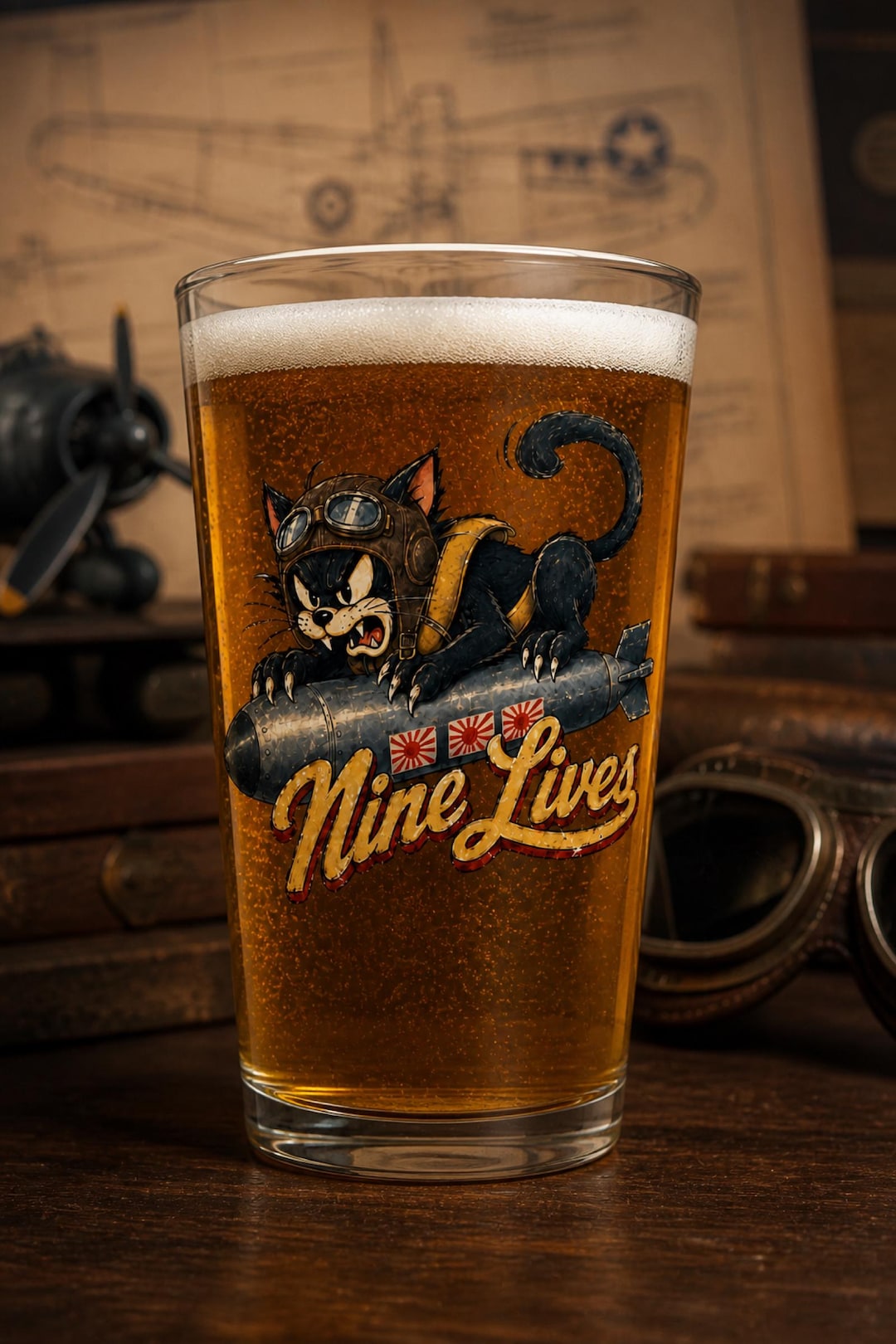
WWII Black Cat Nose Art Pint Glass
The Nine Lives cat, wrapped around a 16oz pint glass. A black cat that only came out after dark seemed like the right one for this post.
Where to See an F-117 Nighthawk
This is the good news for anyone who plans trips around airplanes, which is a category we fall into more often than we admit. There are now more F-117s on public display than of almost any other formerly-black aircraft, and several of them are in museums worth a full day on their own.

- National Museum of the U.S. Air Force — Wright-Patterson AFB, Dayton, Ohio. YF-117A 79-10781, one of the original five development aircraft. Free admission, and the best military aviation museum in the country.
- Palm Springs Air Museum — Palm Springs, California. A restored F-117A that went on display in 2022. Warm, walkable, and a genuinely good museum.
- Hill Aerospace Museum — Roy, Utah, just north of Salt Lake City. F-117A 82-0799. Free admission.
- Strategic Air Command & Aerospace Museum — Ashland, Nebraska, between Omaha and Lincoln.
- Pima Air & Space Museum — Tucson, Arizona. F-117A 84-0810, and the largest privately funded air museum in the world around it.
- Air Zoo — Kalamazoo, Michigan.
- Evergreen Aviation & Space Museum — McMinnville, Oregon, in the same building complex as the Spruce Goose.
- Castle Air Museum — Atwater, California.
- Museum of Aviation — Warner Robins, Georgia. Free admission.
- Stafford Air & Space Museum — Weatherford, Oklahoma.
- Ronald Reagan Presidential Library — Simi Valley, California, which is a fitting place for it.
- Air Force Flight Test Museum — Edwards AFB, California (base access required).
- Gate guardians at Nellis AFB, Nevada and Holloman AFB, New Mexico, and a monument aircraft outside the Skunk Works plant in Palmdale, California.
- Museum of Aviation, Belgrade, Serbia — the wreckage of Vega 31, if you want the other half of the story.
If you are picking one: Dayton. If you are picking one you can combine with a warm-weather trip, Palm Springs or Tucson. And check hours before you drive — several of these are closed Mondays, and the base-access ones require planning well ahead.
Little-Known F-117 Facts
- It has a tailhook. Not for carriers — the F-117 was never a naval aircraft. It carries an emergency arresting hook for engaging the cable at the departure end of a runway, which is standard on many Air Force jets and constantly misreported as evidence of a secret Navy program.
- Only 64 were ever built: five YF-117A development aircraft and 59 production F-117As. The last one was delivered on July 3, 1990.
- It was never exported. Not to the UK, not to anyone. The F-117 is one of the few major American combat aircraft of its era that no allied air force ever flew.
- The paint was the maintenance problem. Early radar-absorbent coatings had to be applied and cured in controlled conditions, and a jet with panels off was not a stealth jet until every seam was resealed.
- It could carry a nuclear weapon. The F-117 was certified for the B61, though it never carried one operationally.
- Its combat record is 1,300-plus sorties in Desert Storm alone, plus Panama, Allied Force and Iraqi Freedom, for a single combat loss across the entire history of the type.
- Only 558 Air Force pilots ever flew one, each carrying a permanently assigned Bandit number in a sequence that started at 150.
- The name “Nighthawk” came late. Inside the program it was the Black Jet, the Cockroach, or just “the jet.” Nighthawk is what it was called once it had to have a name the public could use.
F-117 Nighthawk: Frequently Asked Questions
Why was the F-117 called the Wobblin’ Goblin?
The nickname came from early flight testing, where the aircraft’s faceted, aerodynamically compromised shape produced unstable handling — especially in turbulence and behind a tanker — combined with its black paint, night-only flying and genuinely spooky silhouette. Pilots who flew it operationally consider the name undeserved, since revised flight control software made the production aircraft handle normally.
Was an F-117 ever shot down?
Yes, once. F-117A 82-0806, callsign Vega 31, was shot down by a Serbian S-125 (SA-3) battery near Belgrade on March 27, 1999, during Operation Allied Force. The pilot, Lt. Col. Dale Zelko, ejected and was rescued after about eight hours. It is the only stealth aircraft ever lost to enemy fire. A second F-117 was reportedly damaged over Serbia on April 30, 1999.
Is the F-117 still flying in 2026?
Yes. Although the Air Force officially retired the type in 2008, roughly 45 airframes remain in inventory and a small number still fly from the Tonopah Test Range in Nevada as adversary “red air,” as flying test assets for radar and infrared research, and as stealthy cruise missile surrogates. Current reporting indicates limited flight operations will continue through at least 2034.
How did the F-117 avoid radar?
Three things working together. Its flat, faceted panels deflect radar energy away from the transmitter instead of reflecting it back. Nearly a ton of radar-absorbent material soaks up much of what does strike the airframe. And the aircraft emits nothing that can be tracked — no radar of its own, no afterburner, no supersonic shockwave, with the exhaust cooled and flattened to cut its infrared signature. The commonly quoted radar cross section is around 0.001 square meters.
How fast was the F-117?
Subsonic. Maximum speed was about Mach 0.92, roughly 594 knots, with a service ceiling near 45,000 feet. It had no afterburner and was never designed to go supersonic, because a sonic boom and an afterburner plume defeat the entire purpose of the airplane.
Why is it called an “F” if it is a bomber?
Because the Air Force wanted fighter pilots to volunteer for it. The F-117 has never carried an air-to-air weapon and by the normal designation rules should have been an A-117. Lockheed program manager Alan Brown attributed the “F” to a belief in Air Force leadership that top pilots would be more readily attracted to a fighter designation.
How many F-117s were built?
Sixty-four in total — five YF-117A development aircraft and 59 production F-117As. The final aircraft was delivered on July 3, 1990.
Why was the F-117 retired in 2008?
Partly because precision-guided weapons had become universal and stealth had matured into the B-2 and F-22, and partly because the Air Force wanted the F-117’s sustainment budget for F-22 procurement. The retired aircraft were not scrapped; they went into recallable storage at Tonopah with their wings removed.
Where can I see an F-117 Nighthawk?
Public display aircraft include the National Museum of the U.S. Air Force in Dayton, Ohio; the Palm Springs Air Museum and Castle Air Museum in California; Hill Aerospace Museum in Utah; the Strategic Air Command & Aerospace Museum in Nebraska; Pima Air & Space Museum in Arizona; the Air Zoo in Michigan; Evergreen in Oregon; the Museum of Aviation in Georgia; the Stafford Air & Space Museum in Oklahoma; and the Ronald Reagan Presidential Library in California.
The Bottom Line
The F-117 Nighthawk is the rare airplane whose legend is smaller than its actual achievement. People remember the shape, the black paint and the spooky nickname. What matters is that a Soviet paper nobody wanted, run through a program that could only calculate flat surfaces, produced an aircraft that walked into the densest air defense network on earth and came back out 1,300 times without being touched.
It was not fast. It was not maneuverable. It could not defend itself in any conventional sense. It handled badly enough early on to earn a nickname its own pilots still resent. And it changed the assumptions of air warfare more thoroughly than any airplane since the jet engine.
It also has the more human ending. One F-117 was shot down, by a colonel with obsolete equipment and better ideas, and thirty years later the two men involved sit in each other’s kitchens. If you want a single reason the Nighthawk story is worth telling all the way through, that is it.
And the last word belongs to the airplane. Eighteen years after its own retirement ceremony, it is still up there over Nevada at night, being difficult to find. Some things do not change.
Keep Reading
- B-2 Spirit: The Flying Wing Jack Northrop Was Told to Forget, the 21 That Got Built, and the 37-Hour Missions From Missouri — the curved second generation, and the aircraft that flew the same 1999 campaign.
- F-22 Raptor: The Silent Serial Killer of the Sky and the 187-Jet Mistake America Can’t Undo — the aircraft the F-117’s retirement helped pay for.
- SR-71 Blackbird: How a Cold War Spy Plane Outran Missiles, Leaked Fuel on Purpose, and Stayed the Fastest Plane Ever Built — the other Skunk Works legend, and the opposite answer to the same problem.
- F-4 Phantom II: The Flying Pig That Could Not Shoot Straight, Turned the Air War, and Built the TOPGUN School — how air forces fought SAM belts before stealth existed.
- F-15E Strike Eagle: How a Pure Dogfighter Became the Air Force’s Deadliest Bomber — the other jet doing the heavy lifting over Iraq in 1991.
- US Military Drones: How a Spy Camera Learned to Shoot Back — where the low-observable idea went next.
- B-1B Lancer: The Bomber Carter Cancelled and Reagan Revived — semi-stealthy, supersonic, and still flying forty years on.
Have you seen an F-117 in person — at a museum, on a ramp, or overhead back when nobody was supposed to talk about it? Tell us where in the comments. We are always looking for the next airplane worth driving to.
More from the shopBrowse the full WWII aviation & nose art collection — tees, prints, glassware and gifts, all original designs.

Ben & Nicole Mathews
We’re based in St. Augustine, Florida, sharing the places we’ve actually been — from our home turf to corners of the U.S. and abroad. Ben is an attorney and a retired Air Force JAG (22 years), and a private pilot, which is why aviation and military history shows up here too.