

The first time I heard an F-16 light its afterburner on takeoff, I was standing on a flightline and thought something had gone wrong. The raw, sustained shriek of that Pratt & Whitney F100 is unlike anything else in the inventory — not just loud but visceral, something you feel in your sternum long after the jet is a dot in the sky. I’ve watched a lot of aircraft fly. The Viper is the one that still makes me stop and stare.
Here’s the thing most people get wrong about the F-16: the official name is the “Fighting Falcon,” but ask any pilot or crew chief what jet they fly and they’ll say the Viper — every single time. The Air Force even stood up an official F-16 Viper Demonstration Team. The name won. This is the story of how that happened, what makes the Viper different from every other fourth-gen fighter ever built, and why a jet that entered service in 1978 is still the most common combat aircraft on the planet in 2026.

The Fighter Mafia and the Jet Nobody Asked For
To understand the F-16, you have to understand the late 1960s Air Force, which was absolutely in love with big, expensive, complicated fighters — and getting killed in Vietnam because of it. The F-4 Phantom was the hot rod of the era, but it was also enormous, radar-missile-dependent, and getting beaten in knife-fight engagements by smaller MiGs. Sound familiar? (It should — we wrote a whole post about it.)
Enter Colonel John Boyd. Boyd was one of those rare human beings who changes entire industries by being too stubborn to shut up. A fighter pilot and instructor, Boyd developed the Energy-Maneuverability (EM) theory — a mathematical model proving that a fighter’s combat effectiveness came down to its ability to gain and shed energy faster than its opponent. His conclusion: the Air Force was building the wrong jets. They were too heavy, too complex, and optimized for the wrong fight.
Boyd gathered a circle of like-minded innovators — engineers, analysts, and pilots — who became known as the Fighter Mafia. In 1969, they secured funding for what became the Lightweight Fighter (LWF) program. The concept: a small, agile, single-engine aircraft with an exceptional thrust-to-weight ratio that could out-turn and out-climb anything it met. General Dynamics won the prototype competition with what would become the F-16. The jet that almost didn’t get built would go on to become the most-produced Western fighter in history.
What Makes the Viper Different: The Design Was Radical
The F-16 wasn’t just a smaller fighter. It introduced a cluster of technologies that were genuinely revolutionary — several of which are now standard on every modern fighter in the world.
Fly-by-wire with relaxed static stability. Previous fighters were inherently stable — they resisted changes in attitude, which made them predictable but sluggish in maneuvering. The F-16 was designed to be unstable. Leave it alone and it wants to depart controlled flight. A fly-by-wire computer corrects this continuously, thousands of times per second, translating pilot inputs into precise control surface movements. The result is an aircraft that responds like nothing that came before it. It doesn’t turn; it pivots.
The bubble canopy. The F-16’s one-piece, frameless blown-acrylic canopy gives the pilot roughly 360-degree horizontal visibility and 40 degrees below the horizon — an enormous tactical advantage. When you can’t see a threat, you’re already losing. Earlier jets had canopy frames and heavy bows that created blind spots. The Viper fixed that.
The reclined ejection seat. Fighter pilots typically sit nearly upright. At high G-loads, blood drains from the brain toward the feet, causing G-induced loss of consciousness (GLOC) — arguably the most dangerous invisible threat in a dogfight. The F-16’s seat reclines 30 degrees from vertical, redistributing the G-force load across the pilot’s body and pushing the GLOC threshold several G higher. Combined with the ACES II ejection seat and an anti-G suit, Viper pilots could sustain 9G turns that would put pilots of earlier jets unconscious before they could finish the maneuver.
The side-stick controller. The F-16 replaced the traditional center-mounted stick with a side-stick on the right console — a controversial choice that caused arguments in the test pilot community for years. At high G-forces, moving a center stick requires significant arm strength. The side-stick requires almost none. Some pilots hated it. The ones who flew it in combat swore by it.

So Why Do They Call It the Viper?
The Air Force officially named the aircraft the Fighting Falcon on July 21, 1980. The name never stuck. Within the first squadrons to receive the jet, pilots and crew chiefs had already settled on “Viper” — and the reasons are worth knowing because they’re both real.
First: the shape. From nose-on, the F-16 has a lean, triangular, slightly menacing profile that genuinely does resemble a coiled viper ready to strike. The needle nose, the narrow fuselage, the way the intake sits below the cockpit like a jaw — it reads as predatory in a way the blunt-nosed F-4 never did.
Second — and this is the one aviation nerds love — the F-16 entered service in 1978, exactly when Battlestar Galactica debuted on ABC. The Colonial Viper starfighter in that show was sleek, single-seat, fast, and maneuverable — the human fleet’s primary dogfighter against the Cylons. When pilots climbed into the new F-16 and looked around the bubble canopy at nothing but sky, the comparison was immediate and obvious. The “Colonial Viper” connection stuck so hard that when Lockheed Martin developed the ultimate production variant decades later, they officially named it the F-16V Viper. The nickname outlasted the TV show by forty-plus years and got stamped on the airframe.
The F-16 Goes to War: Israel Fires the First Shots
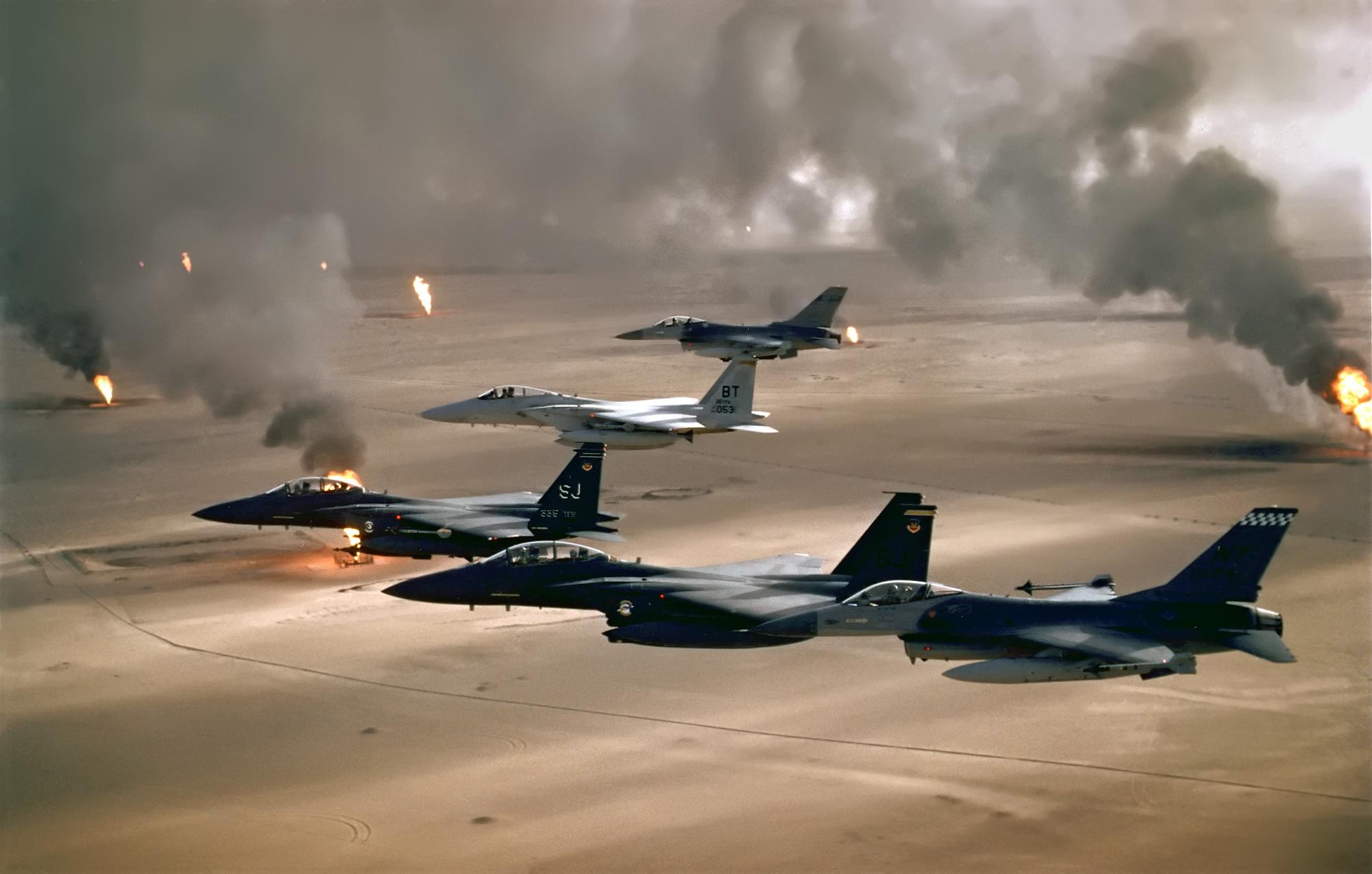
The United States Air Force took the Viper into combat in the Gulf War. But the first nation to fire F-16s in anger wasn’t the US — it was Israel.
On June 7, 1981, eight Israeli Air Force F-16As, escorted by F-15 Eagles, flew a mission that’s still studied in every professional military education course that touches on airpower: Operation Opera (also called Operation Babylon). Their target was Osirak — Iraq’s French-built nuclear reactor, then close to producing weapons-grade plutonium. The strike package flew nap-of-the-earth at 100 feet to avoid radar, refrained from radio communications, and destroyed the reactor in under two minutes of weapons employment. Every aircraft came home. The mission was widely condemned internationally at the time and is now regarded as one of the most consequential precision strikes in history. It was conducted entirely by F-16s, making their combat debut on a target the F-4 and A-4 of the prior generation couldn’t have reached.
Two weeks later, Israeli F-16s shot down their first Syrian MiG. In the 1982 Lebanon War, Israeli F-16s and F-15s flew against a full Soviet-equipped Syrian air defense network and destroyed over 80 Syrian aircraft in what became known as the Bekaa Valley air battle — one of the most lopsided aerial engagements since World War II, and a live demonstration of what a well-trained force with energy-dominant fighters could do against an adversary flying on rigid ground-controlled intercept procedures.
F-16 Variants: Block by Block, Generation by Generation
One of the most confusing things about the F-16 family is the “block” system. Unlike the F-15, which has distinct named variants (C/D, E Strike Eagle), the F-16 was upgraded iteratively, with each production block adding significant capability while keeping the same basic airframe. Here’s the cheat sheet:
F-16A/B (Blocks 1–20): The original. Single-seat (A) and two-seat (B) versions. Day-VFR optimized, AN/APG-66 radar, AIM-9 Sidewinder and AIM-7 Sparrow capability. The jets Israel flew in 1981 were early Block 10s. Good, clean, light fighters — but limited in all-weather and night attack capability.
F-16C/D (Blocks 25–52): The workhorse. Block 25 brought the AN/APG-68 radar and AIM-120 AMRAAM capability. Block 30 introduced the General Electric F110 engine as an option alongside the Pratt & Whitney F100, creating the “Big Mouth” inlet and what pilots called the “GE jet” vs. the “P&W jet.” Blocks 40/42 (“Night Falcon”) added LANTIRN navigation and targeting pods for true night precision strike. Blocks 50/52 added the AN/APG-68(V)5 radar, the HARM Targeting System (HTS) for SEAD missions, and increased capability across the board. The Block 50/52 is what replaced the F-4G Wild Weasel.
F-16E/F (Block 60 — “Desert Falcon”): Developed specifically for the UAE, the Block 60 is in many ways the most capable F-16 ever built — more advanced than US inventory jets. It has an internal FLIR, internal ECM, a conformal fuel tank system that adds range without external drag, and the AN/APG-80 AESA radar. The Air Force looked at Block 60 capabilities and said “we want that” — which helped accelerate the F-16V development.
F-16V Viper (Block 70/72): The current production variant and the one that carries the Viper name officially. The F-16V integrates the AN/APG-83 SABR AESA radar, a new mission computer, Link-16 datalink improvements, a center pedestal display, and an automatic ground collision avoidance system (Auto-GCAS) that has already saved multiple pilot lives by autonomously pulling the aircraft out of controlled flight into terrain. It’s being built for export and as a reconfiguration standard for legacy jets. As of 2026, it’s the world’s most common active military fixed-wing aircraft — 2,100+ operational examples.
The Thunderbirds: When the Viper Became a Star
In 1983, the Air Force Thunderbirds transitioned to the F-16A — and the airshow world was never the same. The combination of the Viper’s raw thrust, instantaneous roll rate, and 9G capability gave the Thunderbirds an entirely new vocabulary of performance that the T-38 they’d been flying simply couldn’t match.
The Thunderbirds’ transition also did something strategically important: it put the F-16 in front of millions of Americans at airshows every year. Recruiting numbers in the years following the Thunderbirds’ Viper debut jumped noticeably. The aircraft wasn’t just a weapons system — it was a symbol of what American aviation could do. It’s not a coincidence that the Viper became one of the most built fighters in history during the same era the Thunderbirds were flying it in front of crowds nationwide.

Things Even Aviation Nerds Don’t Always Know About the Viper
The F-16 replaced three aircraft simultaneously: the F-105 Thunderchief (strike), the A-7 Corsair II (light attack), and the F-4 Phantom II (multirole). That’s three different mission sets folded into one airframe. In practice, it also eventually absorbed the F-4G Wild Weasel’s SEAD mission once Block 50/52 jets with HTS pods came online. One jet, four mission sets. That’s a hell of a résumé.
The F-16 has been flown by 25 nations. Several of those — including Turkey, South Korea, and Taiwan — have built or assembled Vipers domestically under license. The F-16 production line at Fort Worth, Texas ran for over four decades. The current production line in Greenville, South Carolina is building Block 70/72 jets for export customers including Bahrain, Slovakia, and Bulgaria.
The F-16 also carries a distinction almost no other operational aircraft can claim: it has been flown unmanned. The QF-16 full-scale aerial target (FSAT) program converted retired F-16s into drone targets for missile testing — and one of the early test flights had a pilot on board as a safety backup who never had to touch the controls. The Air Force ran a QF-16 through a full aerobatic routine, including 9G turns, completely unmanned.


Why the Viper Hits Different
Most aircraft are compromises — built to meet a requirement, balanced against a budget, shaped by committee. The F-16 is a rare thing: an aircraft shaped by a single, coherent idea. John Boyd’s energy-maneuverability theory drove every major design decision from the wing loading to the reclined seat to the side-stick. That conceptual clarity is why it flies the way it flies and why it’s still relevant 48 years after first flight.
What the F-16 also represents is institutional courage — the willingness of a small group of people inside a bureaucracy to fight for a better idea when the institution wanted to keep buying the same expensive, complicated answer. The Fighter Mafia didn’t just build a jet. They built a methodology for thinking about airpower that reverberated through every generation of fighter design that followed.
Next time you see a Viper on the ramp or at an airshow, look at the canopy, the inlet, the reclined cockpit. Every one of those features was a fight. Every one of them changed the way we build fighters. The name that stuck wasn’t the official one — it was the one pilots gave it. That tells you everything.


Keep Reading: More Aviation History

Military Aircraft
F-4 Phantom II: The Flying Pig That Turned the Air War
Missiles only, Robin Olds, Operation Bolo — and why it built TOPGUN.

Military Aircraft
F-15E Strike Eagle: How a Pure Dogfighter Became a Bomber
The jet the Air Force didn’t want — until it couldn’t live without it.

Military Aircraft
A-10 Warthog: The BRRRRT Heard Across Fort Leonard Wood
Why ground troops love a jet the Air Force keeps trying to retire.
Browse more military aircraft stories in the Aviation section — from WWII fighters to modern air superiority jets.
F-16 Viper FAQ
Why do pilots call the F-16 the Viper instead of the Fighting Falcon?
The “Viper” nickname came organically from the first F-16 squadrons in 1978–1980, inspired by both the jet’s snake-like profile and the Colonial Viper fighters from Battlestar Galactica, which was airing when the F-16 entered service. The nickname was so entrenched that Lockheed Martin officially named the latest production variant the F-16V Viper, and the Air Force stood up the official “F-16 Viper Demonstration Team.” The official name lost.
What is the difference between the F-16 and the F-16V Viper?
The F-16V is the Block 70/72 production standard — the most advanced F-16 variant ever built. It features an AN/APG-83 SABR AESA radar (replacing the mechanically scanned APG-68), a modernized mission computer, updated cockpit displays, and the Auto-GCAS automated ground-collision avoidance system. Earlier F-16 blocks can be upgraded to near-F-16V standard; the V designation applies both to new-build jets and to upgraded aircraft meeting the new avionics standard.
What was the F-16’s first combat action?
The Israeli Air Force fired the first F-16 shots in anger during Operation Opera on June 7, 1981, when eight F-16As destroyed Iraq’s Osirak nuclear reactor. The US Air Force flew F-16s in combat for the first time during the Gulf War in 1991, where the F-16 flew more sorties than any other aircraft in the coalition — 13,500 in 43 days.
How many countries fly the F-16?
As of 2026, the F-16 is operated by 25 nations including the United States, Israel, Turkey, South Korea, Taiwan, the Netherlands, Belgium, Poland, Greece, Pakistan, and several others. Over 4,600 F-16s have been built since 1976, making it the most-produced Western fighter aircraft in history.
Is the F-16 being replaced?
In US Air Force service, the F-16 is gradually being replaced by the F-35A Lightning II. However, F-16 production continues for export customers, and many allied nations are upgrading their fleets to F-16V standard rather than purchasing F-35s. The F-16 is expected to remain in active service globally well into the 2040s.
The Bottom Line
The F-16 Viper started as a rebellion — a small team of visionaries building the jet the institution said it didn’t need. It entered service with a nickname the Air Force didn’t pick, flew combat missions on three continents, replaced four aircraft, got adopted by 25 nations, and 48 years later still holds the title of world’s most common military fixed-wing aircraft. The Fighting Falcon name is on the paperwork. The Viper name is on the patches, the unit coins, and the official demonstration team. That’s not a tie — that’s a win for the pilots.
A Note from Ben
The F-16 has always been one of my favorite aircraft to write about — not because of what it can do in combat, though that’s remarkable enough, but because of where it came from. The Fighter Mafia story, the lightweight fighter competition, the deliberate move away from the gold-plated complexity of fighters like the F-15 — it’s the kind of institutional insurgency that almost never works, and then it did. As a private pilot with an Air Force background, I have a lot of respect for what pure flying performance looks like when engineers are given permission to prioritize it. The F-16 is that.
Sources & Further Reading
This article draws on U.S. Air Force official F-16 fact sheets, Lockheed Martin F-16 Fighting Falcon program materials, and historical accounts of the Lightweight Fighter program and Fighter Mafia. The Air Force Historical Research Agency and National Museum of the U.S. Air Force maintain additional historical records on the aircraft and its development.
For readers who want to explore further, these are reliable starting points:
- U.S. Air Force official website — aircraft fact sheets and news
- National Museum of the U.S. Air Force — aircraft histories and exhibits
- Smithsonian National Air and Space Museum — aviation history resources
More from the shopBrowse the full WWII aviation & nose art collection — tees, prints, glassware and gifts, all original designs.

Ben & Nicole Mathews
We’re based in St. Augustine, Florida, sharing the places we’ve actually been — from our home turf to corners of the U.S. and abroad. Ben is an attorney and a retired Air Force JAG (22 years), and a private pilot, which is why aviation and military history shows up here too.