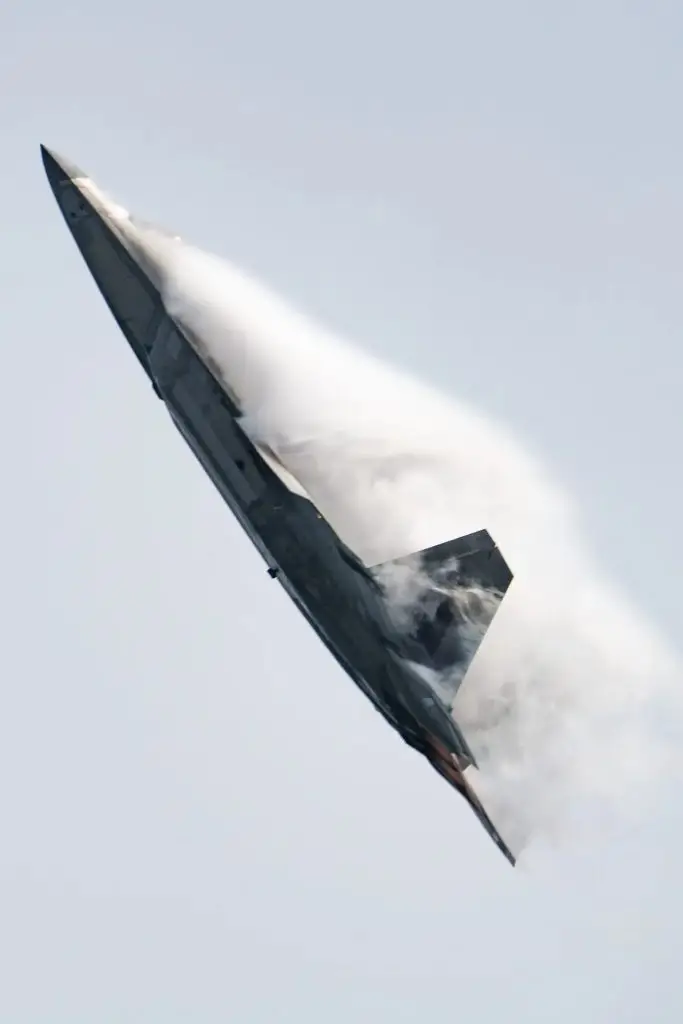

There’s a scene that plays out in classified exercise debriefs around the world, and it goes something like this: the Red Force pilots — flying aggressor F-15s, F-16s, sometimes foreign-operated fourth-gen jets — land after an engagement and ask the debriefer how many Raptors were in the airspace. The answer is almost always more than anyone on the Red Force side knew. The F-22 wasn’t just killing them — it was killing them before they knew it was there. That’s not a capability. That’s a different category of warfare entirely.
I spent years in the Air Force and flew in and out of bases where the F-22 operated. I never flew one — I’m a lawyer, not a fighter pilot — but I have stood next to one on the ramp, looked up at those canted tails and the blended fuselage, and understood immediately that this machine is operating at a level of abstraction that most people, including most military professionals, don’t fully appreciate. This is the story of what makes the Raptor the most dominant air superiority fighter ever built, the wild history behind it, and the political decisions that guaranteed we’d never have enough of them.

The Jet That Beat the Cold War — After the Cold War Ended
The F-22 was born from a Cold War nightmare: the Soviet Union was fielding new fighters — the Su-27 Flanker and MiG-29 Fulcrum — that could match or beat the F-15 Eagle in a turning fight. The Air Force saw the trajectory clearly. In 1981, it launched the Advanced Tactical Fighter (ATF) program with a mandate that was essentially: build us something that can dominate any air threat we will face for the next 30 years, regardless of what it is. The requirements were extraordinary — supersonic cruise without afterburner, stealth, extreme maneuverability, long range, and next-generation avionics. No aircraft had ever been asked to do all of those things simultaneously.
Lockheed teamed with Boeing and General Dynamics. Northrop teamed with McDonnell Douglas. Both teams built flying prototypes: Lockheed’s YF-22 and Northrop’s YF-23. The fly-off was one of the most consequential aircraft competitions in history. The YF-23 was stealthier and faster. The YF-22 was more maneuverable, had flown more test hours, and was considered lower-risk and more adaptable. In April 1991, the Air Force selected the YF-22. The YF-23 never flew again. Aviation historians still argue about whether the right jet won, but the F-22 that emerged from the YF-22 has never lost an engagement — simulated or real — so the debate is mostly academic.
What Makes the Raptor a Different Species of Fighter
Every generation of fighter improves on the last. The F-22 didn’t just improve on the F-15 — it made the F-15 conceptually obsolete in air-to-air combat. Here’s why.
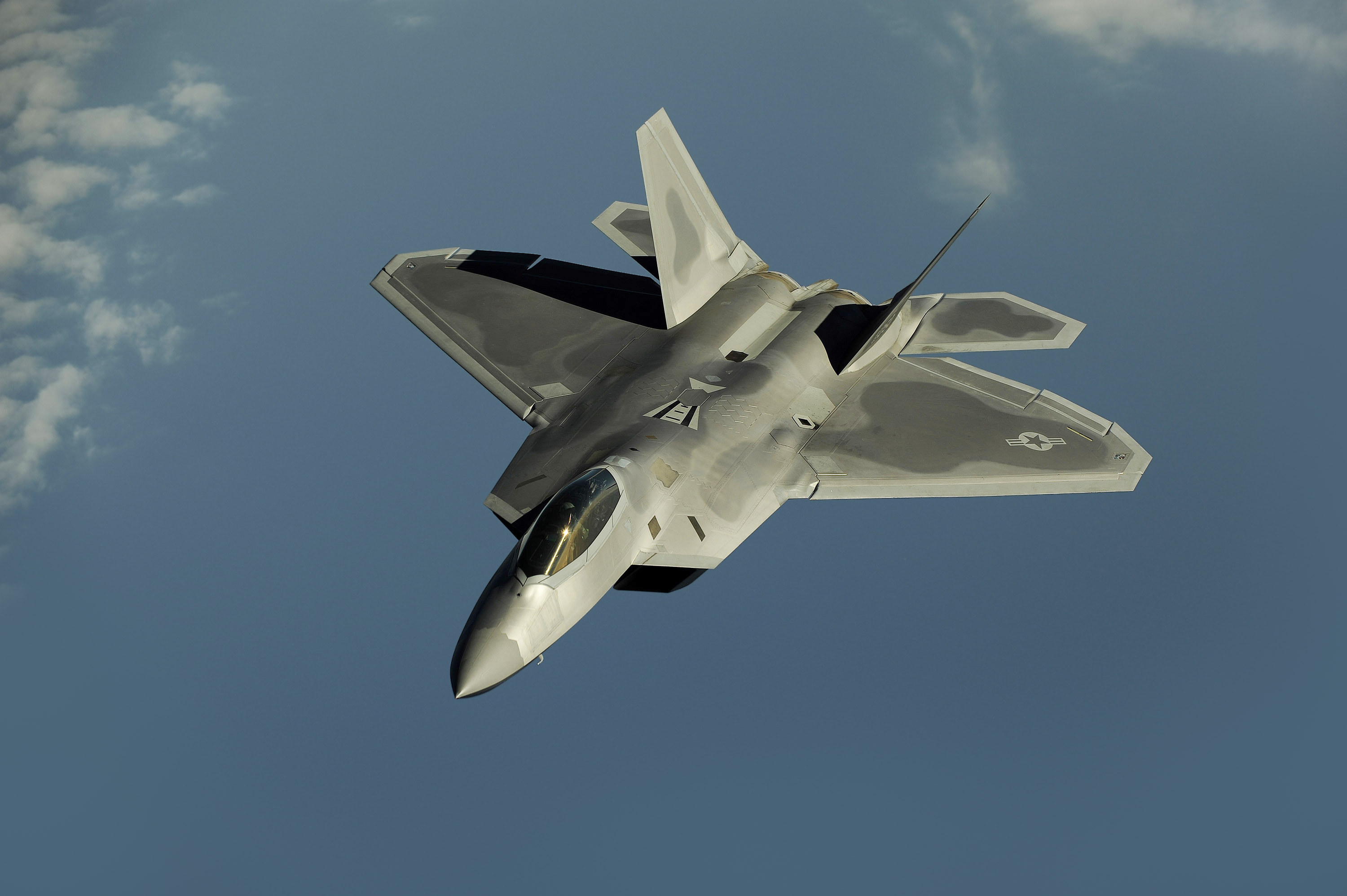
Stealth that’s not just about radar. The F-22’s radar cross-section is famously compared to a marble or a metal ball bearing — somewhere around 0.0001 square meters in the most favorable aspect. For reference, an F-15 has an RCS closer to 400 square meters from the front. The F-22 achieves this through edge alignment (all leading edges are parallel), radar-absorbent materials (RAM) baked into the structure rather than applied as a coating, internal weapons carriage, and serpentine inlet ducts that hide the engine fan face from radar. The result: an enemy radar might not detect the F-22 until it’s already inside weapons range — and by then, the Raptor has been shooting for minutes.
Supercruise. Most fighters can go supersonic, but only with afterburner — a fuel-hungry, heat-generating, radar-signature-increasing process. The F-22’s twin Pratt & Whitney F119-PW-100 engines generate enough thrust to cruise at approximately Mach 1.82 supersonically with the afterburner off. This is operationally significant in ways that aren’t obvious: supercruise extends combat range, shortens time to target, and dramatically increases the kinetic energy of weapons at launch. An AIM-120 fired from a supercruising Raptor has a much larger no-escape zone than the same missile fired from a subsonic platform.
Thrust vectoring. The F119 engines have two-dimensional thrust-vectoring nozzles that move ±20 degrees in the pitch axis. Combined with fly-by-wire flight controls, this allows the F-22 to point its nose at angles that would cause any aerodynamically-controlled aircraft to depart controlled flight. In a close-in turning fight — which the F-22 is designed to avoid, but can win when forced into it — this produces maneuvers that look physically impossible from the outside. Pilots have described using thrust vectoring to literally reverse direction mid-merge, putting the Raptor behind an opponent before the opponent has completed their first turn.

The Silent Serial Killer: What the Kill Ratios Tell You
Numbers don’t lie. In Exercise Northern Edge 2006 and Red Flag 07-2, F-22s flew against Red Force aggressors flying F-15s and F-16s — the best American fighters outside the Raptor itself. The simulated kill ratio: 108-to-0. As in, 108 kills, zero losses. That’s not an edge. That’s annihilation.
It got better. During an Operational Readiness Inspection in 2008, F-22s recorded a simulated kill ratio of 221-to-0. Not a typo. Two hundred and twenty-one engagements, zero losses. Red Force pilots were landing, checking their threat warning receivers, and finding no indication they’d ever been targeted. The Raptor was killing them with emissions they couldn’t detect, from ranges their radar couldn’t reach, and then disappearing before any counter was possible.
This is what makes the F-22 the air superiority equivalent of a sniper who can also run faster than you: it chooses the geometry of every engagement, fires first at ranges that preclude a counter-shot, and withdraws before the adversary has confirmed its presence. The F-15 was the undisputed king of air combat for 30 years and never lost a dogfight. The F-22 would own the F-15 so badly in a free-play exercise that the Air Force stopped running those particular engagements publicly because the numbers were embarrassing.
The Weapons System: Doors Open, Doors Closed, You’re Already Dead
One of the least-discussed engineering achievements of the F-22 is what it doesn’t have hanging off its wings. Every external pylon on a fourth-gen fighter is a radar return waiting to happen. The F-22 carries everything internally in three weapons bays: a large main ventral bay for AIM-120 AMRAAMs and 1,000-pound GBU-32 JDAMs, and two smaller side bays — one on each fuselage cheek — for AIM-9 Sidewinders.
The launch sequence is designed for minimal radar exposure: bay doors open for less than one second, the missile ejects on a pneumatic launcher into the airstream, the doors close, and the F-22 has returned to minimum radar cross-section before the missile has even ignited its motor. For close-range engagements, the side bay Sidewinders have been upgraded to the AIM-9X with an off-boresight high-off-axis capability, meaning the pilot doesn’t need to point the jet at a target to shoot it. Combined with a helmet-mounted cuing system, the Raptor can literally shoot sideways at a target it hasn’t turned to face.

Combat Debut: Syria, 2014
For years, the F-22 existed only in exercises — the most dominant aircraft in simulation history that had never fired a shot in anger. That changed on September 22, 2014, when F-22s flew the opening strikes of Operation Inherent Resolve against Islamic State targets near the Tishrin Dam in Syria. The Raptor’s combat debut wasn’t an air-to-air engagement — ISIS had no air force — but it was significant for a different reason: the F-22 was operating in airspace shared with Syrian government aircraft, Iranian fighters, and, shortly thereafter, Russian jets operating in support of the Assad regime.
What followed was one of the more remarkable low-key standoffs in recent military history. F-22s routinely intercepted and turned away Syrian and Russian aircraft that wandered toward U.S.-backed Kurdish forces. In one documented incident, an F-22 intercepted an Iranian F-4 Phantom — the same jet that was outclassed in Vietnam fifty years earlier — that had approached within 16 miles of a U.S. MQ-1 Predator drone. The F-22 pulled alongside, the Iranian crew saw what was next to them, and they turned around. No weapons fired. Presence as deterrence — the ultimate expression of air superiority.
Between September 2014 and July 2015, F-22s flew 204 sorties over Syria, dropping 270 bombs at approximately 60 locations. In 2017, F-22s participated in strikes that defeated pro-Assad and Russian Wagner Group paramilitaries near Khasham, one of the few direct engagements between American airpower and Russian-affiliated forces in the modern era. The Raptor was in that fight. Nobody who was on the receiving end argued about its effectiveness afterward.
The Number That Still Haunts the Air Force: 187
The Air Force originally planned to buy 750 F-22s. Then 648. Then 442. Then 381. Then 183. The program was ultimately terminated at 187 operational aircraft in 2009 — a number that retired Air Force generals have publicly described as strategically insufficient. The aircraft costs roughly $150 million per unit in flyaway cost and approximately $68,000 per flight hour to operate. Those numbers were used to justify the cuts. They’re accurate. They’re also misleading.
Secretary of Defense Robert Gates argued in 2008 that the F-22 “lacked relevance in asymmetric post-Cold War conflicts.” He wasn’t wrong that ISIS doesn’t need to be fought with stealth fighters. He was wrong about the relevant threat environment, which has demonstrably shifted back toward peer competition with China and Russia — both of whom have developed fifth-generation fighters (J-20 and Su-57) partly in response to watching what the F-22 could do in exercises. The United States now has 187 operational Raptors to counter a threat environment that was partly shaped by those same 187 Raptors existing.
Production line tooling was destroyed after the program ended. Restarting F-22 production would cost an estimated $50 billion and take over a decade. Japan and Australia — close allies who desperately wanted to buy the F-22 — were legally prohibited from purchasing it by the Obey Amendment to the 1998 defense authorization act, which banned F-22 exports entirely. The allies who most wanted to fly next to us in the most contested airspace on earth couldn’t have it. Instead, they bought F-35s, which are excellent aircraft with a very different mission profile.
Things Even Aviation Nerds Don’t Always Know About the Raptor
The F-22 has an on-board oxygen generation system (OBOGS) that was responsible for a serious safety crisis between 2008 and 2012. Pilots were experiencing hypoxia-like symptoms — “Raptor cough,” dizziness, disorientation — at altitude. The Air Force grounded the fleet for five months in 2011, the longest grounding of a frontline combat aircraft since the F-111 era. The root cause was eventually traced to a faulty valve in the OBOGS system. It took four years to fully resolve. The Raptor’s complexity cuts both ways.
The F-22 has an integrated inertial navigation system and GPS that gives it one of the most precise positional accuracies of any aircraft flying. Combined with its low-probability-of-intercept datalink (IFDL — Inter/Intra-Flight Data Link), Raptors in a flight share targeting data without emitting signals enemies can detect. The F-22 flight effectively operates as a networked sensor array where individual jets don’t need to turn on their own radar to have a full picture — one Raptor illuminates, all share the data, and none of them are detectable in the process.
The RAM coating on the F-22 is not a spray-on material applied after manufacturing — it’s integrated into the aircraft’s composite skin panels. This is a significant maintenance difference from the B-2, which uses a spray-on coating that degrades with use and requires extensive between-flight maintenance. The F-22 is still maintenance-intensive, but its stealth isn’t peeling off in the rain.

Why the Raptor Hits Different
Every major Western air force that has exercised against the F-22 has come away saying some version of the same thing: this is not a better fighter, it’s a different problem. The F-15 pilot can beat an Su-27 with enough skill and situational awareness. The F-22 removes skill from the adversary’s side of the equation by denying them the situational awareness to compete in the first place. You can’t dodge a missile you don’t know was fired. You can’t counter a radar that doesn’t trigger your warning receivers. You can’t win a merge against an aircraft that resolved the engagement three minutes before the visual.
The Raptor is also the only aircraft in the U.S. inventory specifically designed for the air-to-air mission above all others. The F-35 is multirole — it does many things well but was designed with a different priority stack. The F-15EX is an evolved legacy platform. The F-22 was built with one core question: what does it take to own the sky against any adversary, unconditionally? The answer to that question flies at Langley, Elmendorf, Hickam, and Tyndall, and it kills at ranges and with a silence that the adversary never quite recovers from psychologically, even in exercises.
We built 187 of them. There are those of us who will spend the rest of our careers believing that was one of the most consequential strategic errors in modern American military history. The line is cold. The tooling is gone. And China is building J-20s by the hundreds.


Keep Reading: More Aviation History

Military Aircraft
F-16 Viper: The Fighter Mafia’s Jet and the Battlestar Nickname
The rebel jet that beat the bureaucracy and became the world’s most common combat aircraft.

Military Aircraft
F-15E Strike Eagle: The Dogfighter Turned Bomber
The jet the F-22 replaced in air superiority — and why it’s still flying.

Military Aircraft
F-4 Phantom II: The Flying Pig That Turned the Air War
The F-22’s spiritual ancestor — the jet that proved missiles alone weren’t enough.
Browse more military aircraft stories in the Aviation section — from the F-4 Phantom to the SR-71 Blackbird.
F-22 Raptor FAQ
Why is the F-22 called the Raptor?
The name “Raptor” refers to a bird of prey — specifically the class of hunting birds including eagles, hawks, and falcons. It was selected to convey the aircraft’s role as an apex predator of the air superiority mission. The name fits: raptors hunt with speed, stealth, and precision from altitudes their prey can’t monitor.
Has the F-22 ever shot down another aircraft?
Yes. In February 2023, an F-22 shot down the Chinese surveillance balloon that had crossed the continental United States, using an AIM-9X Sidewinder. This was the first air-to-air missile kill by an American aircraft in airspace over the continental United States and the first combat weapons employment by the F-22 against an airborne target. The balloon was traveling at 60,000 feet — well above the Raptor’s standard operating altitude — and the engagement required a zoom climb to achieve the shot.
Why was F-22 production stopped at 187 aircraft?
Secretary of Defense Robert Gates ended F-22 production in 2009 under the argument that the aircraft was too expensive, optimized for Cold War peer threats that no longer existed, and that funds were better directed toward counterinsurgency capabilities. The unit cost (~$150M flyaway) and per-flight-hour cost (~$68K) were frequently cited. Critics of the decision — including many active and retired Air Force generals — have argued that the threat environment has since shifted decisively back toward peer competition with China and Russia, making the shortage of F-22s a serious strategic vulnerability.
Can the F-22 be exported?
No. The Obey Amendment to the FY1998 National Defense Authorization Act explicitly prohibits the export of F-22s to any foreign nation. Japan and Australia both formally requested the aircraft and were denied. The ban was driven by technology security concerns — the F-22’s stealth, avionics, and radar technologies were considered too sensitive to share even with close allies. Both nations subsequently purchased F-35s instead.
How does the F-22 compare to China’s J-20?
The J-20 is China’s fifth-generation stealth fighter, and it’s a capable aircraft. Most Western analysis suggests the F-22 retains advantages in stealth (particularly frontal RCS), supercruise capability, and sensor fusion. The J-20 appears to have a larger airframe with greater fuel capacity and potentially longer range. No direct engagement has occurred. What’s strategically significant: China is producing J-20s at a rate that will numerically outpace the F-22 fleet — possibly already has. 187 F-22s against an expanding J-20 force is the math that keeps Air Force planners awake.
The Bottom Line
The F-22 Raptor is the best air superiority fighter ever built. That sentence is not a matter of serious debate among professionals who have operated against it or studied the data. The kill ratios are real, the stealth is real, the supercruise is real, and the operational results in Syria are real. What’s also real is that we have 187 of them against a world that has watched what they can do and has been building responses for twenty years. The Raptor didn’t just change air combat — it changed what every peer adversary decided to spend money on. That’s the measure of a truly dominant weapons system: the enemy’s budget moves because of it.
Read next: F-15E Strike Eagle: How a Pure Dogfighter Became the Air Force’s Deadliest Bomber →
A Note from Ben
I wrote about the F-22 because the decision to stop production at 187 jets is, from a military aviation standpoint, one of the most consequential and arguably shortsighted procurement calls in modern Air Force history. As a retired Air Force JAG who spent 22 years in uniform, I watched the debates around this aircraft from inside the institution. The F-22 was — and still is — unlike anything else in the sky. The kill ratios in exercises are almost impossible to believe until you understand what stealth, supercruise, and sensor fusion actually mean in air-to-air combat. Writing this gave me a chance to finally lay out exactly what America has and what it gave up by stopping the line too soon.
Sources & Further Reading
This article draws on publicly available information from U.S. Air Force official fact sheets and press releases, Lockheed Martin program background materials, and Congressional testimony and reports related to the F-22 Raptor program. For readers who want to go deeper, the National Museum of the U.S. Air Force and the official Air Force website maintain current fact sheets on the aircraft.
For readers who want to explore further, these are reliable starting points:
- U.S. Air Force official website — aircraft fact sheets and news
- National Museum of the U.S. Air Force — aircraft histories and exhibits
- Smithsonian National Air and Space Museum — aviation history resources
More from the shopBrowse the full WWII aviation & nose art collection — tees, prints, glassware and gifts, all original designs.

Ben & Nicole Mathews
We’re based in St. Augustine, Florida, sharing the places we’ve actually been — from our home turf to corners of the U.S. and abroad. Ben is an attorney and a retired Air Force JAG (22 years), and a private pilot, which is why aviation and military history shows up here too.