

No cars, no Uber, no problem. Here’s how to get around Venice — from the airport to the islands — using vaporettos, your own two feet, and a few local tricks first-timers always miss.
Getting around Venice is unlike anywhere else: it is the rare major city with no cars, no buses, no bikes, and no metro. Once you arrive, you get around exactly two ways: on foot and on the water. That sounds daunting and is actually freeing — but only if you know how the water buses work, when to just walk, and which “convenient” options quietly drain your wallet. Here’s everything a first-timer needs for getting around Venice, start to finish.
Getting from the Airport to Venice
Most travelers fly into Venice Marco Polo (VCE), which sits on the mainland, across the lagoon from the city. You have three main ways across the water, and the right one depends on your budget and your luggage:
- Alilaguna water bus (~€15): the scenic, budget-friendly option, with three color-coded lines (Blu, Arancio, Rossa) to San Marco, Rialto, and other hubs. It takes 60–90 minutes depending on your stop and boats can be crowded with luggage, but arriving by water is unforgettable. We took it and loved it, luggage wrestling and all.
- Private water taxi (~€120–€140): the fastest and most comfortable — a sleek motorboat that can drop you right at your hotel’s canal door in about 30 minutes. Pricey, but for groups or heavy bags it can be worth splitting.
- Bus to Piazzale Roma (~€10): the cheapest and quickest route to the edge of Venice (the ACTV Line 5 or the ATVO express, about 20–25 minutes). From Piazzale Roma you transfer to a vaporetto or walk into the city.
Flying into Treviso (TSF) instead? It’s farther out (about 40 km); take the ATVO express bus straight to Piazzale Roma, then continue by vaporetto or on foot.

The Vaporetto: Venice’s Water Bus
The vaporetto is the backbone of getting around — a network of water buses run by ACTV that connect the Grand Canal, the outer edges of the city, and the lagoon islands. The lines you’ll actually use:
- Line 1 — the local that stops everywhere down the Grand Canal. Slower, but a gorgeous, cheap “cruise” past the palazzi.
- Line 2 — the faster Grand Canal express with fewer stops; handy for getting between the train station, Rialto, and San Marco quickly.
- Lines 4.1/4.2 and 5.1/5.2 — the “circle” lines that loop around the outer edge of Venice (and out to Murano); useful for reaching quieter corners.
- Line 12 — from Fondamente Nove out to Murano and Burano.
- Night lines (N) — reduced service that keeps running after the day lines stop.
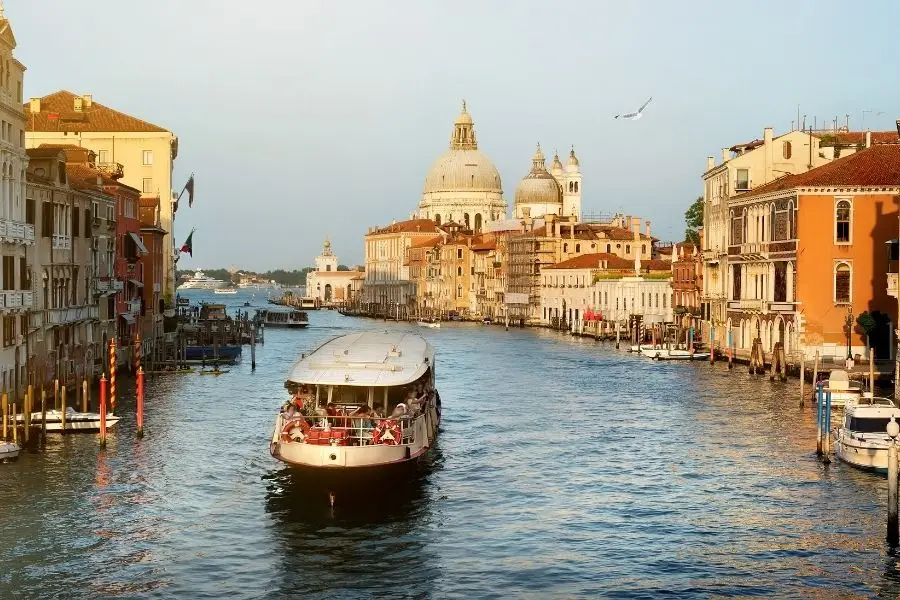
A few essentials: a single ride is about €9.50 and good for 75 minutes, but multi-day tourist travel cards (roughly €25/€35/€45 for 1/2/3 days) pay for themselves in about three rides. Always validate your ticket by tapping it at the machine on the dock every time you board — inspectors do check, and fines are steep. And let Google Maps do the work: it has live vaporetto routes built in, so it’ll tell you which line, which dock, and when.
Heading out to the lagoon islands? Our Murano & Burano day-trip guide maps the exact route.
Did You Know? Cars can only reach the very edge of Venice — Piazzale Roma and the Tronchetto parking island — where an elevated monorail called the People Mover shuttles between them and the cruise terminal in about three minutes. Beyond that point, the internal combustion engine simply stops; the city runs on oars, propellers, and feet.
Walking: Actually Your Fastest Option
Here’s the tip most first-timers learn too late: for anything within a 15–20 minute walk, walking beats the boat. The vaporetto follows the water, which rarely takes the direct line, and you’ll often spend more time waiting for a packed boat than you would just strolling there. Venice is compact — you can cross the entire main island on foot in about an hour — and getting a little lost in the back lanes is half the fun.
You will get turned around — everyone does — but you can’t get truly lost. Yellow signs painted on the walls point toward the major hubs (Per San Marco, Per Rialto, Per la Ferrovia for the train station), and you’re never far from water or a landmark. Google Maps works well on foot here too, though it occasionally sends you down a dead-end at a canal.

Did You Know? Venice’s addresses are gloriously baffling. Instead of numbering houses along each street, the city numbers them by sestiere (district) — so a single number can climb past 6,000 and has little to do with the street it’s on. Even locals navigate by landmarks and the name of the nearest campo (square) rather than by street address.
Traghetto and Water Taxi: The Other Options
Two more ways across the water are worth knowing:
- Traghetto — a no-frills public gondola that ferries you straight across the Grand Canal for about €2, at a handful of points far from a bridge. Locals stand for the short crossing; it’s the cheapest gondola ride in Venice and a genuine time-saver when the nearest bridge is a long walk away. (More in our gondola guide.)
- Water taxi — sleek private motorboats that go door-to-canal-door. Fast and glamorous, but expensive (fares start around €60–€70 within the city and climb fast). Save them for heavy luggage, groups, or a one-time splurge.

Luggage & Accessibility
Venice’s bridges are its charm and its challenge. There are roughly 400 of them, and most involve steps, which matters if you’re hauling bags or have mobility needs:
- Pack light. A backpack or soft duffel you can carry up and over bridges beats a big hard roller. If you must bring one, know you’ll be lifting it a lot.
- Luggage porters exist. Licensed porters (portabagagli) can haul bags to hard-to-reach hotels for a fee — worth it if your lodging is deep in the alleys.
- Step-free travel is possible but limited. Many vaporetto stops are wheelchair-accessible, and the city has some bridges fitted with ramps or lifts, but plenty are not. If accessibility matters, map your route to lodging near an accessible vaporetto stop and check ahead.

Getting Around Venice: What to Skip
A few honest “don’ts” to save time and money:
- Don’t over-rely on the vaporetto for short hops — you’ll wait longer than you’d walk.
- Don’t default to a water taxi unless bags or time force it; the cost adds up fast.
- Don’t treat the gondola as transport — it’s an experience, not a way to get from A to B.
- Don’t forget to validate your vaporetto ticket every time you board, even with a pass.
So, How Hard Is It to Get Around Venice?
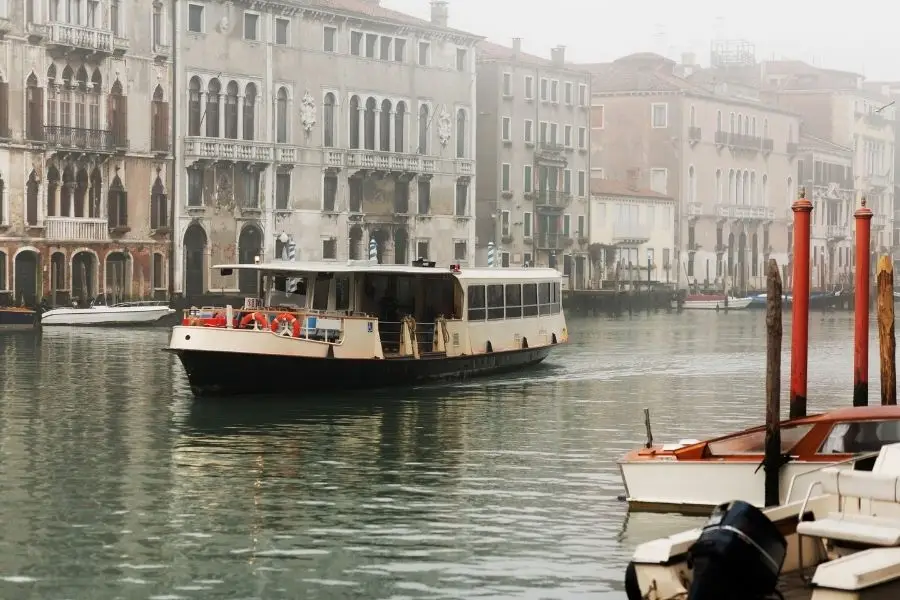
Easier than it looks. Walk for anything close, use a multi-day vaporetto pass for the longer hauls and the islands, keep Google Maps handy, validate every ride, and let yourself wander. Within a day you’ll stop checking the map every two minutes and start reading the city the way Venetians do — by water, by bridge, and by the next square. That shift is when Venice really opens up.

Getting Around Venice FAQ
How do you get around Venice?
On foot and by water. Walk for short distances, and use the vaporetto (water bus) for longer hops and the lagoon islands. There are no cars, buses, or bikes in Venice itself.
How much is a vaporetto ticket?
A single ride is about €9.50 and valid for 75 minutes. Multi-day tourist travel cards run roughly €25, €35, and €45 for 1, 2, and 3 days and pay for themselves in about three rides. Validate your ticket each time you board.
What is the best way to get from Venice airport to the city?
From Marco Polo, the Alilaguna water bus (~€15) is scenic and affordable, a private water taxi (~€120–€140) is fastest and most comfortable, and the bus to Piazzale Roma (~€10) is cheapest, with a vaporetto or short walk to finish.
Is it better to walk or take the vaporetto in Venice?
Walk for anything within about 15–20 minutes — it’s often faster than waiting for a boat. Use the vaporetto for longer distances, the Grand Canal, and the islands.
Are there cars or taxis in Venice?
Not in the historic center. Cars stop at Piazzale Roma and the Tronchetto parking island; within Venice you travel on foot or by water, and the “taxis” are private motorboats.
Is Venice wheelchair accessible?
Partly. Many vaporetto stops are accessible and some bridges have ramps or lifts, but the majority of Venice’s roughly 400 bridges have steps. Step-free travel is possible with planning — stay near an accessible stop and map routes ahead.
Nic’s Pick: The Slow Boat Down the Grand Canal
Everyone’s in a hurry for the fast boat, but my favorite ride was the slow one. We hopped Line 1, the local vaporetto that stops at every dock down the Grand Canal, grabbed a spot by the rail, and just watched Venice slide by — palaces, peeling shutters, laundry strung over the water. It costs the same as any other ride and doubles as the cheapest canal cruise in the city. Don’t rush past it.
Keep Exploring Venice
Ready to put it all together? Start here:
- Venice Travel Guide: What to See, Eat & Do — our full first-timer’s guide.
- 2 Days in Venice: A First-Timer’s Itinerary — the perfect 48-hour plan.
- Murano & Burano Day Trip — the islands by vaporetto.
- Is a Gondola Ride Worth It? — including the €2 traghetto hack.
What tripped you up most about getting around Venice? Share your own tips in the comments.
Wear the trip. Take Venice home with our new Venice tee — plus a Tuscan companion for the rest of your Italy dreams. Printed on demand in the USA, free shipping, and 25% off right now:


More from the shopBrowse the full travel collection — St. Augustine, Paris, Iceland, Venice and Tuscany on shirts, ceramic mugs and canvas totes, all original designs.

Ben & Nicole Mathews
We’re based in St. Augustine, Florida, sharing the places we’ve actually been — from our home turf to corners of the U.S. and abroad. Ben is an attorney and a retired Air Force JAG (22 years), and a private pilot, which is why aviation and military history shows up here too.