

Overpriced tourist trap or once-in-a-lifetime magic? Here’s the honest verdict on a gondola ride in Venice — the real cost, how it works, the history behind the black boats, and how to make it worth every euro.
A gondola ride is the most clichéd thing you can do in Venice. It’s also, if we’re being honest, one of the best. We were always going to do it — a gondola ride in Venice is one of those things you just do. What we actually wondered was whether we would get tourist-scammed on the price. We didn’t, and it turned out to be the single best hour of our trip. But there’s a right way and a wrong way to do it, and the difference is the difference between a magical memory and an expensive shuffle down a crowded canal behind six other boats.
Here’s exactly what a gondola ride costs, how the fixed pricing works, the tricks that make it special, and a little of the surprising history gliding along beneath you.
How Much Does a Gondola Ride in Venice Cost?
The good news: gondola prices are set by the city of Venice, so there’s no haggling and no getting ripped off. The official rates are:

- Daytime (9:00 a.m.–7:00 p.m.): about €80 for roughly 30 minutes
- Evening (after 7:00 p.m.): about €100 for roughly 30 minutes
- Extra time: usually around €40 per additional 15 minutes
Crucially, that price is per gondola, not per person — and a single gondola holds up to five or six passengers. Split between a group, it becomes far more reasonable than it first sounds. Two couples sharing a boat pay about €20–€25 a head for a private cruise through Venice; a family of five splits €80 five ways. (Rates tick up over time, so confirm the current price before you step in.)

A few things that are not included: a musician or singer. The romantic image of a gondolier serenading you is mostly a myth — most don’t sing, and the accordion-and-tenor serenade you sometimes see is a separate, pricier arrangement (often bundled into group tours). If music matters to you, arrange it ahead of time and expect to pay extra.
Did You Know? There are only around 400 licensed gondoliers in Venice, and the job is famously hard to get. Becoming one means an apprenticeship and passing exams in rowing, navigation, foreign languages, and Venetian history — and for centuries the licenses passed down within families, father to son. The first licensed female gondolier only earned her place in 2010.
Is a Gondola Ride Worth It?
Our honest answer: yes — if you do it right. A rushed daytime ride in the gondola-jammed water near St. Mark’s, dodging vaporetto wakes and a conga line of other boats, is underwhelming for €80. But a ride that slips into the silent back canals, where the only sound is the oar and the water lapping stone walls a foot from your elbow, is genuinely magical. The setting is everything.
If the budget is tight, it’s the one Venice splurge we’d still tell you to make. You can eat cheaply on cicchetti and skip the pricey piazza cafés — but the gondola is the memory you’ll actually keep. Think of it as buying a story, not a taxi ride.
Part of what made ours unforgettable was the gondolier himself. He was a second-generation Venetian — his father had rowed these canals before him — and after 35 years on the water, he told us he was retiring — 2025 was his final season, and in 2026 he would hand his license down to his son. As it happened, ours was the last ride of his night, so he gave us the grand tour: gliding through the quiet back canals at sunset and then out across the Grand Canal to the little mooring where he ties up his gondola after dark. You can’t buy a moment like that; you can only be lucky enough to show up for it.

How to Make Your Gondola Ride Amazing
- Go at sunset. The golden light on the water and the palazzi is unbeatable. Yes, it costs €20 more than a daytime ride. Pay it.
- Board away from St. Mark’s. The stands near San Marco and Rialto have the longest lines and the most crowded canals. Walk to a quieter neighborhood like Cannaregio or Dorsoduro for shorter waits and prettier, calmer routes.
- Ask for the quiet canals. Tell your gondolier you’d rather see the small side canals than the Grand Canal traffic. Most are happy to oblige, and that’s where the magic is.
- Bring cash. Many gondoliers still prefer euros handed over at the end. Some now carry card readers, but don’t count on it — ask before you board if it matters.
- Confirm the length and price first. A quick “30 minutes, €80?” before you step in avoids any confusion at the end.
- Talk to your gondolier. Many have been rowing for decades and love sharing stories about the boats, the canals, and their families. It turns a boat ride into an experience.

Tipping isn’t expected — the fare is fixed and gondoliers are well paid — but if yours gives you extra time or a great story, rounding up a few euros is a kind gesture.
The €2 Gondola Ride Almost Nobody Knows About
Here’s a local secret: you can ride a gondola across the Grand Canal for about €2. They’re called traghetti — working gondolas that ferry locals straight across the canal at a handful of crossing points where there’s no nearby bridge. You stand up (as Venetians traditionally do), the crossing takes a couple of minutes, and it’s the cheapest gondola experience in the city. It’s not a romantic cruise, but if you just want to say you rode a gondola without the €80 — or you’re genuinely trying to get across the canal — this is your move.


A Quick History of the Gondola
Gondolas have plied Venice’s canals for a thousand years. At their peak in the 1600s there were several thousand of them — the city’s taxis, delivery vans, and private cars rolled into one. Today only a few hundred remain, almost entirely for visitors, but each is still hand-built the traditional way in a handful of boatyards called squeri. You can watch boats being built and repaired at the picturesque Squero di San Trovaso in Dorsoduro.
Did You Know? A gondola isn’t symmetrical — it’s built with a slight banana-shaped curve, the left side longer than the right by about 24 centimeters. That deliberate lopsidedness offsets the weight of the single gondolier standing on one side, so the boat tracks straight instead of endlessly turning in circles. Each one is made from around 280 hand-cut pieces and eight different types of wood.
Look at the front of any gondola and you’ll see the ferro — the ornate metal prow. It’s not just decoration: its shape is a little map of Venice. The six forward-facing teeth represent the city’s six sestieri (districts), the single tooth facing backward stands for the island of Giudecca, the curved top echoes the Doge’s cap, and the sweeping S-curve mirrors the Grand Canal itself.

Did You Know? All gondolas are black by law. A 1562 sumptuary decree ordered them painted plain black to stop Venice’s noble families from competing over ever-flashier, gilded boats. The anti-showoff rule became the timeless look you photograph today.
So, Is a Venice Gondola Ride Worth the Money?
For us, without question — as long as you ride at sunset, board away from the crowds, and steer for the quiet canals. Do it that way and €80–€100 (split among your group) buys you the most Venetian half hour imaginable, gliding past thousand-year-old doorways with a craftsman at the oar. Do it wrong and it’s a pricey traffic jam. Choose wisely, and it’ll be the part of the trip you talk about for years. We still do.

Venice Gondola Ride FAQ
How much is a gondola ride in Venice?
Prices are set by the city: about €80 for 30 minutes during the day and €100 after 7 p.m., per gondola for up to five or six people, with roughly €40 per extra 15 minutes. Confirm the current rate before boarding.
Is a gondola ride in Venice worth it?
Yes, if you do it right — ride at sunset, board in a quieter neighborhood like Cannaregio or Dorsoduro, and ask for the small side canals. That’s the difference between magic and an expensive crowd.
Is the gondola price per person or per boat?
Per boat. One gondola holds up to five or six passengers for the same fixed price, so sharing with others brings the per-person cost down significantly.
Do gondoliers sing?
Usually not. The serenading-gondolier image is largely a myth; most simply row. A musician and singer can be arranged for an extra fee, often as part of a group tour, but it isn’t included in a standard ride.
Do you tip a gondolier?
Tipping isn’t expected because the fare is fixed by the city. If your gondolier gives you extra time or a memorable ride, rounding up a few euros is a nice gesture but entirely optional.
Is there a cheaper way to ride a gondola?
Yes — a traghetto ferries you across the Grand Canal in a working gondola for around €2. You stand for the short crossing, but it’s by far the cheapest way to ride a gondola in Venice.
What is the best time for a gondola ride?
Sunset. The golden light on the water and buildings is spectacular, and the canals are often calmer than during the midday rush. It costs a little more than a daytime ride and is worth it.
Nic’s Pick: The Gondolier Who Made Me Cry a Little
I’ll admit I worried a gondola ride might feel like a tourist trap — pretty, overpriced, and over in a blur. It turned out to be the opposite. Our gondolier won me over completely: learning that after 35 years this was his last season — that he was retiring and handing the boat down to his son, just as his own father had handed it to him — undid me a little. Something about that — the light, the water, a whole family history balanced on one black boat — got me right in the chest. It wasn’t a tourist trap at all. It was one of the most special hours of our trip.
Keep Exploring Venice
Ready to plan the rest of your trip? Start here:
- Venice Travel Guide: What to See, Eat & Do — our full first-timer’s guide.
- 2 Days in Venice: A First-Timer’s Itinerary — where the gondola fits into a perfect 48 hours.
- Getting Around Venice — vaporettos, traghetti, and what to skip.
- Cicchetti & Bàcari — how to eat cheaply so you can splurge on the gondola.
Did you splurge on a gondola ride — or skip it? Tell us in the comments whether it was worth it for you.
Wear the trip. Take Venice home with our new Venice tee — plus a Tuscan companion for the rest of your Italy dreams. Printed on demand in the USA, free shipping, and 25% off right now:
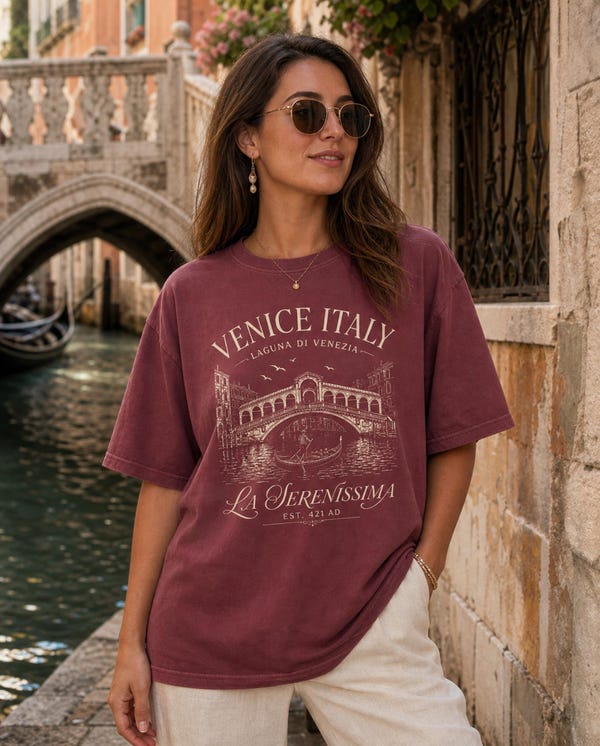

More from the shopBrowse the full travel collection — St. Augustine, Paris, Iceland, Venice and Tuscany on shirts, ceramic mugs and canvas totes, all original designs.

Ben & Nicole Mathews
We’re based in St. Augustine, Florida, sharing the places we’ve actually been — from our home turf to corners of the U.S. and abroad. Ben is an attorney and a retired Air Force JAG (22 years), and a private pilot, which is why aviation and military history shows up here too.