

There is a moment, somewhere between the first store on Laugavegur and the airport departure gate, where every Iceland traveler faces the same question: is it worth it? We are talking about the wool. The sweaters. The blankets. The mittens. The hats with earflaps. The lopapeysa with the yoke pattern in three colors that you try on, feel the weight of, check the price tag, and then stare at the ceiling for thirty seconds.
It is expensive. There is no getting around that. A quality lopapeysa sweater in Reykjavík will run you $100–$200 USD and up — sometimes quite a bit up if it is hand-knitted rather than machine-made. The wool blankets are similarly priced. You are not impulse-buying a souvenir pen here. But after spending time in Iceland wearing one, and then coming home to Florida and wearing it approximately once a year on the coldest nights of winter, I can tell you what we think: we’d do it again without hesitating. These things last. And the warmth is genuinely unlike anything we had felt before.

What Makes Icelandic Wool Different
Icelandic sheep are a breed apart — literally. Their genetic line has been isolated for over 1,100 years, untouched by crossbreeding, shaped entirely by centuries of exposure to subarctic conditions. What that isolation produced is a wool fiber found nowhere else in the world: a double-layered structure with long, glossy outer fibers that repel water and wind, and short, fine inner fibers that trap warmth the way nothing synthetic quite manages.
The yarn made from this wool — called lopi — has one more distinctive quality: it is not spun. Traditional lopi is simply combed and compressed, not twisted, which means it contains significantly more air than spun yarn. More air means more insulation. It also means the sweater weighs less than you expect for how warm it is, and it stays warm even when wet — a practical quality in a country where the weather changes every fifteen minutes.
Tog and Þel: The Two Coats That Do the Work
Icelandic sheep grow a true double fleece, which most modern commercial breeds have been bred out of. That single fact explains almost everything else about the wool.
- Þel (the inner coat) — short, fine, heavily crimped, purely insulating. Roughly 19–22 microns, with the finest fibres measured as low as 10. Close to merino in fineness, and curlier, so it traps more air.
- Tog (the outer coat) — long, glossy, wavy, almost no crimp. Roughly 27–30 microns, growing 6–8 inches in six months. This is the layer that sheds wind and water.
Historically the two were separated and used for different textiles entirely. Lopi does the opposite: it cards tog and þel together. That is precisely why a lopapeysa is both extraordinarily warm and slightly prickly — you are wearing the insulation and the raincoat in the same yarn.
Commonly repeated, and wrong: Almost every article online says Icelandic wool repels water “because it is high in lanolin.” The published figures say the reverse. Icelandic fleece loses about 20–29% of its weight in grease and dirt when scoured, against roughly 50% for modern fine-wool breeds. Icelandic wool is comparatively low-grease. The water resistance comes from tog’s structure and the fibre’s hydrophobic outer cuticle, not from an oil reservoir. Ístex washes the wool with minimal chemicals specifically to keep what little natural oil there is.
The reason it still insulates when damp is that wool absorbs up to about 35% of its own weight in moisture into the hydrophilic core of the fibre while the surface stays water-repelling, then releases it as vapour. Add the trapped air of a low-twist unspun yarn and the garment holds its loft and its shape while wet, instead of collapsing the way cotton does.
How it compares to merino
Honestly: merino wins on comfort, Icelandic wins on almost everything else. Merino runs about 15–24 microns throughout, which is why it works next to skin. Lopi averages well above that because of the tog fraction. What you get in exchange is more warmth per gram, real wind and water resistance, and a garment that will outlast you.
The prickle is not an allergy, incidentally. It is mechanical — coarse fibre ends deflect against the skin and trigger pressure receptors. Dermatology reviews are fairly clear that what people call a wool allergy is usually this. A lopapeysa is outerwear, and Ístex says so about its own chunkiest yarn, Álafosslopi, describing it as suited mainly to outdoor use.
The sheep behind it
The Icelandic sheep is a Northern European short-tailed breed that arrived with Norse settlers around AD 874 and has been genetically isolated since 1933, the last year foreign sheep were imported. That ban was not sentimentality: earlier imports brought disease, triggering outbreaks and mass culls. Scrapie has been present in Iceland for over 130 years, and the movement-restriction fences that still divide sheep districts date from the 1930s.
The flock is shrinking, and by more than the shops let on. The national count is now around 345,000–350,000, down roughly 100,000 in a decade from a 1978 peak of 891,000 — when there were four sheep for every Icelander. As of 2025 there are, for the first time in the country’s history, fewer sheep than people. Ístex’s own website still quotes 400,000–500,000.
Sheep are sheared twice a year. The autumn clip, taken in October and November after a summer running loose in the highlands, is the long clean fibre that becomes lopi. The spring clip is coarser and oilier and mostly ends up as filler and non-wovens. If you are in Iceland in September or early October you can watch the réttir — the communal round-ups that bring the sheep down off the highlands. It is the reason any of this exists.
The Lopapeysa: Iceland’s National Sweater
The sweater most visitors are drawn to is the lopapeysa — pronounced roughly “lopa-PAY-sa.” It is recognizable by its circular yoke pattern: a wide band of geometric design, usually in two or three colors, running around the neck and upper chest. No front or back — the pattern is the same all the way around. The body is knitted in the round on circular needles, meaning there are no seams. You could flip it any direction and it would look the same.
The pattern colors can be natural — undyed Icelandic wool comes in white, black, grey, and several shades of brown — or dyed in the brighter earth tones and blues you see in shop windows. The undyed ones feel particularly connected to the landscape. The dyed ones are beautiful too. You will want both. You can only afford one. This is Iceland.
Little-Known Tidbit
The lopapeysa is younger than most people assume. It did not emerge from centuries of Icelandic folk tradition — it was developed in the early to mid-20th century, largely as a response to the decline of older Icelandic handcraft traditions after independence from Denmark in 1944. The distinctive circular yoke design can actually be traced to a 1930 Norwegian knitting pattern called “Eskimo,” published in a women’s magazine and inspired by Greenlandic Inuit beaded costumes. That pattern spread, evolved, and eventually became the defining symbol of modern Icelandic national identity. What feels ancient was, in a sense, invented — and then embraced so completely that it became genuinely traditional within a generation.

The Lopapeysa Is Not a Viking Garment
This is the thing almost every guide gets wrong, and it is worth getting right, because the true story is better.
The yoked lopapeysa — the one with the patterned band around the shoulders — took its modern form in the 1950s. It is younger than the Icelandic republic by a few years, and it is not medieval, not Viking, not even pre-war. That is the position of Vísindavefurinn, the University of Iceland’s public science service, and of the academic work behind the Design Museum of Iceland’s exhibition on the garment.
Knitting itself is genuinely old in Iceland — it arrives in the 16th century, and the earliest documentary evidence is a bishop’s letter book from 1582–83 recording knitted socks accepted as church tax. Under the Danish trade monopoly, knitted socks and mittens were a major Icelandic export. But knitting is not the lopapeysa.
Even lopi knitting predates the sweater by about thirty years. Attempts to knit directly from unspun lopi date to around 1916–18, and the famous documented experiment was published by Elína Kr. Guðmundsdóttir in the women’s magazine Hlín in 1920. The sweater’s immediate ancestor is the duggarapeysa, the plain seaman’s sweater hand-knitted in quantity in the 1920s and 30s and sold through fishing-supply stores. There was even a false start in 1939, when a Norwegian-style ski sweater with a circular yoke was published as a pattern in Iceland — and did not catch on.
So where did the yoke come from?
No single person invented it, and the museums that researched this most carefully say so plainly. The best-supported single influence is Bohus Stickning, the Swedish knitting cooperative founded in 1939 as unemployment relief, which developed its distinctive yoke in the 1940s. Vísindavefurinn calls it “probably the main model.” A second, older thread runs through Greenlandic Inuit beadwork collars, which reached Nordic knitting via a Norwegian pattern published in 1930.
Commonly repeated, and wrong: You will read that Auður Sveinsdóttir Laxness invented the lopapeysa, often with a colourful sub-plot about Halldór bringing her a book of Inca patterns. Vísindavefurinn says the design claim is “likely not supported by convincing evidence.” She promoted the garment and influenced its look through her social circle, as did many skilled Icelandic knitters. Note that the 2015 research report underpinning all this was commissioned partly by Gljúfrasteinn — the Laxness house museum — and still concluded that no single knitter designed it.
What actually happened is more interesting than an inventor. The sweater was assembled collectively, from foreign models, at exactly the moment Iceland needed a national costume it could actually wear. It took off after sovereignty in 1944 and through the Cod Wars, and again around the millennium as nation-branding. Scholars file it under Hobsbawm’s “invention of tradition,” and mean it as a compliment.
The 2008 crash was a lopapeysa boom
Between September 2008 and January 2009, an estimated 10,000 sweaters sold in Icelandic wool shops, and there was a serious shortage of knitters. Politicians and financiers swapped suits for lopapeysur and jeans. During the Kitchen Utensil Uprising, knitting sessions ran alongside the pot-and-pan protests outside parliament — domestic tools held up deliberately against financial extravagance. If you want one moment that explains what this sweater means in Iceland, that is it.
Our Guide’s Sweater at the Ice Cave

At the Vatnajökull ice cave, our guide was wearing a lopapeysa his grandmother had knitted for him. Not a backup layer. Not a base layer. The sweater. Into the glacier, leading a tour, completely at home in it. He mentioned it in passing, the way you mention something that has always just been true — grandmothers in Iceland knit sweaters for their families the way some families pass down recipes or tools. The sweater was probably ten or fifteen years old, worn in at the collar, and he wore it like it was still brand new.
That is what Icelandic wool looks like in practice. It does not have the look of something fragile or precious. It has the look of something that has been doing its job without complaint for a very long time. The guide was warm. We were cold. He was also wearing crampons and leading people through glacial ice, and he had chosen his grandmother’s sweater for the occasion.
Why Icelanders Wear Them (And Why It Makes Sense)
Iceland does not have a cold-weather survival problem in the same way that, say, the Faroe Islands or Greenland does. Reykjavík winters are milder than New York City winters — the Gulf Stream keeps things damp and blustery rather than Arctic-cold. But the wind is relentless, the rain is horizontal, and the combination of wet and wind is the kind of cold that gets into you in a way that temperature alone does not explain. An Icelandic wool sweater handles that combination better than almost anything else.
The outer fibers are naturally water-resistant. The structure traps warmth even when damp. And because the fiber contains so much air, it breathes — so wearing one while hiking does not produce the clammy, overheating feeling you get from fleece or synthetic insulation. Icelanders wear them outdoors because they are practical. They wear them indoors because they are comfortable. They wear them into glacier ice caves because their grandmothers made them, and because they actually work.

Where to Shop for Icelandic Wool
The main shopping street in Reykjavík, Skólavörðustígur — the street that runs from the city center up to Hallgrímskirkja — is lined with wool shops. The Handknitting Association of Iceland (Handprjónasamband Íslands) has a flagship store near the top of the street and is one of the best places to find hand-knitted work from individual Icelandic knitters. The difference between hand-knitted and machine-made is real and visible up close, and the price difference is significant. Both are genuine Icelandic wool. Only one was made by someone’s hands.
Álafoss — the oldest wool mill in Iceland, operating since 1896 — has a flagship store in Mosfellsbær, about 20 minutes from Reykjavík, and is worth the detour if you want a wide selection of both finished products and yarn. They are also available in downtown Reykjavík. If you want blankets, scarves, or raw materials in addition to sweaters, Álafoss is the reference point most locals and dedicated wool buyers use.
Our advice: try things on. The weight of a real lopapeysa is different from what you expect — heavier than a modern fleece but not bulky, and the fit is relaxed by design. Icelanders wear them loose. They are meant to have room for layering underneath. If you are used to fitted sweaters, size up by one.
Pro Tip: Head Outside the City for Better Prices
Here’s something most travel guides won’t tell you: wool shops outside of Reykjavík tend to offer noticeably better prices than the tourist-heavy shops in the city center. The South Coast and Golden Circle route are dotted with smaller wool shops and factory outlets where the overhead is lower and the selection is often more local. Travelers consistently report finding the same quality sweaters for less — sometimes meaningfully less — than what they saw in downtown Reykjavík boutiques.
Víkurprjón (Vík Wool Factory) in the village of Vík í Mýrdal — a common stop on South Coast itineraries — is one of the best examples. It’s a working factory and shop where the sweaters are made and sold directly, with far less markup than you’d encounter in the capital. Similarly, shops near the Geysir and Golden Circle area cater to travelers but don’t carry the premium pricing of Laugavegur and Skólavörðustígur in Reykjavík.


The general rule: the farther you are from Reykjavík’s tourist core, the better the prices tend to be — without sacrificing quality. If your itinerary takes you down the Ring Road or through the Golden Circle, plan a wool stop into your day. You’ll come away with the same product for less, and you’ll have a better story about where you got it.
Is Icelandic Wool Itchy?
Yes, a bit — and now you know exactly why. The tog fraction sits at 27–30 microns, well above the point at which most people start to feel wool against skin. Lopi blends tog and þel together, so the warmth and the prickle arrive in the same yarn.
Three things make it a non-issue in practice:
- Wear a base layer. This is what Icelanders do. A lopapeysa is a mid-layer or an outer layer, not a shirt.
- It softens. The fibre relaxes considerably over the first few wears and washes.
- &Thorn;el-heavy yarns exist. If you are genuinely sensitive, look for finer lopi lines or a merino-blend Icelandic knit rather than chunky Álafosslopi.
And it is worth repeating that the prickle is mechanical, not allergic. Coarse fibre ends deflect against skin and fire pressure receptors. True wool allergy is rare; what almost everyone has is a comfort threshold.
How to Wear a Lopapeysa
Traditional Icelandic sweaters are cut loose — about 2 to 4 inches (5–10 cm) of positive ease through the chest. That is deliberate: the air gap is part of the insulation, and you need room for a layer underneath. If it fits like a t-shirt, it is too small.
- Base layer first. Merino or synthetic, long-sleeved. Then the lopapeysa. Then a shell if it is actually raining.
- Pullover or cardigan? A cardigan or zip is far more versatile in a country where you move between 2 °C outside and 24 °C indoors all day. A pullover is warmer and more traditional.
- Sizing is gendered, not unisex. Shops carry separate men’s and women’s ranges in standard sizes with no alterations. The Handknitting Association runs XS to XXXL, chest 85 cm to 120 cm.
- Measure a sweater you already own. Lay it flat: chest just below the armpits, length collarbone to waist, sleeve armpit to wrist bone. Then match those numbers, adding the ease.
- It is outerwear. In Reykjavík in winter people wear one instead of a coat, not under one.
Icelandic Wool Blankets
The blankets deserve more attention than they get, partly because they are the one Icelandic wool purchase that no one has to fit.
Ístex weaves wool blankets and cushion covers in Icelandic wool at 130×200, 140×210 and 110×170 cm, with cushions at 35×50 and 50×50. Many of the designs are by Védís Jónsdóttir, others by Pétur Behrens and Guðrún Gunnarsdóttir. Ístex also sells wool duvets under the Lopidraumur name.
Álafoss blankets are a genuine heritage product rather than a tourist invention. The 1896 factory made blankets and carpets from the start and had a state-of-the-art wool-washing station; Álafoss blankets were household staples across Iceland for generations. Current pricing runs around €180–€200.
Worth knowing: A blanket is the purchase we would make again. It packs flat, it does not need to fit anyone, it is not subject to the hand-knitted-in-China question in the same way — woven blankets are mill products and openly so — and it will outlive the sweater.
Where to buy, specifically
- Handprjónasamband Íslands (the Handknitting Association) — Skólavörðustígur 19, Reykjavík, plus Borgartún 31. Founded in November 1977 by a group of women to help knitters market their own work. Holder of the protected designation. Every garment carries the maker’s membership number. This is the safe answer.
- Álafoss — Álafossvegur 23 in Mosfellsbær, 15 minutes out of Reykjavík on the Þingvellir road, in the original 1896 factory building with the old knitting machinery and photographs still on the walls. Second shop on Laugavegur. Worth the drive for the building alone.
- Kolaportið flea market — Tryggvagata 19, weekends 11:00–17:00, free entry. Wool garments among 50-odd vendors. No protected-name guarantee, so inspect and ask.
- Þingborg wool workshop — 8 km east of Selfoss in a 1927 schoolhouse, run by locals since 1991. Knitwear, sheepskins, blankets, and naturally coloured yarn.
- Uppspuni Mini Mill — Lækjartún farm, about 20 minutes from Selfoss. A working mini mill founded in 2017, open to visitors, where you can buy yarn at the source.
- Secondhand — Spúútnik and Gyllti Kötturinn in Reykjavík. A well-made lopapeysa outlives its first owner, and a broken-in one is softer.
Worth knowing: Ístex processes about 99% of all Icelandic wool — roughly 1,000 tonnes sheared a year, 750 usable after washing, of which around 400 tonnes becomes premium knitting yarn. It is farmer-owned: about 2,000 farmers hold the majority and are progressively buying out the rest. It exists because Álafoss, which had traded heavily with the Soviet Union, lost roughly half its revenue when the USSR dissolved and went bankrupt in 1991. Ístex was created to keep the farmers’ clip moving. It now runs public factory tours in Mosfellsbær.
What to Buy Beyond the Sweater
The sweater gets all the attention, but the blankets and throws are equally worth considering — and in some ways more practical as a gift or a keep-for-yourself purchase if you live somewhere warm. Icelandic wool blankets are thick, heavy, and carry the same thermal properties as the sweaters. They are not the softest blankets you will ever touch — lopi is a coarser fiber than merino — but they are among the warmest, and they look the part: natural colors, traditional patterns, the kind of thing that looks good on a couch and actually does something on cold nights.
Mittens and hats are the accessible entry point for people who find the sweater price daunting. A good pair of hand-knitted Icelandic wool mittens will run $30–$60 and will outlast any synthetic gloves you own. The ear-flap hats — with the same yoke-style patterns scaled down to hat size — are similarly well-made and eminently practical. We bought both and use them every winter.

How to Wash an Icelandic Wool Sweater
The short version: rarely, by hand, at about 30 °C, and never on a hanger. The longer version below follows Ístex’s own published instructions — they are the mill that spins the yarn, so they are the source worth trusting.
First: probably don’t
Wool is naturally odour-resistant and sheds dirt on its own. Air the sweater outdoors and only wash it when airing fails. Every wash strips a little more of the natural oil out of the fibre. Icelandic knitters wash these things once or twice a season, not once a fortnight.
Hand washing, step by step
- Fill a basin with lukewarm water, about 30 °C. Not hot. Sudden temperature changes and agitation are what felt wool.
- Add wool soap — Ístex specifies about 25 ml (two capfuls) per 5 litres for hand washing.
- Soak for about 10 minutes. Let the water do the work.
- Wash gently. Do not rub, scrub or wring. Squeeze if you must.
- Rinse thoroughly in water at the same temperature.
- Follow with wool conditioner (ullarnæring) dissolved in 30 °C water — about 12 ml per 5 litres. This does not need rinsing out. Ístex sells a conditioner precisely because washing removes the fibre’s remaining oils; this is the closest thing to an official re-lanolising step. A little hair conditioner in the final rinse is the common substitute.
- Press the water out in a towel, or spin for one to three minutes. Do not wring.
- Reshape while damp and dry flat. Stretch it back to length and re-set the ribbing, which contracts in the wash.
Worth knowing: Never hang a wet lopapeysa. The weight of the retained water will stretch the garment out of shape permanently, and unspun lopi has very little twist holding it together. Flat, on a towel, every time.
If you must use a machine
Ístex does publish machine quantities — about 75 ml of wool soap and 25 ml of conditioner for a 4–5 kg load — so it is not forbidden. Use the wool or hand-wash cycle at a maximum of 30 °C. That said, some Icelandic makers say flatly that they never machine wash the sweaters they make. Hand washing is the safe answer.
Pilling
Unspun lopi will pill, particularly under the arms and anywhere a bag strap rubs. This is normal wear on a lofty, low-twist yarn, not a defect — and Plötulopi garments in particular wear faster at friction points. A sweater comb or a gentle shaver will lift them; do it sparingly.
Storage and moths
- Fold, never hang. Same reason as drying — the fabric’s own weight stretches it.
- Cedar, not mothballs. The wood’s oils repel insects while letting the wool breathe.
- Do not use airtight containers or plastic bags. This is the counter-intuitive one. Sealed plastic traps moisture and produces mildew and odour. Use cotton or linen bags, cotton bins, or a cedar chest.
- Cool, dry, ventilated. Not the basement. A closet or attic away from direct sun, heat and damp.
How to Care for Icelandic Wool
This is the part most people do not know going in. Icelandic lopi wool does not want to be washed the way most people wash things. Machine washing will felt it — the fibers will lock together, the sweater will shrink, and you will have a small, dense object that used to be your beautiful lopapeysa. Do not machine wash. Do not put it in the dryer. Do not dry clean. Dry cleaning solvents can break down the natural lanolin in the fiber, which is part of what makes it water-resistant.
The right approach: air it out. Wool has natural antimicrobial properties — the same lanolin that repels water also resists odor and bacteria. After wearing your lopapeysa, hang it outside or in a well-ventilated space rather than throwing it in a laundry pile. If it picks up debris from a hike or a glacier tour, brush it off gently with a soft clothes brush. A lint brush or a natural-bristle garment brush works well.
When it genuinely needs washing — after a long trip, or once or twice a season — hand wash in cold water with a gentle wool detergent. Press out excess water (do not wring), lay flat to dry on a clean towel away from direct sunlight and heat. Reshape it while damp. That is it. A well-maintained Icelandic wool sweater can last decades, which is exactly what makes the price make more sense.
Quick Wool Care Reference
- Everyday care: Hang or air out after wearing. Brush off surface debris with a garment brush.
- Washing when needed: Cold hand wash only. Gentle wool detergent.
- Drying: Press out water, lay flat to dry. Never hang while wet — the weight will stretch the shape.
- Never: Machine wash, tumble dry, dry clean, or wring.
- Storage: Fold, don’t hang. A folded sweater holds its shape; a hung sweater stretches at the shoulders over time. Cedar or lavender sachets will deter moths.
Why Icelandic Sweaters Are So Expensive
Because someone knitted it by hand, in a country with one of the highest minimum wages in the world. That is the whole answer, and the arithmetic is easy to do.
A hand-knitted lopapeysa takes 14 to 25 hours depending on the pattern and the number of colours; the chair of the Handknitting Association puts an average size at about 24 hours. Iceland’s minimum wage is around $14.50 an hour. So before wool, before the shop’s margin, before VAT, you are looking at roughly $200–$360 of labour in the garment. Icelandic knitters have publicly complained that they are in fact paid below minimum wage for the work.
What it actually costs, as of 2026
- Handknitting Association of Iceland (the benchmark, because their sweaters are definitionally the real thing): women’s pullovers $359–$399, zip cardigans around $397, button cardigans $420–$435, and elaborate anniversary patterns up to $603.
- Álafoss: a “handknitted” collection at €209–€220, alongside a sweater explicitly labelled designed and hand knitted in Iceland at €510. That two-and-a-half-fold gap inside one retailer is the clearest signal a shopper gets.
- Tourist-shop pricing: pullovers around $210–$260. This is the band where the country of manufacture usually is not stated.
Our reconciliation from live shop prices: a genuine, hand-knitted-in-Iceland adult lopapeysa in 2026 runs roughly ISK 43,000–53,000 (about $360–$435) for a standard design, more for a complicated one. If you are being offered one for half that, the question is not whether you are getting a bargain. It is where it was knitted.
How to Spot a Real One: The Protected Name
Here is the single most useful thing in this article, and hardly anybody mentions it.
“Íslensk lopapeysa” is a legally protected product name. Iceland’s Food and Veterinary Authority registered it as a protected designation in 2020 — only the second such registration in the country, after Icelandic lamb. The application was made by the Handknitting Association, on the back of peer-reviewed research.
To carry the name, a sweater must meet seven criteria:
- Wool from Icelandic sheep only
- New wool, not recycled
- Knitted in Icelandic lopi
- A patterned yoke worked in the round, shoulder to neckline
- Hand-knitted in Iceland
- Knitted in one piece, seamless
- Either a pullover or an open cardigan
Worth knowing: Look for the exact phrase “Íslensk lopapeysa” or “Icelandic Lopapeysa” and its certification mark. “100% Icelandic wool” is a materials claim and tells you nothing about where the sweater was knitted. Those are two completely different statements, and the gap between them is where the whole problem lives.
The problem the label exists to solve
Roughly two-thirds of the lopapeysa market in Iceland — particularly the tourist trade — is knitted in China. Icelandic wool is shipped out, knitted, and shipped back. One Reykjavík retailer alone produces about 20,000 sweaters a year in China for its Icelandic shops; its owner filed the sole objection to the protected-name application, arguing that domestic production would need 200 to 250 full-time knitters. At the time the price gap was about $170 imported against $200 locally made, with Chinese knitters earning $3–5 an hour against Iceland’s $14.50 minimum.
The founder of the Handknitting Association put it plainly: “People buy the imported sweaters as the real thing. But it is not.” And this is not new — Icelandic press was covering the same controversy in 2012.
To be fair about it: hand-knitted in China is still hand-knitted. What is missing from the label is the location, not the method. But you are almost certainly paying an Icelandic price for it.
Two physical checks that actually work
- Ask for the knitter’s name. Every Handknitting Association garment carries the maker’s membership number and is quality-checked on delivery; you can ask who knitted yours. Álafoss marks its hand-knitted sweaters with the knitter’s name too. A named knitter is the strongest single authenticity signal available to a shopper.
- On a cardigan, look under the button or zip band. A traditional Icelandic cardigan is knitted in the round as a closed tube, machine-stitched with two straight seams, then cut open between them — a technique called steeking. So a genuine one has a cut-and-machine-sewn front edge hidden under the band. It is a real, checkable detail.
Is the Price Worth It?
We live in Florida. We wear our Icelandic wool maybe three or four times a year. We wear it on the days in January when it actually gets cold, and on the evenings when the temperature drops unexpectedly and nothing else quite fits the moment. Is a $150 sweater worth it when you can only wear it a handful of times a year? We think yes — because every time you pull it out, it is exactly right, and because it will still be exactly right in twenty years. Things made well, from materials that were bred and evolved for a specific purpose over eleven centuries, tend to hold up. That is not marketing. That is just wool.
The Iceland trip overall was expensive. The wool was one of the few purchases where we have never felt a moment’s buyer’s remorse. We’d budget for it again before we booked flights.
Nic’s Pick
“I run cold in general, so I was paying attention to the wool blankets more than the sweaters from the start. What I ended up with was a medium-weight Icelandic wool throw in a natural grey-brown palette — not a statement piece, just a genuinely useful blanket. I use it at night when the air conditioning is aggressive, which in Florida is basically always. It is heavy enough to feel substantial without being too hot, and it does not pill or shed the way fleece does. The one thing I wish I had known: do not sleep in it if you run any chance of sweating. Wool is warm when damp but it feels different than dry wool. For static reading-on-the-couch warmth, it is perfect. If you can only get one thing from the wool shops, a blanket or throw is the best everyday-use option for people who live somewhere that only gets cold a few times a year.”
FROM THE SHOP
We made the SunSpun Creations Etsy shop to hold on to some of these Iceland stories in print form. If the trip is on your list — or already behind you — these Iceland travel designs are the ones we keep coming back to.

Nordic coastal wall art — vintage-inspired design with GPS coordinates. Part of the Iceland travel poster series.
From $19.99
Shop on Etsy →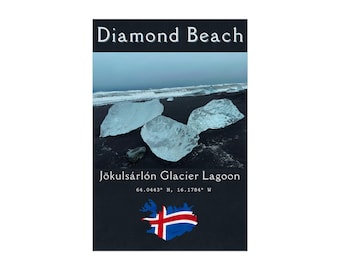
Glacial ice on volcanic black sand — a travel poster-style print of one of Iceland’s most iconic views.
From $19.99
Shop on Etsy →
Travel tee for Iceland waterfall veterans. Vintage-graphic design, comfortable unisex fit.
From $28.00
Shop on Etsy →
Frequently Asked Questions About Icelandic Wool
Is Icelandic wool itchy?
It depends on the product. Lopi wool is coarser than merino and some people find it scratchy directly on bare skin — particularly at the collar and wrists. Most people wear a thin layer underneath without issue. Blankets and heavier throws are less of a concern since they are not worn against skin. If you are sensitive to fiber texture, buy from a shop that lets you feel the product before purchasing, and ask specifically about the softness of the particular yarn used.
How do I tell if a lopapeysa is hand-knitted vs. machine-made?
Hand-knitted sweaters will typically have minor variations in the stitching that are visible up close — slight irregularities in the yoke pattern, a texture that feels slightly uneven in the most satisfying way. Machine-made sweaters have a more uniform appearance. Both use genuine Icelandic wool; the difference is labor. Hand-knitted sweaters are more expensive and carry a card identifying the individual knitter. Look for that card in shops certified by the Handknitting Association of Iceland.
Can I bring Icelandic wool on a plane?
Yes. Wool clothing and blankets have no import restrictions for personal use. Just make sure you account for the weight — a full lopapeysa and a wool blanket together can add 2–3 pounds to your bag, which matters if you are traveling with carry-on only. We shipped ours home rather than wrestle with luggage weight.
Are cheaper wool products in Iceland actually Icelandic wool?
Not necessarily. There are products in tourist gift shops that are wool but not from Icelandic sheep, or that are blended with synthetic fibers. Look for products certified by Ístex (the Icelandic textile company that produces authentic Lopi yarn) or the Handknitting Association of Iceland. The price will tell you something too — genuine Icelandic wool in finished product form is not cheap anywhere in the country.
What about the VAT refund — does it apply to wool purchases?
Yes, and it is worth doing if your purchases are substantial. Iceland’s VAT is 24%, and visitors permanently resident outside Iceland can claim it back on a single receipt of ISK 12,000 or more — note that figure, because the old ISK 6,000 threshold is still repeated all over the internet and is out of date. Items on the same receipt can be combined. The goods must leave Iceland within three months, and every tax-free form has to be export-validated before you check in. Refunds under ISK 100,000 are stamped by the refund operator; above that you need a customs stamp. At Keflavík the desk is in the arrival hall opposite the car rentals. Most wool shops participate. Ask at the register — they will fill out the paperwork. Get to the airport early and visit the VAT desk before checking your bags. The refund comes back to your credit card in a few weeks. Use the same card for all your wool purchases to make the process easier. We have a full rundown of the Iceland VAT refund process in our cost guide.
Buying online for export is cheaper than the VAT refund
This surprised us. The Handknitting Association lists two prices on the same product: $385.39 retail, $310.80 for export orders. The ratio is exactly 1.24 — they simply remove VAT at source. No form, no queue, no operator commission.
The in-person route means paying 24% and then reclaiming it through a refund company that takes a cut, having hit the minimum and got stamped before check-in. So ordering for export is cheaper on the sticker, though not necessarily once you add international shipping and whatever your own country charges on import. Buying in person is still the only way to check the label and the fit.
Commonly repeated, and wrong: You will be told you must not wear your sweater before clearing customs or the refund is void. We checked Skatturinn (the tax authority), Ísland.is and Visit Reykjavík. None of them says the goods must be unused, unworn or sealed. What they require is that the goods be presentable for inspection on departure. Keep it accessible and looking new, because an official may ask to see it — but the “never wear it” rule appears to be travel folklore, not Icelandic law.
The Bottom Line
Icelandic wool is the one category of Iceland souvenir where the price and the product are actually in alignment. You are not paying $150 for a sweater because Iceland is expensive and tourists are a captive market. You are paying $150 for a sweater that will last thirty years, keep you warm in weather no synthetic can match, and came from an animal that has spent eleven centuries in the North Atlantic evolving to produce exactly this kind of fiber. That is a reasonable price for a piece of actual craft.
We live in Florida. We wear ours a handful of times a year. We do not regret it for a single moment.
KEEP READING: MORE ICELAND
ICELANDReykjavík Travel GuideWhat to do, where to eat, and how many days you actually need in Reykjavík. ICELANDIceland Travel Costs: What We Actually SpentThe full budget breakdown — including the wool purchases and the VAT refund we almost missed. ICELANDIceland Glacier Ice CaveOur guide wore his grandmother’s lopapeysa into the glacier. Here’s everything else you need to know.
What We’d Do Differently
We’d buy the blanket on day two instead of day nine. We spent the first week walking past the wool shops in Reykjavík telling ourselves we’d think about it, and then on the last day before we left the city we finally went in and bought the blanket Nicole had been thinking about since Skólavörðustígur. The sweater we bought the same day. We should have done both sooner so we could have enjoyed them for the rest of the trip — worn the sweater on the Ring Road, used the blanket in the Airbnb. Instead, they went straight into luggage. Learn from our mistake: buy the wool in Reykjavík, and then use it in Iceland.
More Iceland from BenThere Travel
Planning your Iceland trip? These posts cover the rest of the Ring Road and the highlights we remember most:
- Iceland Ring Road: A 10-Day Adventure Guide From a Couple Who Actually Drove It
- Reykjavík Travel Guide: What to Do, Where to Eat, and How Many Days You Actually Need
- Iceland Travel Costs: What We Actually Spent — Including the VAT Refund
- Iceland Glacier Ice Cave: What It’s Actually Like to Stand Inside a 10,000-Year-Old Glacier
- Northern Lights in Iceland: What We Learned From Searching Every Night
- Browse all our Iceland travel guides

Ben & Nicole Mathews
We’re based in St. Augustine, Florida, sharing the places we’ve actually been — from our home turf to corners of the U.S. and abroad. Ben is an attorney and a retired Air Force JAG (22 years), and a private pilot, which is why aviation and military history shows up here too.