

There is a specific kind of courage that only makes sense when you understand the math. During Operation Rolling Thunder — the Air Force’s sustained bombing campaign against North Vietnam that ran from March 1965 through October 1968 — the brass set a rotation standard of 100 combat missions over North Vietnam. Complete 100, and you rotated home. Simple.
The problem was the math. In the early months of Rolling Thunder, the odds of surviving to mission 100 in an F-105 Thunderchief — the primary strike aircraft — were somewhere around one in four. Statistically, if you flew the Thud into Route Package Six, the most heavily defended airspace since World War II, the campaign would end you before you ended it. The pilots knew this. They flew anyway. Every single day.
This is the story of that campaign — the airplane that carried it, the men who flew it, and one very specific fighter pilot with a spectacular mustache who decided to fight back by turning the entire doctrine upside down.

What Operation Rolling Thunder Actually Was
Rolling Thunder was not a single battle. It was a three-and-a-half-year air campaign — the longest sustained American air offensive since World War II — designed to pressure North Vietnam into negotiating while simultaneously limiting the flow of troops and supplies to the Viet Cong in the south. President Johnson authorized it in February 1965 and it launched on March 2 of that year. It ended, quietly and inconclusively, on November 1, 1968, when Johnson halted it as part of peace negotiations.
In those three and a half years, American aircraft flew over 300,000 sorties over North Vietnam, dropped approximately 864,000 tons of bombs, and lost over 900 aircraft. More than 700 American airmen were captured, and hundreds more were killed or missing. The bombing did not stop the North Vietnamese war effort in any meaningful way. What it did do was kill a lot of young Americans in the skies over one of the most effectively defended countries in the history of aerial warfare.
The campaign was built around a targeting list that was approved in Washington, D.C. — not by the commanders on the ground or in the air. The White House controlled which bridges, rail yards, and supply depots could be struck on which days. Field commanders found out what they could hit by reading classified message traffic. Strike packages were planned around political considerations as much as military ones. Every professional aviator who flew the campaign knew this. It was, by nearly universal consensus of the men who flew it, an insane way to fight a war.

The Bases: Where the Thuds Launched From
The bulk of the Rolling Thunder strike missions launched from two Royal Thai Air Force Bases in Thailand. Korat RTAFB and Takhli RTAFB became the front-line homes of the F-105 wings for the duration of the campaign. Thailand offered a geographic advantage — it put the Thuds within strike range of the North Vietnamese target complexes without basing them in South Vietnam itself, where base security and political complications were a constant problem.
Korat was home to the 388th Tactical Fighter Wing. Takhli housed the 355th Tactical Fighter Wing. Between them, these two wings flew the overwhelming majority of the F-105 strikes into North Vietnam’s most defended zones. Pilots drove between the bases, socialized at the same Officers’ Club circuit, and kept a running, grim tally of who had gone down and who hadn’t. The 100-mission number was posted on bulletin boards. Everyone knew where everyone else stood.
Ubon RTAFB, also in Thailand, was the home of the 8th Tactical Fighter Wing — the Wolfpack — which flew F-4 Phantoms. When Robin Olds took command there in 1966, Ubon became the staging ground for one of the most audacious operations of the entire air war. More on that in a moment.
Da Nang Air Base in South Vietnam also contributed to Rolling Thunder operations, along with Bien Hoa and other in-country bases. But for the deep strikes into North Vietnam — the Route Package Six missions targeting the Hanoi-Haiphong corridor — the Thailand bases were the launch point. The pilots called the route to the target “Thud Ridge,” named after the karst limestone ridge northwest of Hanoi that the Thuds used as a navigation reference and partial cover from radar on the way in.
The F-105 Thunderchief: The Thud That Carried the War
The Republic F-105 Thunderchief was not built to be the primary strike aircraft of the Vietnam War. It was designed in the early 1950s as a supersonic nuclear delivery vehicle — a jet that could sprint to a Soviet target at low altitude and high speed, drop a nuclear bomb, and get out before the shock wave caught it. The fuselage was essentially built around an internal bomb bay designed to carry a nuclear weapon. The whole airplane was optimized for a single, specific mission that it was never actually called on to perform.
What it got instead was Vietnam. And for that, it was redesigned on the fly, literally and figuratively. The internal weapons bay was configured for conventional bombs. External hardpoints were added. The Thud flew the bomb runs that Rolling Thunder required — which meant it was carrying enormous loads of conventional ordnance into a threat environment it was never designed to survive.

The numbers that came out of Rolling Thunder are stunning even by the standards of a campaign everyone agrees was poorly managed. Of the 833 F-105 Thunderchiefs ever built, approximately 382 were lost in combat or in combat-related accidents during the Vietnam War. That’s nearly half the entire production run — destroyed in the skies over a country roughly the size of New Mexico. By any historical standard, this is an extraordinary attrition rate for a frontline aircraft. It says something about both the ferocity of the North Vietnamese air defense system and the demand placed on the Thud by the targeting requirements handed down from Washington.
The airplane itself was genuinely impressive. At Mach 2.08, the F-105 was faster than almost anything else in the air. Its Pratt & Whitney J75 engine produced over 26,000 pounds of thrust with afterburner. It could carry 14,000 pounds of ordnance — more than a fully loaded B-17 Flying Fortress in World War II — and deliver it with precision by the standards of the era. On a good day, flying a low-level ingress route and pulling off the target at 600 knots, it was almost impossible to kill.
The problem was the days weren’t always good. And the North Vietnamese made sure of that.
One thing that surprises people: the Thud wasn’t entirely defenseless in air-to-air combat. For a bomber that everyone said couldn’t fight, F-105s were credited with 27.5 confirmed aerial kills over North Vietnam — mostly MiG-17s caught at low altitude where the Thud’s speed advantage mattered. Leo Thorsness shot down a MiG-17 on the same day he earned his Medal of Honor. The Thud was a blunt instrument built for the ground, but when cornered, it bit back.
The SA-2 Problem: Why Rolling Thunder Was So Deadly
The Soviet Union supplied North Vietnam with the SA-2 Guideline surface-to-air missile system — one of the most capable air defense weapons in the world at the time. The SA-2 had a lethal radius of roughly 65 meters and was guided by a Fan Song radar that the North Vietnamese became extremely proficient at using. They also deployed it cleverly: positioning batteries near known ingress routes, relocating launchers frequently to avoid becoming patterns, and using radar discipline to reduce the amount of warning the incoming strike packages received.
Add to that one of the densest concentrations of anti-aircraft artillery ever assembled outside of major WWII battles — the North Vietnamese eventually deployed over 8,000 anti-aircraft guns around the Hanoi-Haiphong corridor — and the environment into which the Thuds flew every day starts to become comprehensible in a dark way. The strike packages flew through a wall of metal. The SAMs came from below. The AAA filled the altitude bands the SAMs couldn’t cover. And then the MiG-21s showed up at the egress to pick off anyone who’d used up their maneuvering energy evading everything else.
The Wild Weasels — modified F-105Fs and eventually two-seat F-105Gs equipped to detect and attack radar emissions — were developed specifically to deal with the SA-2 threat. The Wild Weasel crews would fly ahead of the strike package, locate active SAM radars by homing on their emissions, and either suppress them with AGM-45 Shrike anti-radiation missiles or force them to shut down. Flying directly at an active SAM site radar to provoke it was, to put it charitably, a job that required a very specific personality. The Wild Weasel crews had a motto: YGBSM — which stands for “You’ve Gotta Be Shitting Me.” That was reportedly the exact reaction of the first Electronic Warfare Officer when someone explained what his new job description actually was.
The 100-Mission Number: What It Took to Get There
The Air Force set 100 combat missions over North Vietnam as the rotation standard for Rolling Thunder. This was not an arbitrary number — it was based on statistical modeling, historical precedent from Korea, and a judgment that enough time in the cockpit over North Vietnam would either kill a pilot or make him so experienced that rotating him home was the only way to preserve the institutional knowledge. Complete 100, get your patch, go home.
Not everyone counted the same missions. A mission deep into Route Package Six — the most defended area around Hanoi and Haiphong — counted. Milk runs to easier targets didn’t always count. Pilots were aware of this distinction in a very immediate way: the missions that counted were the ones most likely to kill you. A pilot could accumulate numbers on the counter without accumulating the ones that came with the worst odds. Or he could fly Thud Ridge every time they needed someone in the seat, and watch his counter climb alongside his odds of not making 100.
The completion rate in the early years was grim. Estimates vary — the records are not perfectly clean — but in the first year of Rolling Thunder operations, somewhere between 50 and 75 percent of F-105 crews did not complete their 100-mission tour without being shot down, killed, or captured. For the pilots flying Korat and Takhli in 1965 and 1966, the math was written on the wall of the Officers’ Club whether anyone said it out loud or not.

Shot Down and Still Counting: The Men Who Got There the Hard Way
One of the more remarkable facts about the 100-mission tour is how many men reached it — or came close — despite being shot down, ejected, and rescued at least once along the way. The Air Force’s Combat Search and Rescue capability, centered on the HH-3 Jolly Green Giant and later the HH-53 Super Jolly, was extraordinary. Crews who punched out over North Vietnam had a realistic chance of rescue if the search and rescue operation could be launched quickly and if the survivor could evade long enough.
Some pilots were rescued and went back to finish their tour. Some were rescued more than once. The culture of the bases accommodated this in a matter-of-fact way that the civilian world might find hard to understand: you got rescued, you took a couple of days, you went back to flying. Because the alternative was leaving a slot empty, and someone else would have to fly it.
Leo Thorsness is one of the most important names in this story. Thorsness flew F-105 Wild Weasels out of Takhli with the 357th Tactical Fighter Squadron. On April 19, 1967, on his 93rd mission, he and his Electronic Warfare Officer Harold Johnson were flying flak suppression for a strike package north of Hanoi when everything went wrong in the most compressed and violent way imaginable. Thorsness’s wingman was hit by a SAM and ejected. He immediately began orbiting the downed crew to protect them, attacking the MiGs that were trying to prevent rescue, running out of Shrike missiles and then using his gun, flying to a tanker, returning to continue the fight, and engaging additional MiGs over the rescue area with a jet that was designed for suppressing radar sites, not air-to-air combat. He shot down one MiG-17 confirmed and drove off at least one more.
For that mission, Leo Thorsness was awarded the Medal of Honor. He never received it in person in Vietnam. Eleven days later, on his 93rd mission counting in the official tally (there is some confusion in the records about the exact count), he was shot down and captured. He spent six years in the Hanoi Hilton. He received the Medal of Honor from President Nixon in 1973 after his release.
Jack Broughton was the deputy wing commander at Takhli and later wrote Thud Ridge, the definitive first-person account of what it was actually like to fly the F-105 in Rolling Thunder. If you want to understand what the 100-mission math felt like from inside a cockpit at 600 knots with SAMs in the air and Washington telling you which bridge you could and couldn’t hit, Thud Ridge is the book. It’s not a comfortable read. It’s not supposed to be.
Robin Olds, the Wolfpack, and the Mustache That Became a Movement
Robin Olds arrived at Ubon RTAFB in September 1966 to take command of the 8th Tactical Fighter Wing. He was 44 years old. He had 12 aerial victories from World War II flying P-38s and P-51s over Europe. He was also exactly the wrong age and the wrong level of experience to still be in a cockpit in a combat zone, which meant the Air Force was going to put him in an office somewhere sensible unless he did something about it. He did something about it.
The thing he did about the mustache is worth telling in some detail, because it says something specific about who Robin Olds was and how he led people. Shortly after arriving at Ubon, Olds grew a handlebar mustache. Air Force regulations at the time prohibited mustaches that extended beyond the corners of the mouth — a specific and enforceable rule. Olds’ mustache extended considerably beyond the corners of his mouth. This was not an accident.

The commanding general in theater could have ordered him to shave it. Instead, he let it stand. The stated reason was morale — Olds’ mustache had become a symbol of the Wolfpack’s identity and independence, a small, visible declaration that the men at Ubon were doing something different from the regulation-compliant norm. The entire wing grew them in solidarity. The official Air Force photo of Olds with the full handlebar was published in Stars and Stripes and distributed worldwide. The Pentagon was furious. The pilots loved it.
When Olds finally rotated home and had to shave before reporting to the Pentagon, the Wolfpack held a formal ceremony. They called it the “Bolo Wash” — named after Operation Bolo, the ambush he had executed six months earlier. Olds sat in a chair. His men shaved the mustache with great ceremony. Then he walked into the Pentagon, clean-shaven, and sat across a desk from generals who had been watching him with a mixture of admiration and barely concealed institutional discomfort for the better part of a year.
Operation Bolo: The Sneak Attack That Changed the Air War
The context for understanding Operation Bolo is this: by late 1966, the North Vietnamese had learned to play the air war defensively. Their MiG-21 pilots understood that the F-105 Thunderchief — the airplane doing the heavy strike work — was not an air-to-air fighter. The Thud was fast, but it was heavy, carrying bombs, and it couldn’t turn with a MiG-21. The North Vietnamese strategy was to vector MiG-21s to intercept strike packages at the point where the Thuds were most vulnerable: heavy, slow to maneuver, and committed to an ingress route. The MiGs would hit the Thuds and run before the F-4 escort could engage. It was working.
Olds’ solution was deception on a scale the Air Force had not attempted before. He would make his F-4 Phantom strike package look, sound, and behave exactly like an F-105 strike package. Same ECM jamming signatures. Same radio call signs. Same ingress routes, altitudes, and airspeeds. Same IFF squawks. The North Vietnamese ground controllers monitoring radar and radio traffic would see what looked like a standard Thud package heading for the Hanoi area. They would scramble the MiG-21s. And they would find Phantoms instead of Thuds.
On January 2, 1967, it worked. Seven MiG-21s were shot down in approximately 15 minutes of combat over the Hanoi area. No American aircraft were lost. It was the largest single-engagement aerial kill total of the entire air war. The North Vietnamese MiG-21 force was effectively neutralized for months — they lost, in one engagement, a significant portion of their most capable aircraft and, more critically, their most experienced MiG-21 pilots.
Olds personally shot down one MiG-21 in the engagement, bringing his career total to 16 aerial victories across two wars. He remains the only American pilot to score air-to-air kills in both World War II and Vietnam. The Air Force eventually grounded him from further combat flying, determining he was too high-profile a target — the North Vietnamese had reportedly put a bounty on shooting him down — and too valuable an institutional asset to risk losing.
Little-Known Tidbit: The Bolo Missions Counter Problem
Little-Known Tidbit:
The 100-mission counter wasn’t just a bureaucratic formality — it was the subject of constant debate, political pressure, and occasional outright manipulation. Some missions counted; some didn’t. Missions that were diverted to easier targets mid-flight, aborted due to weather, or routed away from the highest-threat areas by Washington were sometimes credited and sometimes not, depending on command interpretations that varied between wings and between commanders. At least one Congressional inquiry into mission-counting methods produced no resolution. The pilots, who were the ones doing the dying, mostly just kept their own count on a piece of paper in their flight suit pocket.
The Men Who Didn’t Make It: A Brief Count
To put the scale of Rolling Thunder losses in human terms: over the course of the campaign, more than 700 American aviators were captured and held in North Vietnamese prisons — primarily the Hoa Lo Prison in Hanoi, which American POWs renamed the Hanoi Hilton. Hundreds more were killed and never recovered. The F-105 Thunderchief pilot community — the guys who flew Thud Ridge every day — was small enough that by 1967, virtually every senior pilot in an F-105 wing either knew someone personally who had been shot down or had themselves ejected at least once.
The Hanoi Hilton itself became a story of a different kind of courage. The POWs organized themselves. They established a chain of command. They communicated through the walls by tapping code — a method called the tap code that let them pass messages through prison walls one letter at a time. They resisted interrogation systematically and at enormous personal cost. James Stockdale, a Navy A-4 pilot who was the senior American POW for much of his captivity, organized the resistance and later received the Medal of Honor. Leo Thorsness, as noted, was there. Jeremiah Denton was there — the naval aviator who blinked T-O-R-T-U-R-E in Morse code during a forced televised press conference that the North Vietnamese staged to demonstrate humane treatment of American prisoners.
These stories exist because of Rolling Thunder. They exist because of decisions made in Washington about how to fight a war, and because of the men who flew the aircraft into conditions that the decisions created.
FROM THE SHOP
We created SunSpun Creations to turn some of these aviation and military history stories into shirts, prints, and gifts. If this story connects with you, these related designs are a place to start.
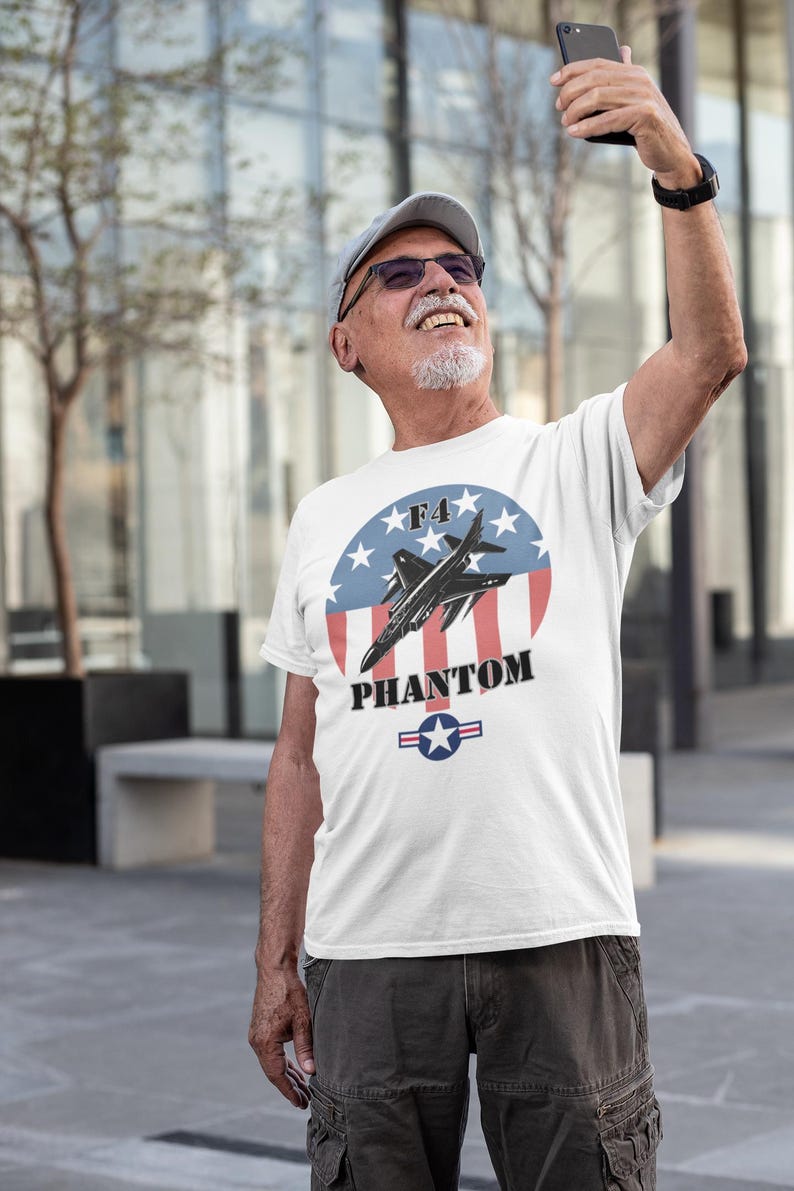
F-4 Phantom Fighter Jet Tee — Vintage Military Aviation
The Phantom flew alongside the Thud in every Rolling Thunder strike package — the escort that the Wolfpack turned into an ambush weapon. A vintage-style tee for anyone who knows the difference between a Thud and a Phantom and why it mattered. Available S–3XL.
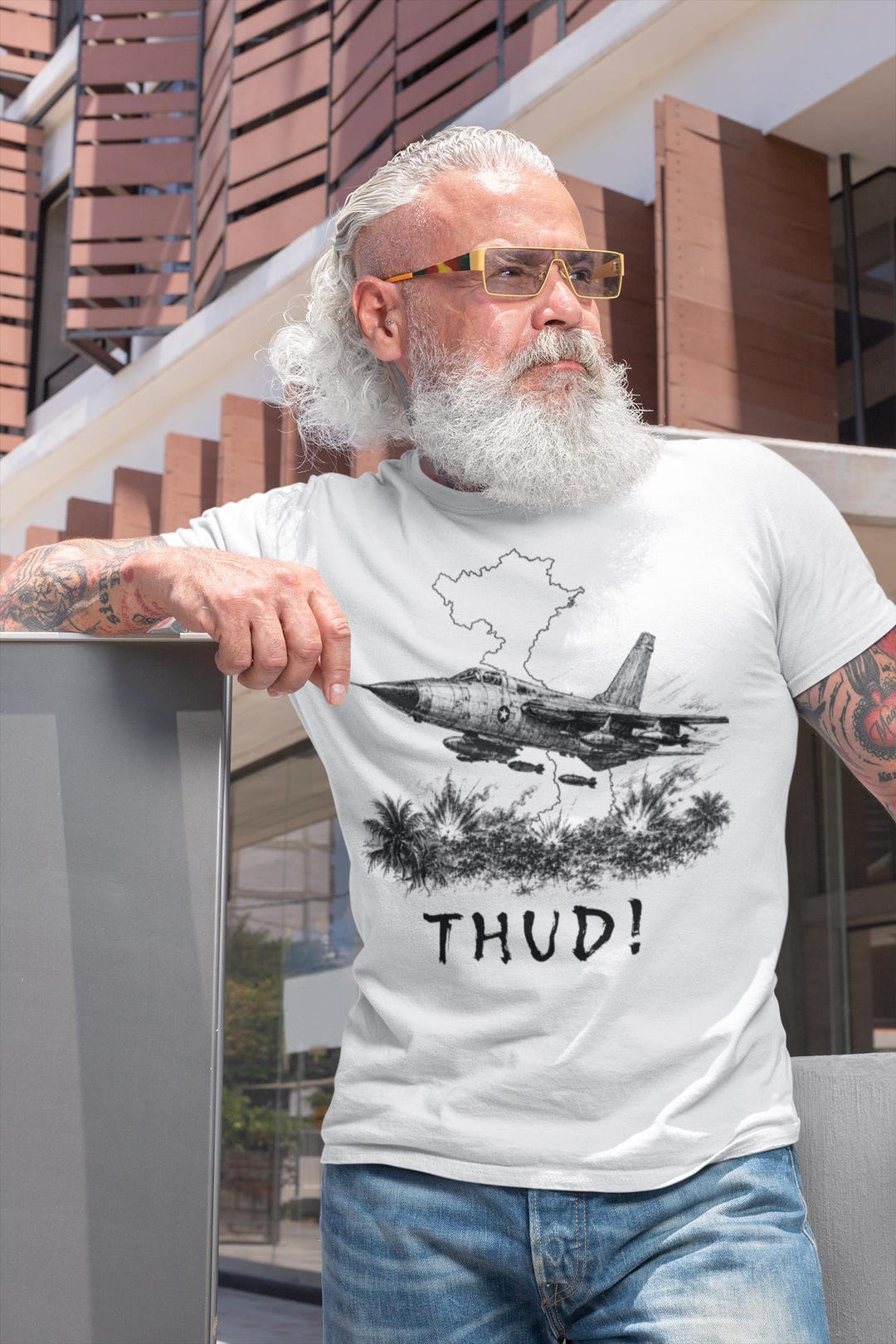
F-105 Thunderchief Tee — Vietnam War “Thud” Shirt
The airplane this entire story is built around. A vintage, hand-inked F-105 in a banking bomb run over North Vietnam — for anyone who knows what Thud Ridge and the 100-mission math actually meant. Available S–3XL.
F-105 Thunderchief Can Cooler — Operation Rolling Thunder Koozie
Toast the Thud and the crews who flew those 100-mission tours up North. Our F-105 koozie keeps your can cold and your Rolling Thunder history close.
Why Rolling Thunder Failed — and What It Cost
The consensus among historians, and among virtually every aviator who flew the campaign, is that Rolling Thunder failed to achieve its strategic objectives. It didn’t stop the flow of supplies down the Ho Chi Minh Trail. It didn’t break North Vietnamese morale or will to fight. It didn’t force negotiation on American terms. What it did was kill a lot of Americans and a very large number of North Vietnamese, damage infrastructure that was repaired continuously with Soviet and Chinese assistance, and cost the United States billions of dollars and hundreds of aircraft.
The reasons for this are structural as much as tactical. The target selection process — run from Washington, politically constrained, regularly interrupted by bombing halts that Washington imposed to signal openness to negotiation — meant the North Vietnamese had time to repair damage between strikes, disperse assets during pauses, and adapt to American patterns. The restricted targeting list meant that some of the most militarily significant targets — the port of Haiphong, where Soviet ships offloaded supplies, and the rail lines connecting North Vietnam to China — were off limits for political reasons for much of the campaign.
The men who flew the missions knew this in real time. Jack Broughton’s Thud Ridge documents conversations among F-105 pilots who understood that the bridge they were being sent to bomb for the third time that month had been repaired twice already. They flew anyway, because the alternative was not flying, and not flying meant someone else flew in their seat, and pilots didn’t leave other people in their seat if they could put themselves there. That’s a specific kind of professional ethic that makes sense inside a community and is very hard to explain outside of one.
Things You Might Not Know About Operation Rolling Thunder
The Wild Weasel mission was invented specifically for this campaign. Before Rolling Thunder, there was no established doctrine for suppressing modern SAM systems. The Air Force and Navy developed the tactics, aircraft modifications, and electronic warfare procedures in real time, under fire, against an active threat. The Wild Weasel concept — deliberately flying at active radar sites to provoke them and then killing the radar — was essentially a new type of combat aviation developed on the job over North Vietnam in 1965 and 1966.
The F-105G two-seat Wild Weasels had the highest crew survival rate of any Rolling Thunder aircraft. This seems counterintuitive — they flew directly at SAM sites — but the Wild Weasel crews developed extremely effective defensive tactics and had the electronic systems to detect threats at range. The original F-105D single-seat strike aircraft suffered the highest attrition.
North Vietnam’s air defense network was one of the most sophisticated ever fielded against American airpower. By 1967, it included approximately 8,000 anti-aircraft artillery pieces, 25 SA-2 SAM battalions, and MiG-17, MiG-19, and MiG-21 interceptor squadrons. It was integrated, it was partially Soviet-operated during the early phases, and it improved continuously throughout the campaign. The cost of suppressing it — in aircraft, aircrew, and ordnance — exceeded the military value of most of the targets being struck.
Robin Olds was grounded before he could get his fifth Vietnam kill. With four MiGs shot down over Vietnam and 12 from WWII, Olds needed one more Vietnam kill to become a double ace. His commanders determined he was too valuable to risk losing — the story of his shooting down would have been a propaganda catastrophe — and he was pulled from combat flying. He reportedly considered this one of the great frustrations of his career.
The Air Force prohibited filming and photographing the 100th mission celebrations at the bases. This was a deliberate policy: a celebration of a pilot completing 100 combat missions was deemed bad for the war narrative — it implied other pilots hadn’t made it, which was uncomfortable for the public messaging around Rolling Thunder. Celebrations happened anyway, off camera, in the Officers’ Club at Korat and Takhli. The photos from those celebrations that exist are mostly unofficial.
FROM THE SHOP

Watch Out For Gremlins — Vintage Aviation Tee
The gremlins that plagued WWII pilots had a way of following the aircraft into Vietnam — at least that’s what the crew chiefs said when the J75 engine on a Thud did something it wasn’t supposed to do at the worst possible moment. A vintage aviation tee rooted in the lore that connects every generation of military aviation. Available S–3XL.
Operation Rolling Thunder FAQ
What was Operation Rolling Thunder?
Operation Rolling Thunder was the sustained U.S. Air Force and Navy bombing campaign against North Vietnam, running from March 2, 1965 to November 1, 1968. It was the primary American aerial offensive of the early Vietnam War, designed to pressure North Vietnam into negotiations and interrupt the flow of supplies to the south. It is widely considered to have failed its strategic objectives despite enormous cost in aircraft and personnel.
What was the F-105 Thunderchief’s role in Rolling Thunder?
The F-105 Thunderchief — nicknamed the Thud — was the primary strike aircraft of Rolling Thunder, flying the majority of bombing missions against North Vietnamese targets. Of 833 F-105s built, approximately 382 were lost during the Vietnam War — nearly half the production run. In its Wild Weasel variant, the F-105 was also used to suppress North Vietnamese surface-to-air missile sites in advance of strike packages.
What was the 100-mission number in Vietnam?
The Air Force set 100 combat missions over North Vietnam as the rotation standard for Rolling Thunder aircrew. Complete 100 missions and you rotated home. In the early years of the campaign, the odds of completing 100 F-105 missions without being shot down, killed, or captured were low — some estimates put the completion rate in 1965–1966 at 25 to 50 percent. Some pilots who were shot down and rescued continued flying until they completed their 100 missions.
Who was Robin Olds and what did he do in Vietnam?
Robin Olds was a WWII fighter ace with 12 aerial victories who commanded the 8th Tactical Fighter Wing at Ubon RTAFB, Thailand. He led Operation Bolo on January 2, 1967 — a deception operation in which F-4 Phantoms flew disguised as F-105 Thunderchiefs and ambushed North Vietnamese MiG-21 interceptors, shooting down seven MiGs with no American losses. Olds shot down four MiGs in Vietnam, giving him a career total of 16 aerial victories across two wars. He was also famous for his handlebar mustache, grown in violation of regulations, which became a symbol of the Wolfpack wing’s identity.
Why did Operation Rolling Thunder fail?
Rolling Thunder failed to achieve its strategic objectives primarily because of politically constrained target selection — the White House controlled which targets could be struck on which days — repeated bombing halts that gave North Vietnam time to repair damage, and the resilience of North Vietnamese logistics supported by Chinese and Soviet assistance. The campaign destroyed enormous amounts of infrastructure, but North Vietnam repaired or routed around it continuously. The cost in American aircraft and personnel exceeded the strategic value achieved.
Where were Rolling Thunder missions launched from?
The primary bases for F-105 Rolling Thunder missions were Korat Royal Thai Air Force Base (388th TFW) and Takhli Royal Thai Air Force Base (355th TFW), both in Thailand. F-4 Phantom escort and strike missions launched primarily from Ubon RTAFB (8th TFW — Robin Olds’ Wolfpack). Additional missions were flown from Da Nang, Bien Hoa, and other South Vietnamese bases, as well as from Navy carriers in the Gulf of Tonkin.
The Bottom Line
Operation Rolling Thunder is one of the most studied, most debated, and most uncomfortable chapters in American aviation history — not because the men who flew it were anything less than extraordinary, but because the institutional and political decisions that shaped it were so clearly inadequate to what was being asked of those men. The F-105 Thunderchief went into North Vietnamese airspace every day for three and a half years. The pilots flew the math with their eyes open. Robin Olds found a way to fight back that the doctrine hadn’t anticipated. Leo Thorsness flew his 93rd mission and got a Medal of Honor and six years in a prison before he came home.
The 100-mission number was a promise: survive this and go home. The rate at which it was kept, across the Thud community at Korat and Takhli, tells you everything you need to know about what the campaign actually cost at the human level. Most of the men who flew it would tell you they’d do it again. Not because it was well-run — because it wasn’t. But because the guy in the next seat was counting on them, and that calculus doesn’t change regardless of what Washington thinks it’s doing.
If this story opened something for you, the F-4 Phantom full post goes deep on Operation Bolo and the creation of TOPGUN. The B-17 Flying Fortress post covers the 25-mission math of WWII daylight bombing — the historical precedent the Air Force was drawing on when they set the Vietnam 100-mission standard. The P-51 Mustang post covers the escort fighter that Robin Olds flew in Europe before he flew Phantoms in Vietnam. And if you want to understand what modern American airpower looks like on the other end of these lessons, the F-15E Strike Eagle post covers the generation of aircraft that came out of Vietnam’s failures.
Follow along on Instagram @bentheretravel for more aviation history, travel, and Pittsburgh content.
Read Next
- F-4 Phantom II: The Flying Pig That Could Not Shoot Straight, Turned the Air War, and Built the TOPGUN School
- B-17 Flying Fortress: Daylight Bombing, the 25-Mission Math, and Why It Mattered
- P-51 Mustang: The 117-Day Dare That Won the War in the Air
- F-22 Raptor: The Silent Serial Killer of the Sky and the 187-Jet Mistake America Can’t Undo
- WWII Bomber Nose Art: The Story of Lucky 13 & America’s Greatest Aircrews
A Note from Ben
Rolling Thunder is the campaign I think about when people ask me what it’s like to work inside a military institution that is making decisions you disagree with. The answer is: you do the mission, you protect the guy next to you, and you hope the institution learns. Sometimes it does. The Wild Weasel concept, TOPGUN, the Aggressor program — all of these came directly out of Rolling Thunder’s failures. The Air Force and Navy paid an enormous price to learn what they should have been able to figure out before the first Thud rolled down the runway at Korat. The lesson cost a lot of people a lot more than it should have. As a JAG who spent 22 years inside the institution, that kind of story hits differently than it does from the outside.
Sources & Further Reading
This article draws on U.S. Air Force historical records, the National Museum of the U.S. Air Force’s F-105 Thunderchief and Rolling Thunder documentation, the Congressional Record on Rolling Thunder target selection policy, and firsthand accounts including Jack Broughton’s Thud Ridge (1969), Leo Thorsness’s Surviving Hell, and Jeremiah Denton’s When Hell Was in Session. All historical images are public domain U.S. government photographs.
For readers who want to explore further:
- U.S. Air Force official website — aircraft fact sheets and historical documentation
- National Museum of the U.S. Air Force — F-105 Thunderchief history
- Smithsonian National Air and Space Museum — Vietnam War aviation history

Ben & Nicole Mathews
We’re based in St. Augustine, Florida, sharing the places we’ve actually been — from our home turf to corners of the U.S. and abroad. Ben is an attorney and a retired Air Force JAG (22 years), and a private pilot, which is why aviation and military history shows up here too.