
The airplane the Army didn’t especially want, flown by men whose passports called them farmers and clergymen, wearing a face copied out of a magazine. Here’s the real story of the P-40, the Flying Tigers, and the most famous nose art in aviation history.
Ask anyone to draw a World War II fighter from memory and you’ll get some version of the same thing: a snarling mouth full of teeth painted across a long, sharp nose. It’s on lunchboxes, ball caps, tattoo flash, and a hundred thousand T-shirts. It is, without much competition, the most recognizable piece of nose art ever applied to an airplane.
What almost nobody knows is that the men who made it famous didn’t invent it, weren’t in the U.S. military when they flew it, were fighting for a country that wasn’t technically at war yet, and were paid a cash bounty per airplane like nineteenth-century bounty hunters. The Flying Tigers were, in the most literal sense, a mercenary outfit — and the airplane they flew was one American commanders considered second-rate the day it rolled off the line.
They went undefeated anyway.

The Airplane Nobody Else Wanted
The Curtiss P-40 was not born great. It was born available. Curtiss took the airframe of the radial-engined P-36 Hawk, bolted a liquid-cooled Allison V-1710 to the front of it, and produced a fighter that was fast enough, tough enough, and — critically — ready to build in quantity in 1939 when almost nothing else was.
That last part mattered more than any performance figure. When France, Britain, and China came shopping for fighters, the P-40 was the airplane actually sitting on the loading dock. The U.S. Army Air Corps was pouring its hopes into turbo-supercharged designs like the P-38 and P-47; the P-40’s Allison engine had a single-stage supercharger, which meant its performance fell off a cliff above about 15,000 feet. In the high-altitude bomber-interception war over Europe, that was disqualifying.
In the low-and-medium-altitude war over Burma and southwest China, it was almost irrelevant. And so a batch of one hundred Tomahawk IIBs originally built on a British contract got quietly diverted to an outfit that didn’t officially exist.
Did You Know? The P-40 was the third most-produced American fighter of the war — 13,738 built, behind only the P-51 Mustang and P-47 Thunderbolt. The airplane everyone calls mediocre outlasted a lot of airplanes everyone calls great.
Plane Specifications: Curtiss P-40B / Tomahawk IIB
The Flying Tigers flew the early P-40 — the short-nosed, six-gun Tomahawk, not the later long-tailed Warhawks most people picture. These are the numbers the AVG actually went to work with.

Two things in that table decided how the Flying Tigers fought. The first is the service ceiling paired with that single-stage supercharger: above roughly 15,000 feet the P-40 was a tired airplane, so the AVG lived and worked lower. The second is the last line. Pilot armor, a bulletproof windscreen, and self-sealing fuel tanks. Hold on to that one — it is the entire ballgame.
How the P-40 Stacked Up Against Its Adversaries
Here is the first little-known fact that trips up almost everyone: the Flying Tigers almost certainly never fought a Zero. The Mitsubishi A6M was a Japanese Navy fighter, and by December 1941 it had largely been pulled out of China for the Pacific offensive. The AVG’s opponents were Japanese Army aircraft — the fixed-gear Nakajima Ki-27 “Nate” and the new Ki-43 “Oscar,” a Zero lookalike that fooled pilots on both sides of the war. As Air & Space Forces Magazine puts it bluntly, the AVG called every Japanese fighter a Zero. The name stuck to the legend and never came off.

Read that table the way a fighter pilot would, and the shape of the fight jumps out. Every Japanese fighter in the theater was lighter, climbed better, and could turn inside the P-40 without breathing hard. A Ki-27 weighed roughly half what a Tomahawk weighed. In a classic turning dogfight, the American pilot loses — not sometimes, but as a matter of physics.
But go down two rows. None of them had armor. None of them had self-sealing fuel tanks. Japanese designers had bought maneuverability by deleting everything that made an airplane survivable. A Ki-43 that took a short burst from two .50-caliber Brownings did not limp home; it burned, or it came apart. Meanwhile a P-40 that took the same treatment from two rifle-caliber machine guns very often flew back to base with holes in it and a pilot who was merely furious.
And go down one more row. The P-40 dove like an anvil and rolled beautifully at speed — it had one of the fastest dive speeds of any early-war fighter, and its ailerons stayed effective when the Zero’s went stiff as a barn door above about 300 mph. Nobody in the sky over Burma could follow a diving Tomahawk.
Did You Know? Chennault had been sending detailed intelligence reports on Japanese aircraft performance back to Washington since the late 1930s. They were largely ignored. When the Ki-43 and the Zero shocked Allied pilots in December 1941, the man commanding a hundred mercenaries in China had already written the manual on how to beat them.
The Flying Tigers: A Secret Air Force That Officially Did Not Exist
The American Volunteer Group is one of the strangest organizations the United States has ever put in the sky, and the strangeness starts at the top.
A deaf, half-disgraced captain in exile

Claire Lee Chennault spent the 1930s losing an argument. The Air Corps Tactical School doctrine of the day held that the bomber would always get through, that fighters were a sideshow, and that pursuit aviation was a career dead end. Chennault said, loudly and in writing, that this was nonsense — that fighters properly warned by a ground observer network could shred a bomber formation. He was abrasive about it. He was also going deaf from years in open cockpits.
He retired a captain in 1937 and took a job the same year advising the Chinese Air Force for Madame Chiang Kai-shek. A retired American officer with a chronic bronchial cough, no rank, no command, and one very unfashionable theory about fighter aviation went to China and built, from scratch, a warning net of telephones, radios, and human spotters strung across hundreds of miles of countryside. That network is the reason a handful of P-40s could ever be in the right place at the right altitude at the right time.
Signed by the President, written down nowhere
By 1941 China was losing badly and needed pilots. In April of that year, Franklin Roosevelt authorized the recruitment of active-duty American military pilots and ground crew to resign their commissions and fight for a foreign power — while the United States was formally neutral. There was no executive order. There was no public announcement. The mechanism was a private company: the Central Aircraft Manufacturing Company, CAMCO, which issued the contracts.
Recruiters worked American air bases quietly, and squadron commanders were leaned on to release good men. The pay was extraordinary for 1941: roughly $600 a month for a pilot, up to $750 for a squadron leader, against the $200-odd an Army lieutenant was making. Ground crew signed for $250 to $400.
Then there was the other clause. Five hundred dollars for every Japanese aircraft destroyed. Not a medal — a check. By the time the group disbanded, CAMCO had paid out 296 of those bonuses to 67 different men. Adjusted for inflation, some Flying Tigers made more in seven months of combat than a modern airline captain makes in a year.
Did You Know? Because the men were traveling as civilians, their passports had to list civilian occupations. AVG personnel crossed the Pacific documented as bankers, clerks, students, salesmen, and musicians. Gregory “Pappy” Boyington — the future Marine Corps Medal of Honor recipient and Black Sheep squadron commander — traveled as a member of the clergy. Chennault’s own passport listed his occupation as “farmer.”
Chennault’s classroom in the jungle

The volunteers arrived at Toungoo in Burma in the summer of 1941 and discovered that their new employer intended to teach them to fly. Many of them resented it. Chennault made them sit through weeks of lectures with a blackboard and a pointer, drilling one idea until it was reflex:
Use your speed and your diving power to make a pass, shoot, and break away. You have a plane that will dive faster than theirs and one that is more sturdily constructed. Close your range, fire, and dive away.
Claire Chennault’s standing instruction to AVG pilots
He forbade turning dogfights outright. Fighters were to work in pairs, never alone, and always to attack from above with the sun behind them. If the pass failed, you kept diving and came back around; you did not, under any circumstances, try to out-turn a Japanese fighter to save your pride. Pilots who ignored him tended not to get a second lesson.
This was not new — the German Rotte and the “boom and zoom” principle were understood elsewhere. What was new was a commander who had already reverse-engineered the specific enemy his men would face, from years of watching Japanese aircraft over China, and who could tell them exactly which numbers in that comparison table to exploit.
Twelve days after Pearl Harbor
The AVG’s CAMCO contracts had begun on July 4, 1941. The group had not fired a shot in anger by December 7. Then, on December 20, 1941, ten Japanese bombers came over Kunming without fighter escort, and Chennault’s warning net had been tracking them for the better part of an hour. The Tigers were waiting above and behind. Most of the bomber formation never made it home.
Three days later the group was over Rangoon, and for the next six months the Flying Tigers fought one of the most lopsided air campaigns of the war — usually outnumbered two to one or worse, usually able to put fewer than three dozen serviceable airplanes into the air on any given day, and operating with no supply chain worth the name. Ground crews cannibalized wrecks, patched fuselages with fabric and sheet tin, and hand-pumped fuel out of drums.

In roughly fifty significant engagements, the group was never turned back from an objective.
See them fly: 1942 newsreel footage
This is period newsreel film of the AVG in China, released while the group was still in combat and now in the public domain. It is grainy, breathless, and full of 1942 propaganda cadence — and it is also the actual airplanes, the actual mouths, and the actual men.
The record — and the honest version of it
The official tally credited the AVG with just under 300 Japanese aircraft destroyed against twelve P-40s lost in air combat. That is a kill ratio of roughly twenty-five to one, and it is the number that built the legend.
It is also almost certainly too high. Historian Daniel Ford went into the Japanese unit records decades later and concluded that actual Japanese losses were closer to 115 or 120 aircraft. Overclaiming was universal in WWII air combat — three pilots firing at the same burning bomber all honestly believe they killed it — and the AVG had a cash incentive that made careful accounting even harder.
Here is the thing worth sitting with: even the skeptical number is a ten-to-one kill ratio. A hundred civilian contractors flying an airplane nobody wanted, with no spare parts, in somebody else’s war, ran up one of the most favorable exchange rates of the entire conflict. Nineteen to twenty-three AVG pilots became aces; Robert Neale finished as the group’s top scorer with more than fifteen.
Did You Know? Radio Tokyo did the Tigers a favor. Japanese broadcasts estimated that the AVG was operating with around 300 aircraft — nearly ten times its real strength. Chennault never corrected them. The group typically got fewer than 36 flyable P-40s into the air on a given day.
Four men worth knowing
Bert Christman was a comic strip artist before he was a fighter pilot. He drew the Scorchy Smith aviation strip for the Associated Press and co-created a character named the Sandman for what would become DC Comics. He gave it up to fly. On January 23, 1942, he bailed out over Rangoon and was machine-gunned in his parachute. He was 26. Somewhere in the archives there is a man who invented a superhero and died in a nylon canopy over Burma.
James Howard flew with the 2nd Squadron “Panda Bears” and later, back in American uniform over Europe, single-handedly attacked a formation of some thirty German fighters attacking a B-17 box and held them off for more than half an hour. He received the Medal of Honor — the only fighter pilot in the European theater to be awarded one.
Robert Neale, the top ace, ran the 1st Squadron “Adam and Eves” and finished with more than fifteen victories, most of them scored in the space of about five months.
Gregory Boyington arrived as a washed-up, hard-drinking Marine lieutenant traveling on a clergyman’s passport, quarreled with almost everyone, and left early. He then went home, took over VMF-214, and became one of the most famous Marine aviators in history.
The Salween Gorge
In May 1942, with Burma lost and Japanese ground forces pushing up the Burma Road toward the Salween River gorge, there was effectively nothing left between them and unoccupied China. Chennault threw his P-40s at the gorge with bombs and guns, working the road cut into the canyon walls where vehicles could neither scatter nor turn around. The column was wrecked. The Japanese advance on that axis stopped there.
It is a strange footnote: a fighter group flying obsolescent airplanes, on the verge of dissolution, arguably closed the door on an invasion route into China.
Disbanded on their first birthday
The AVG was dissolved on July 4, 1942 — exactly one year to the day after the contracts began. The group was folded into the U.S. Army Air Forces as the 23rd Fighter Group, and the Army wanted the veterans to accept induction. Most of them, sourly, refused; the terms were bad and the resentment was real. Only five pilots stayed on. The rest went home, and the outfit that had never lost an engagement was gone in twelve months.
Did You Know? The famous winged tiger insignia — the one on the leather jackets, leaping through a blue V for victory — was designed by Walt Disney Studios, not by the pilots. It has nothing to do with the shark mouth. Chennault himself admitted he never understood how a squadron of shark-faced P-40s came to be called tigers.
Where the Shark Mouth Actually Came From
The Flying Tigers did not invent the shark mouth. They didn’t even invent it in that war.
The idea goes back to the First World War, when German pilots flying the Roland C.II — a fat-bodied two-seater universally nicknamed the Walfisch, or whale — painted eyes and gaping mouths on the nose. The gag was old before the P-40 existed.
What made it iconic was a much shorter chain of events in 1941. In North Africa, the Royal Air Force’s No. 112 Squadron converted to Curtiss Tomahawks and noticed something about the airframe: the P-40’s big chin radiator sits under a long, tapering nose, so the airplane already has a jawline. All it needs is teeth. The squadron painted them on, and 112 has worn a shark mouth on every aircraft type it has flown ever since.

In early November 1941, AVG pilot Charles Bond was flipping through an illustrated magazine in Burma and hit a photograph of a 112 Squadron Tomahawk in the desert — South African pilot Neville Bowker’s aircraft, named Menace — wearing the mouth. Bond took the idea to Chennault. Chennault, who had been trying to make a hundred airplanes look like several hundred airplanes for months, ordered every P-40 in the group painted.
Within weeks the AVG’s Tomahawks were the most visually aggressive fighters in the theater, and within months the shark mouth had become permanently attached to a group that was actually named after a completely different animal.
Did You Know? No. 112 Squadron RAF still flies the shark mouth today. They wore it on Tomahawks and Kittyhawks in the desert, on Mustangs over Italy, and on jets afterward — an unbroken line of teeth running from 1941 to the present.
War Paint: Why Painting a Face on an Airplane Works
Most WWII nose art was private. A pin-up on a B-17’s flank was for the ten men who flew in her, painted where the crew could see it on the walk-around and the enemy would never get a good look at it. As I dug into in the nose art symbol decoder, those images were mostly about going home — luck, sweethearts, the girl on the calendar, a cartoon that made the airplane feel like a person rather than a machine you might die in.
The shark mouth is a different animal entirely, and it is worth being precise about why.
It faces outward. It is painted on the one part of the airframe an opponent sees in a head-on pass, at the exact moment when he has a fraction of a second to decide whether to hold his line or break away. It does not commemorate a girl back home. It is not for the crew. It is aimed at a stranger with a gunsight, and its entire job is to make him flinch.
Anthropologists have a boring name for this — a threat display — and humans have been doing it for as long as we have had faces. The Maori haka performed before a match is the version most people have seen: a coordinated, deliberately terrifying performance staged in front of an opponent before contact, designed to inflate the group and rattle the other side. Spartan hoplites polished their shields. Zulu regiments drummed their spears. The AVG painted teeth.
And in the Flying Tigers’ case the display was doing double duty, because the group was bluffing. A hundred men and fewer than three dozen serviceable airplanes were pretending to be an air force. Chennault was already staging his fighters between fields, letting Japanese intelligence overestimate his strength by a factor of ten. Making every airplane in the inventory look identical, unmistakable, and homicidal was part of the same con: if the airplane you fought last Tuesday over Rangoon and the airplane you’re fighting today over Kunming both have the same set of jaws, how many of them are there?
That is the real significance of the AVG’s shark mouth, and why it outlived every other marking of the war. It wasn’t decoration and it wasn’t sentiment. It was the loudest possible statement from the smallest possible force — and it worked well enough that eighty years later, when you ask someone to picture a fighter plane, they picture a mouth.
If you want the wider story of how American crews turned their aircraft into personal statements — the artists, the paint sources, the famous airplanes, and how a squadron of steel got a personality — that’s all in the story of Lucky 13 and America’s bomber nose art.
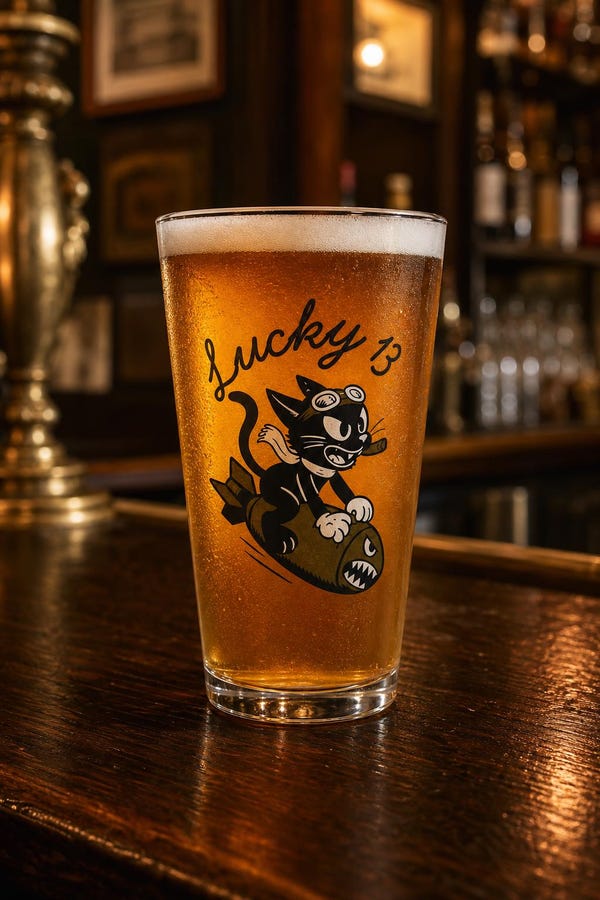
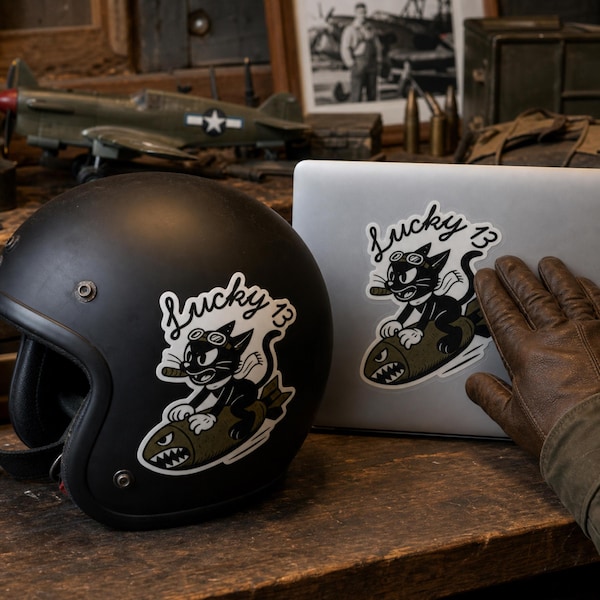
Wear the war paint. The shark-toothed bomb and the gremlin come out of the same instinct that put a mouth on a P-40 — luck, menace, and a little dark humor, hand-drawn the way the ground crews did it:


Frequently Asked Questions
Did the Flying Tigers really fight Zeros?
Almost certainly not. The Mitsubishi A6M Zero was a Japanese Navy fighter and had largely left China by December 1941. The AVG’s opponents were Japanese Army aircraft — the fixed-gear Nakajima Ki-27 “Nate” and the Ki-43 “Oscar,” which looked enough like a Zero to fool everyone. AVG pilots called every Japanese fighter a Zero, and the name stuck to the legend.
Who painted the first shark mouth on a P-40?
No. 112 Squadron RAF, flying Tomahawks in North Africa in 1941. AVG pilot Charles Bond saw a photo of one of their aircraft in a magazine in November 1941 and brought the idea to Claire Chennault, who ordered every Flying Tigers P-40 painted. The concept itself is older still — German crews painted mouths on the Roland C.II “Walfisch” in the First World War.
Were the Flying Tigers actually mercenaries?
Legally, yes. They resigned their U.S. military commissions and signed civilian contracts with a private company, CAMCO, to fly for China. Pilots earned roughly $600 a month plus a $500 bonus for each Japanese aircraft destroyed. CAMCO paid out 296 of those bonuses to 67 men.
Was the P-40 a bad fighter?
It was outclassed in climb, ceiling, and turn by every Japanese fighter it met — and it was faster in a dive, rolled better at speed, hit harder, and was the only one of them with pilot armor and self-sealing fuel tanks. Flown Chennault’s way, diving in and never turning, it was extremely effective. Flown like a Spitfire, it got people killed.
How long did the Flying Tigers exist?
Exactly one year. The CAMCO contracts began July 4, 1941; the group flew its first combat on December 20, 1941; and it was disbanded and absorbed into the U.S. Army Air Forces as the 23rd Fighter Group on July 4, 1942.
What is the difference between the shark mouth and the Flying Tiger insignia?
They are two completely separate markings. The shark mouth was painted on the nose. The winged tiger leaping through a blue V — the one on the jackets and patches — was designed by Walt Disney Studios. Chennault said he never knew how a group of shark-faced airplanes ended up named after tigers.
The Bottom Line
The P-40 was never the best fighter in the sky. It was the fighter that was there — available in 1939, cheap enough to hand to allies, tough enough to bring men home, and fast enough downhill that nothing could follow it. Handed to a deaf retired captain with an unfashionable theory and a hundred men flying on somebody else’s passports, it produced one of the most lopsided combat records of the war.
And the mouth those men borrowed from an RAF squadron in the Egyptian desert turned out to be the most durable piece of aviation art ever painted. Not because it was beautiful — because it was aimed at somebody. Eighty years on, it is still working.
Keep Reading
- How to Read WWII Nose Art: What the Pin-Ups, Cartoons & Symbols Meant
- WWII Bomber Nose Art: The Story of Lucky 13
- F4U Corsair: Why They Called the Bent-Wing Bird “Whistling Death”
- SBD Dauntless: The “Slow But Deadly” Dive Bomber That Won Midway
More from the shopBrowse the full WWII aviation & nose art collection — tees, prints, glassware and gifts, all original designs.

Ben & Nicole Mathews
We’re based in St. Augustine, Florida, sharing the places we’ve actually been — from our home turf to corners of the U.S. and abroad. Ben is an attorney and a retired Air Force JAG (22 years), and a private pilot, which is why aviation and military history shows up here too.