

If you live in Pittsburgh long enough, you stop calling them dumplings. You stop calling them pasta. You call them by their proper name — pierogi — and you take them seriously, the same way a Texan takes their brisket seriously and a New Yorker takes their slice. They are not a side dish here. They are a full-on cultural artifact, a Polish gift to the Steel City, hand-pinched and boiled and pan-fried and served with sour cream like the comfort food they are.
And if you’re going to do pierogi right in Pittsburgh, there is exactly one place to start. It’s not a brewery. It’s not a fancy sit-down restaurant in the Strip. It’s a converted gas station on Island Avenue in McKees Rocks, with a wraparound deck, a takeout window, and a Polish woman named Helen who has been making pierogi by hand for fifty years.
The place is Pierogies Plus. And we’ll fight you about it.

The platonic ideal: a plate of pierogi with sautéed onions and sour cream. Photo: Wikimedia Commons (public domain).
The Helen Mannarino Story
Pierogies Plus is the kind of business you can’t fake and can’t franchise. The whole story is one person.
Helen Mannarino grew up in Poland, helping in her family’s restaurant. In 1974, she emigrated to the United States and put down roots in McKees Rocks — the working-class river town just down the Ohio from downtown Pittsburgh that has been a Polish, Slovak, and Eastern European stronghold since the steel mills first lit up. She married. She raised a son. She worked in restaurant kitchens, including a stretch at a French place called Simply French.
Then, in 1991, with a small business loan and training from the Urban League of Pittsburgh, Helen took over a former gas station on Island Avenue and turned it into a pierogi shop. Just like that. No marketing budget. No focus groups. Just a Polish woman with fifty years of muscle memory in her hands, doing what she had always done — pinching dough around fillings — but doing it for everybody who walked up to the window.
Three and a half decades later, she’s still there. Her sister Grace works alongside her. They make pierogi the way Helen’s mother and grandmother made them in Poland: by hand, in small batches, with real ingredients and the kind of care you can taste in the first bite. The shop sells thousands of pierogi a week and has been written up in the Pittsburgh Post-Gazette, profiled by Heinz, and quoted in business journals from the Pittsburgh Business Times to LinkedIn. None of that has changed how the place works. You still walk up to the same window. Helen is still in back.
Did You Know? Pittsburgh is widely considered the unofficial pierogi capital of the United States. The late-19th and early-20th-century wave of Polish, Slovak, Czech, and Ukrainian immigrants who came to work in the steel mills brought their pierogi tradition with them — and the city has never let go. From church basements to ballparks to former gas stations on Island Avenue, you can find a hand-pinched pierogi within ten minutes of just about anywhere in the city.
What a Real Pierogi Is
Before we go any further, let’s settle a few things. A pierogi is a half-moon dumpling made from unleavened wheat dough, stuffed with a savory or sweet filling, sealed by hand around the edge, and then boiled. After the boil, most Pittsburghers will tell you they should be finished in butter or oil in a hot pan until the edges crisp up and turn gold. Then you eat them, ideally with sautéed onions and a heavy spoonful of sour cream.
The traditional Polish fillings include potato and cheese, sauerkraut, mushroom, sweet farmer’s cheese, and, in season, blueberries or sour cherries. Pittsburgh has added its own twist over the decades — jalapeño, bacon, kielbasa, even pizza — but the gold standard is still the cheddar-and-mashed-potato pierogi. That’s the one your grandma made. That’s the one Helen makes.

The work behind the dumpling. Cutting dough circles by hand is step one of about ten, and there’s no shortcut. Photo: Wikimedia Commons (public domain).
What to Order at Pierogies Plus
Here’s how we do it. Our standing order — the one we’ve been getting since the first time somebody told us “you have to go to Pierogies Plus” — is the cheddar and mashed potato pierogi with sautéed onions. Twelve of them, on a paper plate, hot enough that you’ll burn your mouth on the first one because you can’t wait. We always add sour cream on the side, and we always — always — get an order of bacon to crumble on top.
Cheddar. Potato. Sautéed onions. Sour cream. Bacon. That is the combination. That is the food we are willing to drive across rivers in a snowstorm to eat. It is, to use a phrase that would normally embarrass us in print, to die for. The salty bacon against the soft, butter-crisped dumpling. The cool tang of the sour cream against the warm sweetness of the caramelized onions. The cheddar inside doing its quiet work. Every bite is the kind of food that makes you put your fork down for a second and just sit there.
The other fillings are excellent, and we don’t begrudge anyone who orders the sauerkraut, the farmer’s cheese, the kielbasa, or the seasonal specials. But the cheddar-and-potato is the move. Anyone who tells you different did not grow up in Pittsburgh.

This is what you want — pierogi finished in butter until the edges go gold, plated up with onions and ready for sour cream. Photo: Wikimedia Commons (public domain).
Why Pierogies Plus Beats Everywhere Else
Pittsburgh has a lot of places that sell pierogi. Some are excellent. Church basements run them as fundraisers. Bars in the South Side put them on the menu. The Strip District has Polish delis selling them frozen by the dozen. The Pirates serve them at PNC Park. We’ve eaten them all, and we’ll be honest — the bar in this city is high.
But here’s why Pierogies Plus is different.
The dough. Helen’s dough has the right thickness and the right elasticity. It’s not gummy. It’s not too thin. It bites cleanly and gives you that little bit of chew that means somebody who knows what they’re doing rolled it out. Frozen grocery-store pierogi never have this. Restaurant pierogi rarely do either.
The filling-to-dough ratio. Too much dough and it’s bread. Too little and you’re eating a flat envelope. Helen has nailed it. Every pierogi has a generous interior of cheesy, fluffy potato — properly seasoned, not under-salted the way a lot of pierogi are.
The hand-pinch. Real pierogi are pinched closed by hand, and the seal is part of the texture. Machine-folded pierogi tend to have a uniform crimp that crisps up oddly in the pan. Helen’s seal has the slight irregularity of human hands, which means the edges crisp differently every time and you get that contrast that makes the pan-fry sing.
The setting. The McKees Rocks shop is not pretending to be anything it isn’t. It’s a converted gas station with a takeout window, a small dining area, and a wraparound porch where on a good summer day you can sit outside, eat your pierogi, and watch trucks rumble down Island Avenue. It is exactly what a pierogi place in Pittsburgh should look like, and the lack of pretense is part of why the food tastes so good. There’s no Instagram lighting. There’s no concept menu. There’s just a Polish woman, her sister, and a lot of dough.
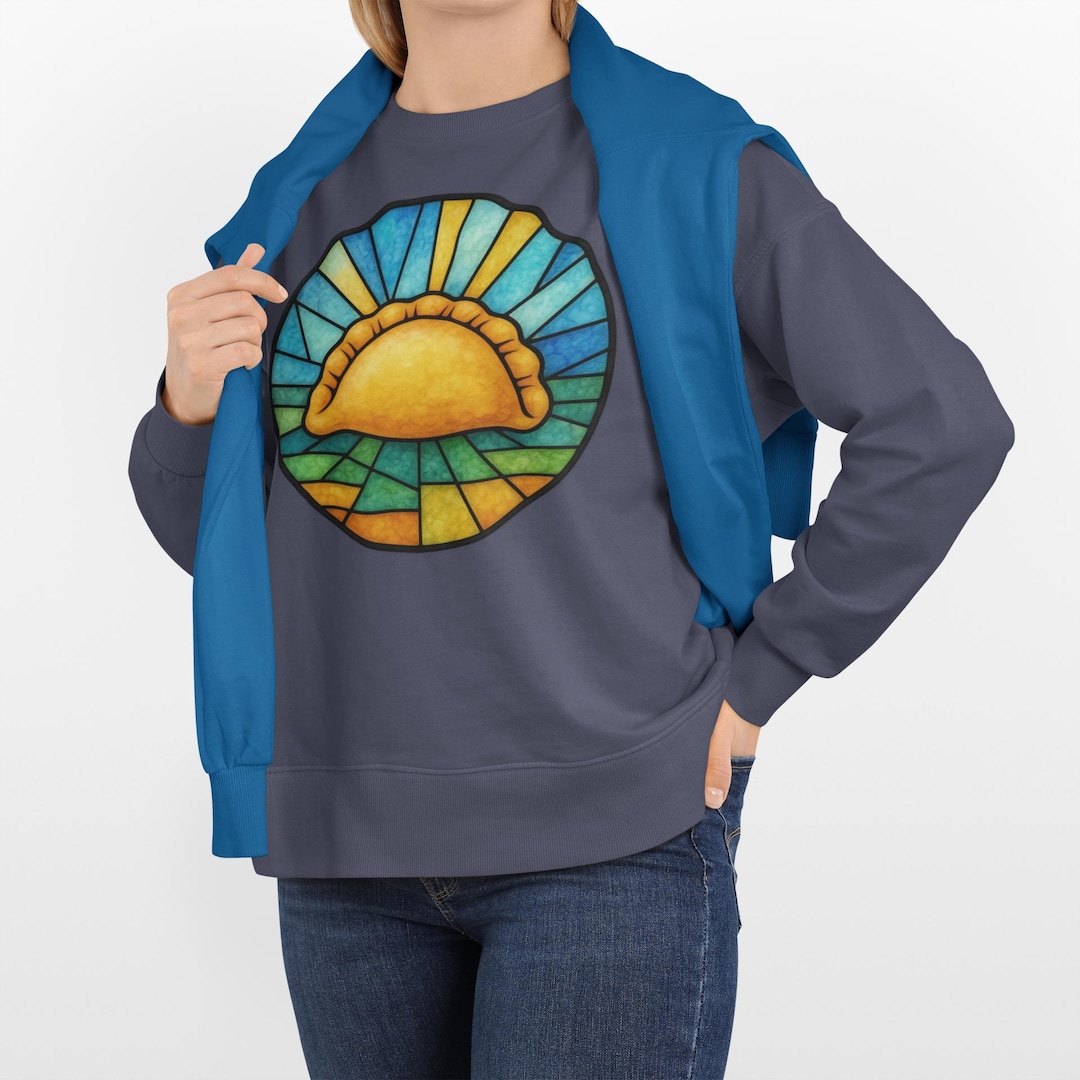
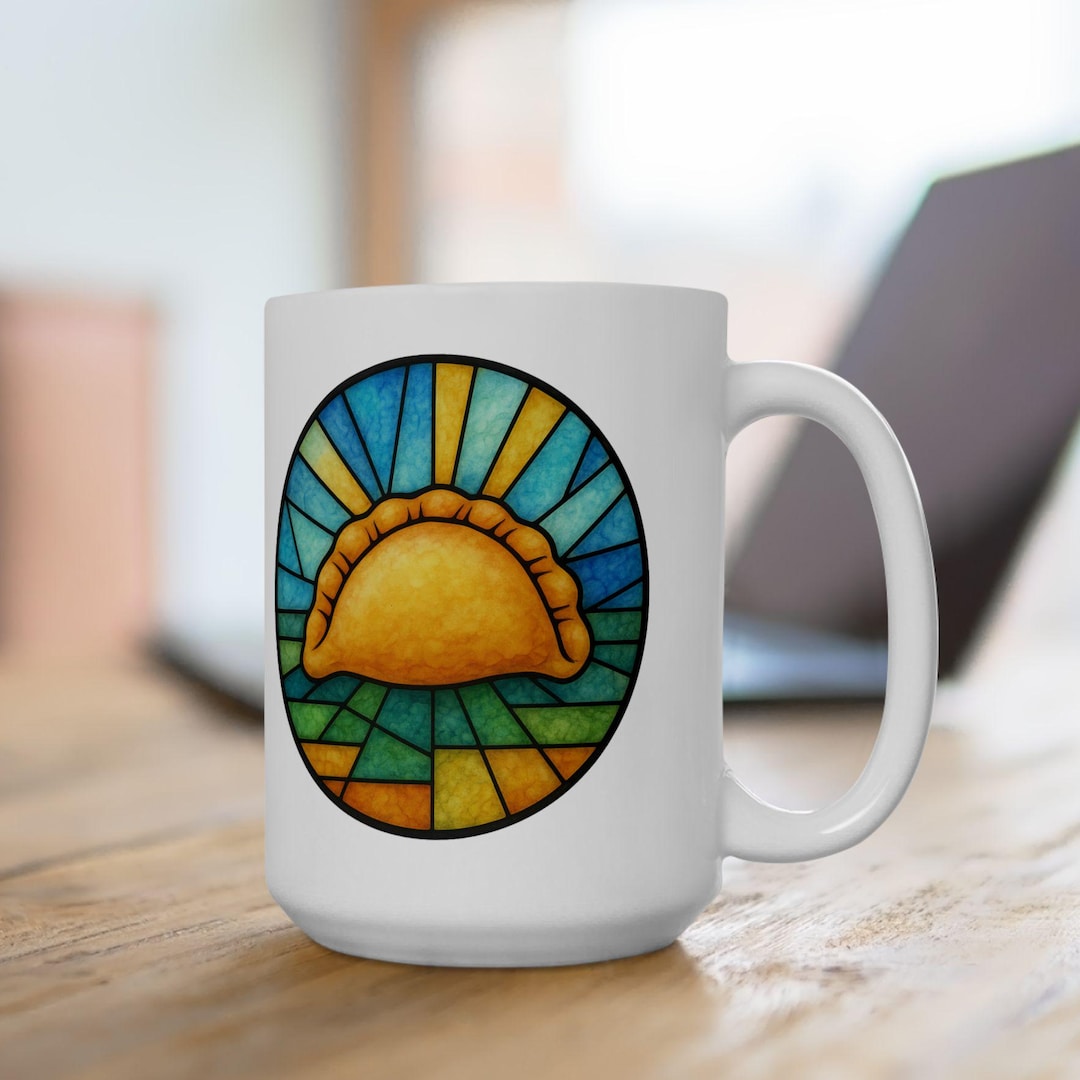
A pierogi rendered in stained-glass cathedral style — because a hand-pinched dumpling that’s been holding Pittsburgh together for a hundred years deserves the same reverence as a saint in a church window. Soft midweight crewneck, true-to-size fit.
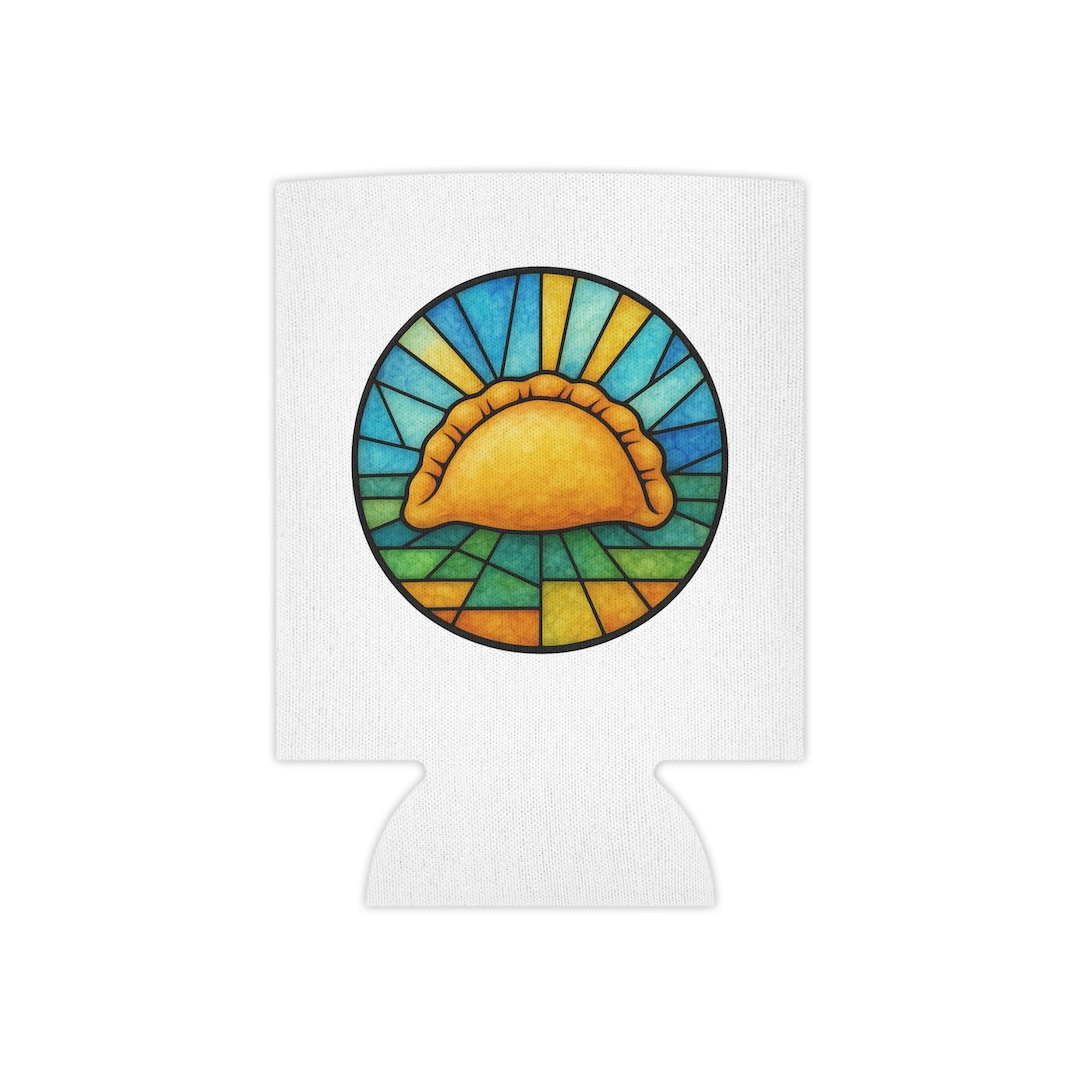
After a plate at Pierogies Plus, keep the Polish-food love going. Our stained-glass pierogi koozie is pure Yinzer comfort for your next pop.
The Stained-Glass Pierogi (And Why Reverence Matters)
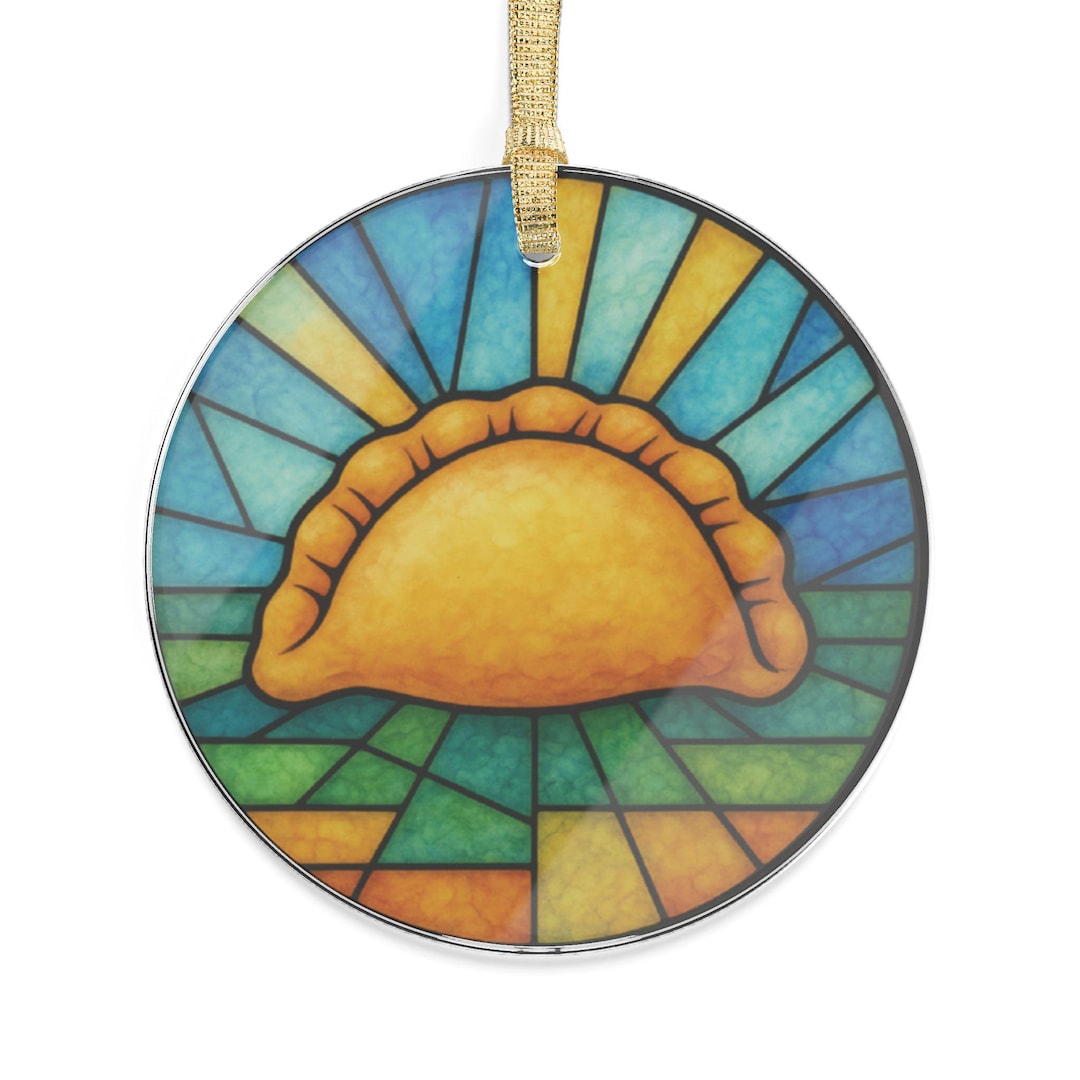
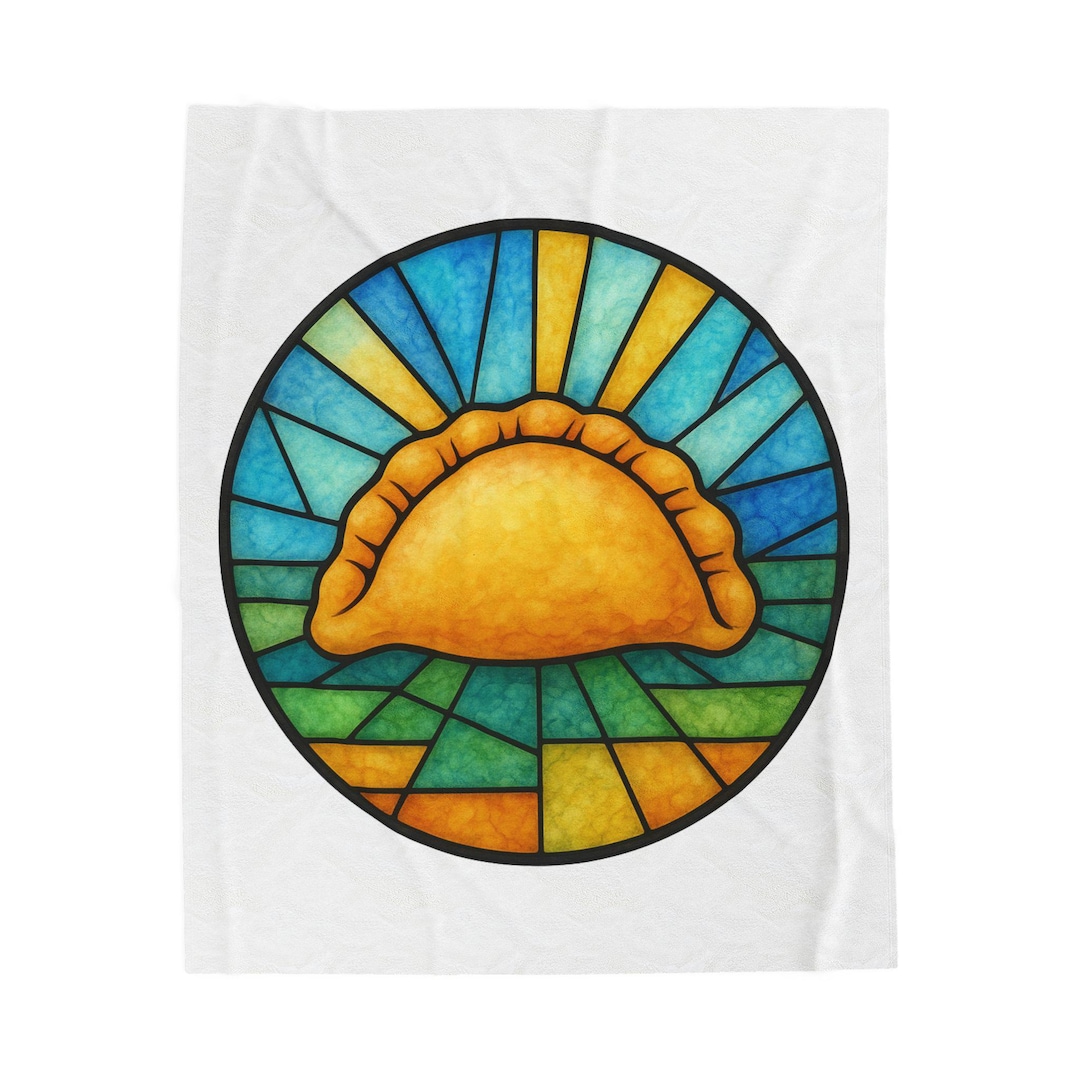
We made a small collection of pierogi-themed art and apparel for the shop, and the design we kept coming back to was a stained-glass pierogi. It started as kind of a joke — what if we treated the humble dumpling the way medieval Europeans treated their saints, in cathedral-window style with leaded glass and golden light? But the more we drew it, the more it felt right. A hand-pinched pierogi does deserve that kind of reverence. It’s a piece of Polish-American history, carried across an ocean, kept alive in steel-town kitchens for over a century, served from a former gas station in McKees Rocks. That’s a story worth a stained-glass window.
The collection includes a sweatshirt, an ornament, a velveteen blanket, an apron, and a coffee mug. Yinzers, Polish grandmas, lapsed Catholics, foodies who appreciate a good visual joke — the stained-glass pierogi has somehow turned out to be the design that connects with all of them. We get DMs from women in Cleveland and Detroit and Buffalo who saw it and immediately bought one for their mother.

The Pierogi Race at PNC Park
You cannot write about pierogi in Pittsburgh without mentioning the Great Pierogi Race. If you have never been to a Pittsburgh Pirates game at PNC Park, here is what you need to know: between innings of every home game, a group of giant racing pierogi run a foot race around the warning track. They are the unofficial mascots of Pittsburgh baseball and they are a serious deal.
The racers are Potato Pete in the blue hat, Jalapeño Hannah in the green hat, Cheese Chester in the yellow hat, Sauerkraut Saul in the red hat, Oliver Onion in the purple hat (the highly intelligent one — long story), Bacon Burt in the orange hat, and Pizza Penny in the checkered red and white. They’ve been running since 1999, inspired by the Milwaukee Brewers’ racing sausages, and they’re the reason a lot of Pittsburgh kids learned to love baseball in the first place.
There’s something perfect about a city that has chosen, as its official ballpark mascot, a foot race between giant dumplings. It tells you exactly what kind of place Pittsburgh is. We’re not above ourselves. We know what we are. The food we are most proud of is a hand-pinched Polish dumpling, and we will dress people up as one and make them sprint. That is Pittsburgh.

The actual work. Hand-filling pierogi is slow, and that’s the whole point. Photo: Wikimedia Commons (public domain).
How to Eat at Pierogies Plus
If you’re going for the first time, here’s how we’d do it.
Go in person if you can. The shop is at 342 Island Avenue in McKees Rocks, about ten minutes from downtown Pittsburgh. The address sounds industrial, and it is. That’s part of the charm. Park, walk up to the window, and order at the counter.
Order a dozen, not a half-dozen. A half-dozen is a snack. A dozen is lunch. You will not regret going bigger.
Get them with sautéed onions on top. Always. Don’t ask the onions to be a side. They go on top.
Sour cream and bacon. Spoon the sour cream over the pierogi, crumble the bacon on top, and mix gently as you eat so each bite gets a little of everything. This is not optional.
Take some home frozen. They sell pierogi by the dozen, frozen, to go. Stash them in your freezer. The next time it’s a snowy Tuesday in February and you can’t think of anything good to eat, boil six of them, finish them in butter, and remember why you love Pittsburgh.
Pierogies Plus FAQ
Where exactly is Pierogies Plus?
342 Island Avenue, McKees Rocks, PA 15136. About a ten-minute drive from downtown Pittsburgh, on the river side of town. There’s a parking lot, and the shop is in a converted gas station. You can’t miss it.
Who is Helen Mannarino?
The owner and founder of Pierogies Plus. She emigrated from Poland to McKees Rocks in 1974 and opened the shop in 1991 with help from the Urban League of Pittsburgh. She’s been making pierogi by hand for more than fifty years.
What’s the best pierogi to order?
Cheddar and mashed potato with sautéed onions. Side of sour cream. Side of bacon. Anybody who tells you different is wrong about pierogi.
Do they ship?
They’ve sold frozen pierogi to take home for a long time, and they offer local pickup, catering, and various freezer packs. For shipping options, check their website directly — they update it seasonally.
Is Pittsburgh really the pierogi capital of America?
Unofficially, yes. The waves of Polish, Slovak, and Czech immigrants who built the steel mills made pierogi a foundational comfort food here. Between Pierogies Plus, the church festivals, the Strip District delis, the Pirates pierogi race, and a hundred neighborhood spots, no other American city is even close.
What about the pierogi race at PNC Park?
The Great Pittsburgh Pierogi Race runs between innings at every Pirates home game. Six (sometimes seven) costumed racers — Potato Pete, Jalapeño Hannah, Cheese Chester, Sauerkraut Saul, Oliver Onion, Bacon Burt, and Pizza Penny — sprint a lap of the warning track. It is somehow the best part of the game even when the Pirates are winning.
The Bottom Line
You can argue about a lot of things in Pittsburgh. You can argue about the best place for a Primanti’s. You can argue about whether the Mon Wharf is parking or a flood zone. You can argue about chipped ham. But you cannot, with a straight face, argue about who makes the best pierogi in the city. Helen Mannarino does. Pierogies Plus does. The hand-pinched cheddar-and-potato with sautéed onions, sour cream, and crumbled bacon is the platonic ideal of Pittsburgh comfort food, and the rest of us are just trying to get our orders in before they close.
If you’re new to the city, drive out to McKees Rocks. If you grew up here, you already know. And if you’re stuck somewhere far from the Three Rivers and you’re missing home, a stained-glass pierogi on a sweatshirt or a coffee mug is the next-best thing — a small, ridiculous, reverent reminder that some food is so good it deserves a window in a cathedral.
If you liked this one, we’ve got more on the city we love — including our roundup of the best Pittsburgh gifts for Yinzers (that they’ll actually love), where the stained-glass pierogi makes another appearance alongside chipped ham shirts and Steel City skyline tees. And if you want to follow along as we keep eating our way through the ‘Burgh and beyond, we’re on Instagram as @bentheretravel.
Read next: Best Pittsburgh Gifts for Yinzers (That They’ll Actually Love).
Nicole’s Pittsburgh Note: Nicole grew up with Pittsburgh food, neighborhoods, family traditions, and Yinzer culture, so these recommendations come from more than a quick visit. These are the kinds of places, flavors, and experiences that actually feel connected to Pittsburgh — not just the tourist checklist. If you’re looking for Pittsburgh gifts that will actually land, our SunSpun Creations shop has original Pittsburgh-inspired designs including pierogi art, Yinzer skyline tees, and more.

Ben & Nicole Mathews
We’re based in St. Augustine, Florida, sharing the places we’ve actually been — from our home turf to corners of the U.S. and abroad. Ben is an attorney and a retired Air Force JAG (22 years), and a private pilot, which is why aviation and military history shows up here too.