

A field guide to the visual language painted on the warplanes of World War II — American and Allied — and what the pin-ups, cartoons, black cats, shark teeth, and little rows of bombs were actually saying.
A B-17 was a machine built to fly into flak and fighters, and a lot of the young men who crewed one never came home. So why, on the nose of that machine, would you paint a winking pin-up, a grinning cat, or Donald Duck in boxing gloves? Because nose art was never just decoration. It was a language — a way for a 20-year-old crew to say this plane is ours, this is our luck, and this is what we’re flying home to.
We’ve already told the story of where nose art came from and the artists who painted it. This one is different: it’s a decoder. Point at any design on a wartime bomber — and, as it turns out, on British, Australian, and Soviet planes too — and this guide will tell you what it meant and why it was there.
Nose Art Was a Language — Here’s How to Read It
Aircrews were mostly kids — the National WWII Museum puts the typical age at 17 to 25 — living under rigid military discipline. Nose art was one of the only places they were allowed to talk back. Officially it was tolerated as a morale booster; unofficially it was a crew “thumbing its nose” at the whole regimented machine around it. The result was a surprisingly consistent vocabulary. Once you know the words, you can read almost any plane: who the crew were, what they believed protected them, and how many missions they’d survived.
Broadly, the designs fall into a handful of families — the pin-up, the cartoon, the luck charm, the menace, and the scoreboard. Here’s what each one was really saying.
The Pin-Up, Decoded

The single most common motif of the war was a woman. The National WWII Museum found female figures accounted for 43% of nose art in the European theater and a full 66% in the Pacific. But “pin-up” wasn’t one idea — it was several, and the type of woman a crew chose told you what job she was doing.
The femme fatale

The vamp — dangerous, powerful, a little threatening. Painting the plane as a beautiful, deadly woman was a way of claiming her power as your own: she is the danger now, not the flak outside. That’s the spirit behind a design like the Sky Widow.
The sweetheart

The girl-next-door pin-up was the opposite job: not danger, but home. She was the wife, the girlfriend, the reason to make it back — a talisman more than a threat. Crews genuinely came to see the aircraft as female, even as a protective mother figure watching over them.
The tropical girl — and the sailor’s answer
In the Pacific, the pin-up went local: the hula girl, the island beauty, the tropical paradise the war had dropped these men into — the mood behind the Pacific Pearl. And when the pin-up looked back at the men who flew, you got the cheeky flip side — the sailor sweetheart, like Permission to Come Aboard.
Wear the pin-up. The femme fatale, the tropical girl, and the sailor sweetheart — the same nose-art language, on a tee:


Did You Know? The U.S. Navy and Marine Corps officially banned nose art. That’s why the wildest pin-ups rode Army Air Forces bombers — not carrier planes. Sailors got their pin-ups on flight jackets and lockers instead of fuselages.
Cartoons, Mascots & the Disney “Squadron”
If the pin-up carried longing, the cartoon carried nerve. Painting Bugs Bunny or a scrappy cartoon cat on a bomber did something psychological: it turned a terrifying machine into a friendly mascot, and it defused fear with a joke. A unit with a cartoon character on its planes had a face — an identity to rally around.
And here’s the part most people don’t know: a lot of that art came straight from Hollywood. During the war, Walt Disney Studios designed close to 1,300 military insignia — free of charge — for American and Allied units. The operation was run largely by one artist, Hank Porter, whom Disney called his “one-man art department.” Donald Duck was the runaway favorite, appearing in at least 146 designs; his combative little temper apparently suited a squadron better than Mickey’s good manners.
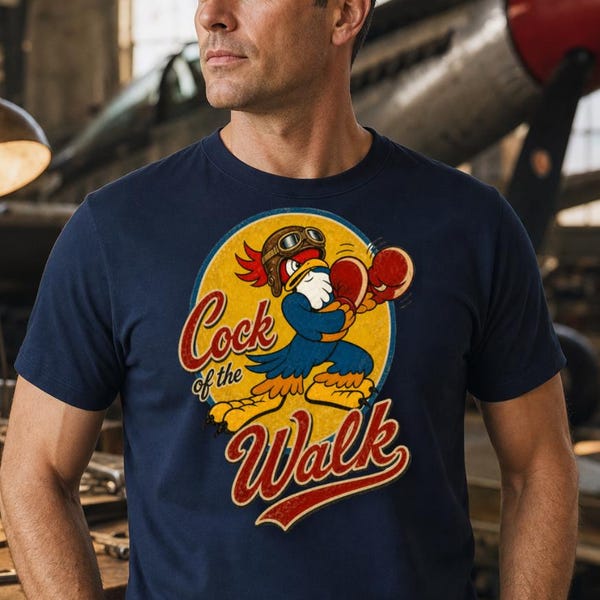
The animal cartoons carried attitude too. The cat — nine lives, always landing on its feet — was luck with a wink, the idea behind designs like Nine Lives. The rooster was pure swagger, chest out, spoiling for a fight. That’s exactly what the 388th Bomb Group painted on the B-17 below: a boxing rooster riding a bomb, the “Cock o’ the Walk.”


Did You Know? One of the RAF’s most famous fighter leaders, Wing Commander Ian “Widge” Gleed, flew a Spitfire painted with Figaro — the kitten from Disney’s Pinocchio — swatting a swastika. Even the aces were quoting cartoons.
Wear the mascots. The lucky cats, the fighting rooster, the ball-turret cat — the cartoon crew:



Luck & the Gamble
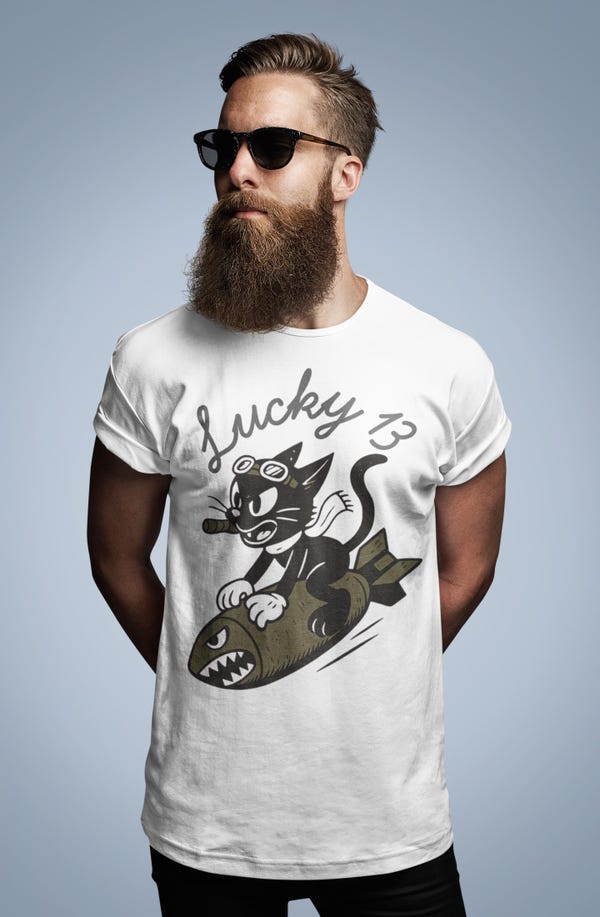
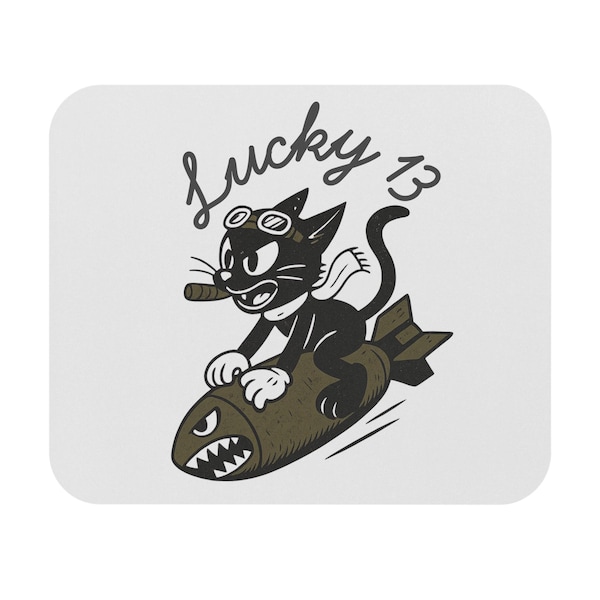
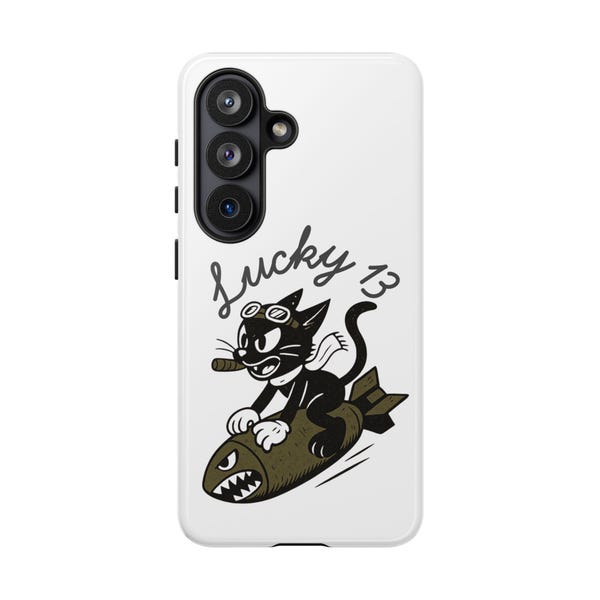
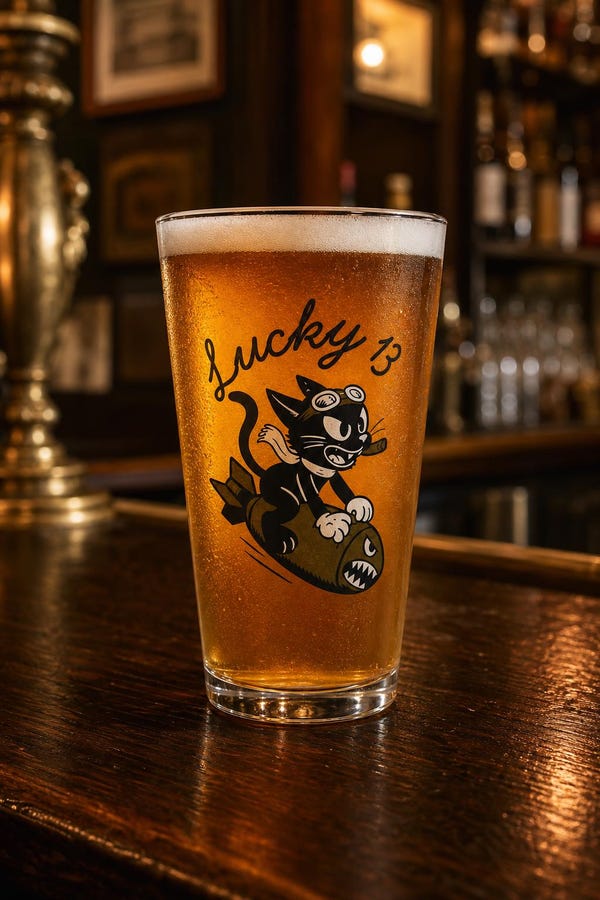
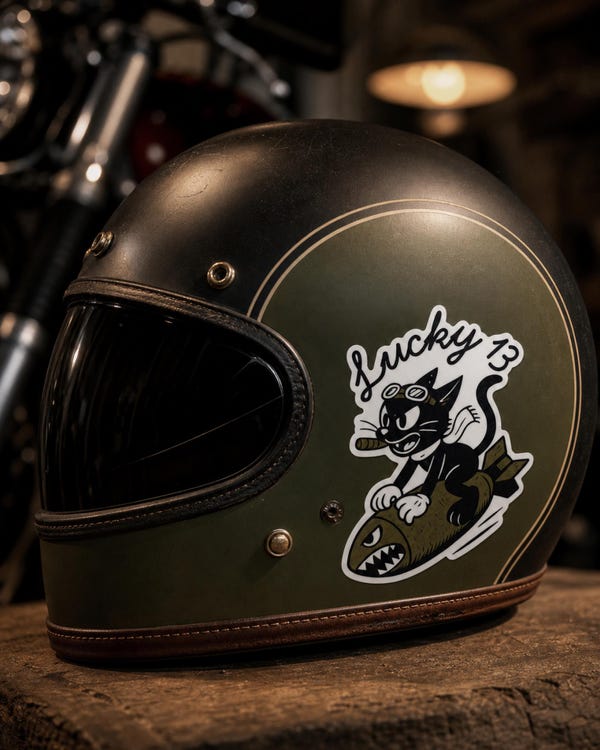
Fliers are famously superstitious, and nose art was where they made their luck visible. The black cat, the horseshoe, the pair of dice, the playing-card ace — these weren’t random doodles. Naming your luck was a way of controlling it, and daring the odds was its own kind of armor. The boldest move of all was to grab the unluckiest symbol there is and wear it on purpose — which is the defiance behind the number 13 and the Lucky 13 cat-and-bomb that started this whole series.
Wear your luck. The Lucky 13 cat-and-bomb — the boldest superstition in the sky — on a shirt, a mouse pad, a phone case, a pint glass:
Menace & Defiance

Not every crew wanted to look lucky — some wanted to look lethal. The shark mouth is the most recognizable nose art ever painted, and its lineage shows how these ideas traveled. German pilots painted toothy faces on aircraft as far back as WWI. The archetypal grin we picture today appeared on the Curtiss Tomahawks of RAF No. 112 Squadron in North Africa in 1941. A few months later, an American pilot with the Flying Tigers spotted it in a magazine photo, and commander Claire Chennault ordered every one of the group’s P-40s painted the same way — cementing the shark mouth in legend over the skies of China.
The grim reaper, the skull, the diving eagle — same job. These were designed to be read by the enemy as much as by the crew: a promise that this plane bites back.
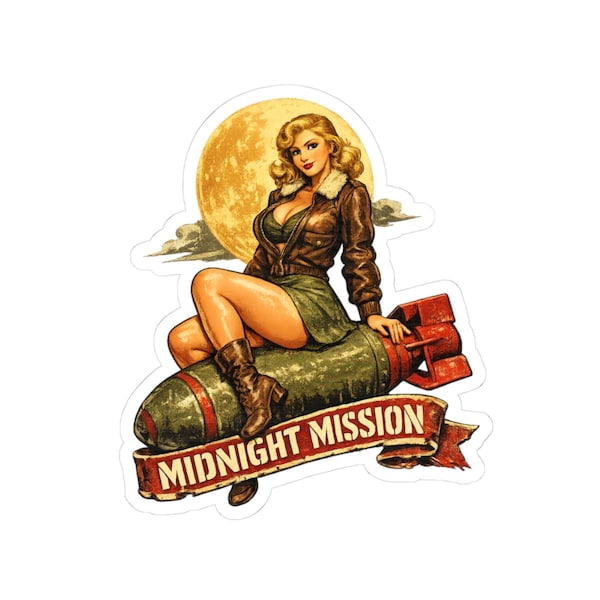
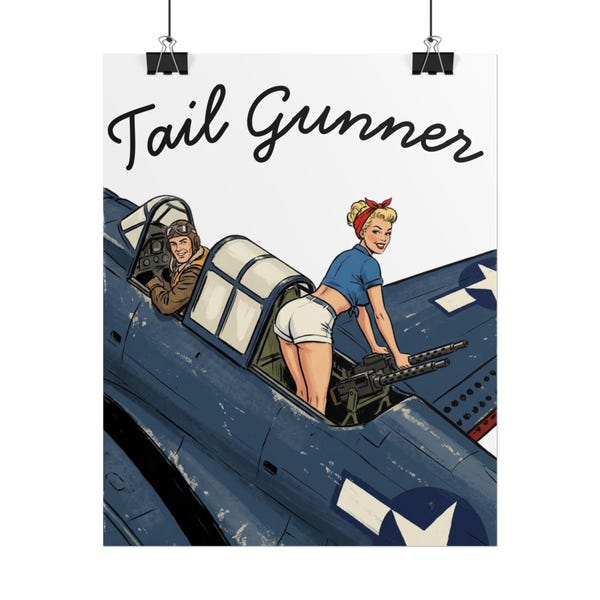
More from the nose-art shop. Bomber decals, the tail-gunner pin-up, and the crow’s-nest crew:

The Scoreboard — Reading a Plane’s Record
The most information-dense nose art wasn’t a picture at all — it was the tally beside it. On American bombers, every small painted bomb meant one completed mission. A different color or a star often marked a mission the crew led. And the kill marks told you who the plane had beaten: a swastika for a German aircraft, a fasces for an Italian, a rising sun for a Japanese one.
Fighter pilots had an even richer shorthand — an umbrella for flying top cover, a top hat for bomber-escort duty, a broom for a fighter sweep. Learn those few symbols and you can walk up to a restored warbird and read its entire combat biography off the nose, no placard required.
It Wasn’t Just the Americans: Decoding Allied Nose Art

Nose art is so tied to the American bomber in our imaginations that it’s easy to forget it was an Allied-wide language — and each air force spoke it with its own accent. Read a British, Australian, or Soviet plane and the grammar shifts.
The RAF: a colour-coded scoreboard
Bomber Command crews painted nicknames below the cockpit just like the Yanks, pin-ups and all — but their mission tally was a code all its own. A yellow bomb meant an operation; a red bomb marked a trip to “the Big City” (Berlin); a white bomb was a daylight raid; and an ice-cream cornet stood for a raid on Italy. The Lancaster “S-Sugar” above topped 100 operations and carried a mocking Goering quote its ground crew added; “The Phantom of the Ruhr” wore a Grim Reaper through 121 ops.

The Commonwealth: boxing kangaroos
Australian squadrons made the tradition their own. RAAF Lancasters wore an “Advance Australia” badge and boxing kangaroos, and instead of bombs some counted their operations as rows of little kangaroos. The target code got playful too — a beer stein marked “M” for Munich, an ice-cream cone for Italy — and mixed crews wore their heritage on the nose, like a kangaroo in a tartan kilt for an Australian-and-Scottish crew.
The Soviets: no pin-ups, all patriotism
The Red Army Air Force spoke a completely different dialect. Unlike the Americans and British, Soviet crews never painted pin-up girls. Their aircraft instead carried patriotic inscriptions and, above all, the names of the civilians and collectives who had paid for them — presentation planes bearing dedications like “From Lenochka, for her dad,” funded by a schoolgirl who collected money after her father was killed. Later in the war came predatory animals — lions and leopards — and pointed little cartoons, like a cat toying with a mouse, aimed squarely at the enemy.
Wear the Language
Every design above lives in the SunSpun Creations shop — printed on demand in the USA, free shipping, and 25% off right now.
WWII Nose Art: Frequently Asked Questions
What did pin-up nose art actually mean?
It usually meant one of two things depending on the style. A dangerous “femme fatale” claimed the plane’s power — the aircraft itself became the deadly woman. A sweetheart or girl-next-door pin-up meant home: a wife or girlfriend painted on as a good-luck talisman and a reason to make it back. Female figures were the most common motif of the war, at 43% of European-theater art and 66% in the Pacific.
Why did WWII planes have Disney and cartoon characters on them?
Cartoons turned a frightening war machine into a friendly mascot and defused fear with humor, while giving a unit a shared identity. Walt Disney Studios actually designed nearly 1,300 unit insignia for free during the war, with Donald Duck the most requested character by far.
Did other countries paint nose art, or just the Americans?
It was an Allied-wide tradition. The RAF painted pin-ups and colour-coded bomb tallies (a red bomb meant Berlin, an ice-cream cornet meant Italy); Australian squadrons used boxing kangaroos; and the Soviets, who never used pin-ups, inscribed their planes with patriotic dedications and the names of the civilians who paid for them.
What is the most famous piece of nose art?
The shark mouth. It was popularized by the RAF’s No. 112 Squadron in North Africa in 1941 and made legendary by the Flying Tigers on their P-40s over China — the single most copied nose-art design in aviation history.
Did the U.S. Navy allow nose art?
No. The U.S. Navy and Marine Corps officially forbade nose art, which is why the famous pin-ups and cartoons rode Army Air Forces bombers and fighters. Naval aviators expressed the same impulse on flight-jacket art instead.
What do the little bombs painted on a plane’s nose mean?
They’re a mission scoreboard — one small bomb for each completed mission. On RAF aircraft the colour mattered: a red bomb meant a raid on Berlin. Separate symbols like swastikas or rising suns recorded enemy aircraft the plane had shot down.
The Bottom Line
Nose art was a language of luck, love, and defiance, painted by kids — American, British, Australian, Soviet — who had every reason to be afraid and found a way to answer back in colour. Once you can read it — the femme fatale and the sweetheart, the lucky cat and the fighting rooster, the shark’s teeth and the little rows of bombs — you’re not just looking at old airplanes anymore. You’re reading what those crews were thinking, one nose at a time.
Keep Reading
- WWII Bomber Nose Art: The Story of Lucky 13 & America’s Greatest Aircrews — where the tradition came from and the artists who painted it.
- F4U Corsair: The “Whistling Death” — the bent-wing fighter the Japanese learned to fear.
- F6F Hellcat: The Zero Killer — the Navy fighter that turned the Pacific air war.
More from the shopBrowse the full WWII aviation & nose art collection — tees, prints, glassware and gifts, all original designs.

Ben & Nicole Mathews
We’re based in St. Augustine, Florida, sharing the places we’ve actually been — from our home turf to corners of the U.S. and abroad. Ben is an attorney and a retired Air Force JAG (22 years), and a private pilot, which is why aviation and military history shows up here too.