

There are roughly 10,000 waterfalls in Iceland. Nobody has actually counted them — that’s a real estimate from Icelandic tourism authorities, who basically gave up trying. Most of them are anonymous: a ribbon of meltwater dropping off a cliff somewhere out in the highlands, no name, no parking lot, no Instagram tag. And then there is Skógafoss.
Skógafoss is the one almost everyone has seen, even if they’ve never been to Iceland. It’s the wall of water you’ve watched in Game of Thrones, in Marvel’s Thor: The Dark World, in Justin Bieber’s “I’ll Show You” video, and in roughly half the “epic Iceland drone footage” reels on the internet. Sixty meters of river dropping straight off a cliff in one clean sheet, throwing up a permanent fog of mist that turns the late-morning sun into rainbows you can practically lean against.
But the part nobody puts in the Instagram caption is the reason that cliff is even there. Or the legend of the Viking treasure chest buried right behind the falls. Or the 527-step staircase next to it that 80% of visitors never climb — the one that opens up into one of the most surreal landscapes on the entire south coast.

The cliff that used to be the coastline
Here’s the geological setup, because it explains everything else about this place.
Skógafoss drops over a cliff that, in another era, was Iceland’s actual ocean coastline. About 12,000 years ago — toward the end of the last Ice Age — the sea level along Iceland’s south coast was much higher and the shoreline ran inland in a long, dramatic line of cliffs. As the glaciers retreated and the land itself began to rebound (a process called isostatic rebound, where land that was crushed under ice slowly springs back up over centuries), the sea pulled back. The old coastal cliff line stayed behind, abandoned, with a brand-new flat coastal plain stretching out in front of it for several kilometers.
Today, you can drive along the Ring Road and see this old cliff line as a continuous wall on your left, running parallel to the highway for miles. Skógafoss is just one of dozens of waterfalls dropping over that ancient sea cliff — they all formed because rivers up on the highland plateau had nowhere to go but straight off the edge. Seljalandsfoss, the famous “walk behind it” waterfall about 30 km to the west, is dropping over the same cliff. So is Gljúfrabúi. So is Kvernufoss, hidden in a slot canyon a 20-minute walk from the Skógafoss parking lot.
It’s basically one continuous stage with multiple actors. Skógafoss is just the loudest one in the cast.
Did You Know?
The cliff at Skógafoss is still slowly eroding backward at a measurable rate. The waterfall has retreated roughly 25 kilometers north from its original location at the coast over the past 10,000 years, carving the river canyon you can hike up today. Stand at the base of the falls and you’re standing roughly where the Atlantic Ocean used to be when humans were still figuring out agriculture.
The legend nobody tells you at the parking lot

Now for the part that makes Skógafoss more than just a pretty waterfall.
Sometime around 900 AD — give or take a few decades — a Viking settler named Þrasi Þórólfsson made his home in the village of Skógar, just downstream of the falls. The Icelandic sagas describe Þrasi as a powerful and somewhat mysterious figure, possibly a sorcerer, certainly wealthy. According to local legend, Þrasi buried a chest of gold and treasure in a cave behind Skógafoss before he died, and the chest has been there ever since.
For centuries, locals tried to retrieve it. The mist made the cliff face slick. The ledge was too narrow. And the chest was, by some accounts, protected by Þrasi’s own magic. Then, sometime in the 1600s or 1700s — the dates vary depending on who’s telling the story — a young farm boy and a few friends decided to try. They climbed in behind the falls, found the chest, and managed to get a rope through one of its iron rings. They started pulling.
The ring came off. The chest stayed.
By the time the boy walked back to Skógar village, the ring was the only thing he had to show for it. He gave the ring to the local church, where it was eventually attached to the church door as a handle. That ring still exists. It is on display today at the Skógar Folk Museum (Skógasafn), about a five-minute walk from the falls. The chest, presumably, is still behind the water.
I’ll let you decide what you believe. What I’ll say is that there is something genuinely strange about standing at the base of Skógafoss and knowing that, for over a thousand years, people have been telling exactly this story about exactly this place. The waterfall doesn’t care. It just keeps falling.
From the Shop
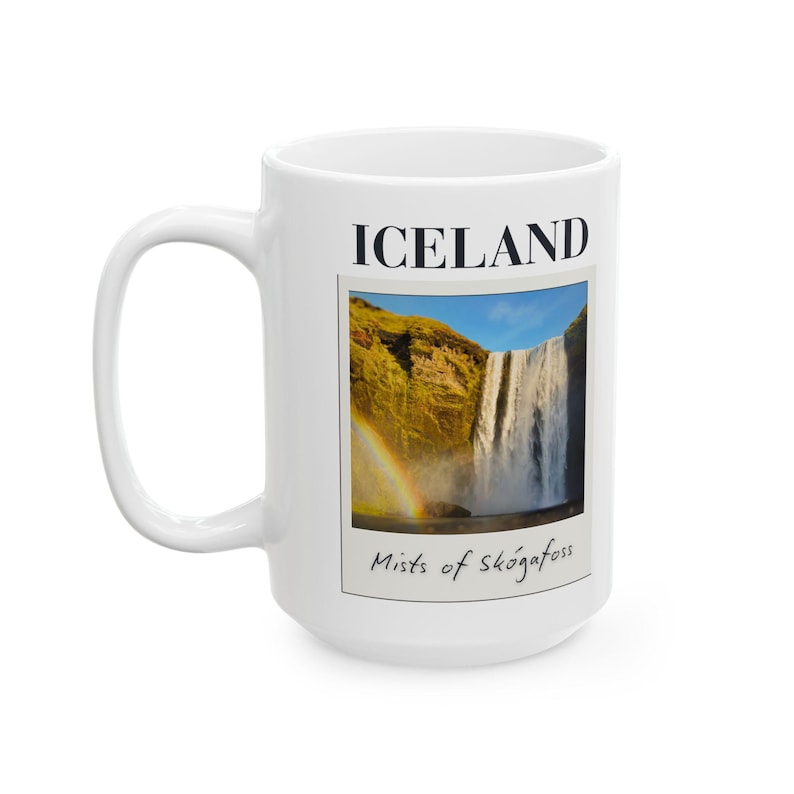
Skógafoss Iceland Coffee Mug
The rainbow waterfall on a mug — the same view that knocked us sideways with mist. Add it to your morning coffee routine and let Þrasi’s waterfall start your day.
What it’s actually like to walk up to it
The first thing that surprises you isn’t the waterfall. It’s the sound.
You hear Skógafoss from the parking lot. You hear it before you see it. By the time you’ve walked the flat, gravel-and-grass path from the car park to the base — maybe a five-minute stroll — the sound has gone from “river” to “highway tunnel.” When you finally round the small rise and the falls open up in front of you, the noise is so loud that conversation just stops. People around you stop trying to talk and start filming.
The second thing that surprises you is the spray. Skógafoss is 25 meters wide and falls 60 meters straight down (about 82 feet wide, 200 feet tall). The Skógá river dumps an absurd volume of water over that cliff every second, and when all of that water hits the pool at the bottom, it explodes back up in a cloud of mist that drifts hundreds of feet downwind. On a calm day, you can stand 50 meters back and still feel it on your face. On a windy day — which, in Iceland, is just “a day” — that mist gets blown sideways across the entire viewing area, and there’s no such thing as staying dry.
This is also why the rainbows here are so reliably absurd. The mist plume is so dense and so consistent that, any time the sun is anywhere in the sky, you get a rainbow. On really good days, you get a double rainbow. We’ve stood at the base watching the rainbow shift positions as we walked — you can chase it.
The pebble-and-volcanic-rock beach at the base of the falls is open to walk on, and the Skógá river curves out from the pool and runs down toward the village. You can wade up to about 10 or 15 meters from the falling water before the spray makes it pointless. People do it for the photos. Bring a microfiber cloth. Wipe your lens. Try again.
Did You Know?
Skógafoss has appeared in more major film and TV productions than any other waterfall in Iceland. Game of Thrones used it as a backdrop in Season 8. Marvel’s Thor: The Dark World used it for a sweeping aerial shot. Ridley Scott’s Prometheus opened with sweeping helicopter shots of waterfalls in the same general region. The Icelandic Film Commission estimates that Skógafoss alone generates millions of dollars a year in tourism just from people coming to see “that waterfall from that movie.”
The 527 steps most people skip

Here is the part of Skógafoss that most visitors never see.
To the right of the falls, bolted to the side of the cliff, there’s a metal staircase. It runs from the base all the way to the top — a vertical climb of about 60 meters (200 feet), broken into a series of switchbacks. The official step count varies depending on who you ask, but the number most often cited is 527 steps.
Most people in the parking lot look up at it, take a photo of someone else climbing it, and move on. Don’t be most people. The view from the top is one of the best on the south coast — and the trail that begins up there is even better.
The climb itself takes 10 to 15 minutes if you’re moving steadily and aren’t stopping every 20 steps to catch your breath. (We stopped every 20 steps to catch our breath. It’s fine. Everyone does.) The staircase is solid, it has handrails, and it’s been engineered to handle Iceland’s brutal weather. In high winds, though, it can feel like the whole thing is swaying — that’s normal, that’s how it’s supposed to flex, and you should still grip the rail like you mean it.
What you get at the top is a viewing platform that looks straight out over the lip of the falls. The Skógá river comes barreling toward you across the highland plateau, narrows at the cliff edge, and then just disappears over the side. You can lean over the railing (carefully — there is no second chance here) and watch the water fall away beneath you. On a clear day, you can see the Atlantic Ocean from up there, several kilometers south, with the flat coastal plain stretching out between you and the sea. That entire plain used to be ocean.
Safety Note
The viewing platform at the top is fenced, but the surrounding cliff edge is not. Every year, tourists in Iceland are injured or killed by ignoring barriers and getting too close to cliff edges for photos. Skógafoss is no exception. The wind can gust hard enough to push an adult off balance, and there’s nothing between you and a 60-meter drop except your judgment. Stay behind the railings. The shot you get from the platform is better than the shot you get from the edge anyway.
Waterfall Way — the trail nobody warned you about
This is the part that genuinely surprised us, and the reason I’d argue Skógafoss deserves more than the 30 minutes most tour buses give it.
From the top of the staircase, a hiking trail follows the Skógá river upstream. This is the Fimmvörðuháls trail — a multi-day backpacking route that eventually crosses a mountain pass between two glaciers (Eyjafjallajökull and Mýrdalsjökull) and ends at Þórsmörk on the other side. The full route is about 25 kilometers and takes most hikers two days with an overnight at a mountain hut.
You don’t have to do the whole thing. You probably shouldn’t, unless you’ve planned for it. But you should walk at least the first hour or two. Because here’s what locals call this stretch: Waterfall Way.

The Skógá river above Skógafoss is essentially a continuous chain of waterfalls. Some estimates put the count at 22 named or significant falls in the first 8 kilometers of trail. None of them are as big as Skógafoss itself, but several are arguably more beautiful — narrower, more intimate, dropping into emerald pools with no railings, no parking lots, and almost no other people.
You walk the rim of a deep canyon for most of it. The trail is well-trodden but unpaved, and in places it skirts the edge with absolutely no barrier. Mossy lava boulders scatter the slopes. In late September, when we were there, the highland grasses were turning gold and rust-orange, and the contrast against the black volcanic rock and white water was something I’d never seen anywhere else.

If you only have an hour, walk to the second or third waterfall above the main falls and turn around. If you have three hours, you can get to the fifth or sixth and back comfortably. If you have a full day and serious hiking gear, the Fimmvörðuháls trail keeps going up into terrain that was actively erupting as recently as 2010, when the Eyjafjallajökull eruption — the one that grounded European air traffic for weeks — opened a new fissure right next to this trail.
The lava field from that 2010 eruption is still there. You can walk across it. The rock is still warm in places, more than a decade later, where geothermal activity hasn’t fully cooled.
Did You Know?
When Eyjafjallajökull erupted in April 2010, it created two brand-new mountains right on the Fimmvörðuháls pass — small craters named Magni and Móði, after Thor’s two sons in Norse mythology. The names were chosen by a public vote in Iceland and made official. Hike a few hours up Waterfall Way and you can stand on volcanic rock that didn’t exist when most people reading this were already adults.
From the Shop
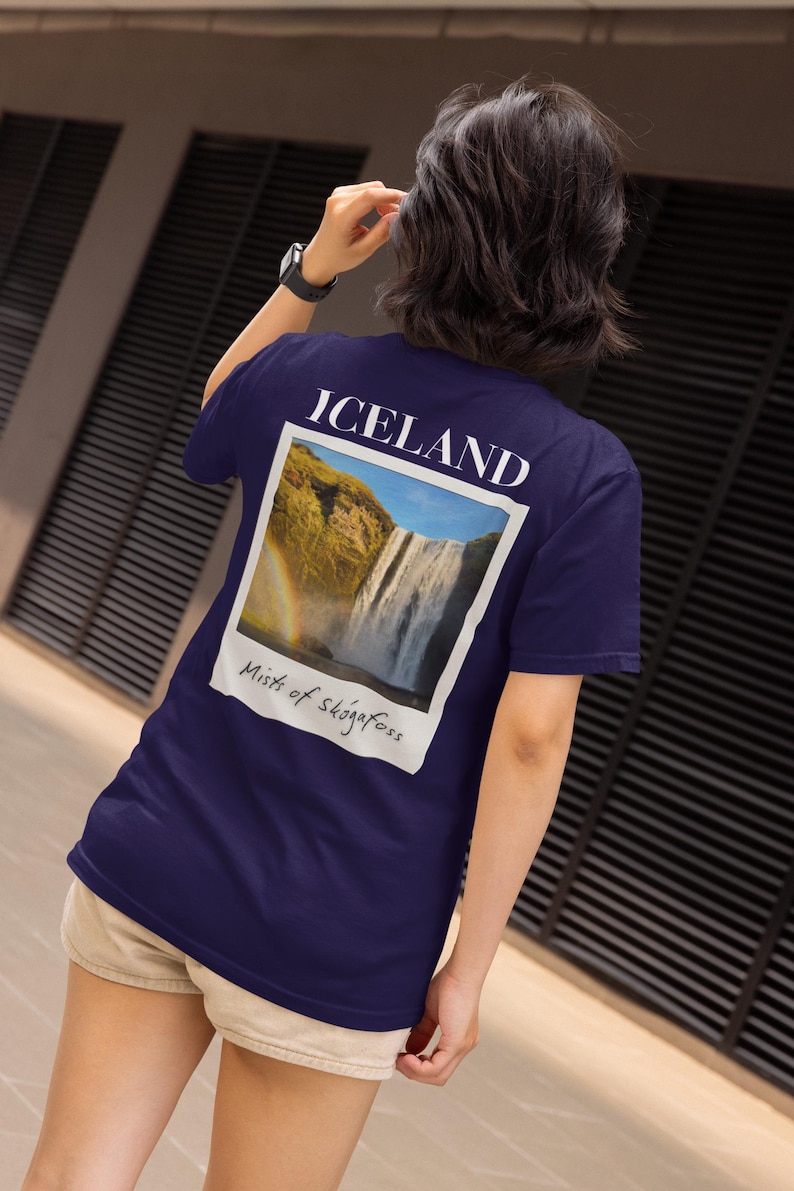
Skógafoss Iceland Waterfall T-Shirt
A polaroid of the rainbow waterfall on a soft cotton tee. The trip on a t-shirt — wear the morning we nearly got blown off the trail.

Skógafoss Travel Souvenir Tee
A second cut and color of the same waterfall — for anyone who already has the mug and wants the matching shirt. Soft, comfortable, and instantly recognizable to anyone else who’s been to Iceland’s south coast.
How Skógafoss connects to the village (and the museum)
The village of Skógar sits at the foot of the falls — population roughly 25, depending on whether you count summer guesthouse staff. It’s tiny. It’s also home to one of the best folk museums in Iceland.
The Skógar Folk Museum (Skógasafn) was founded in 1949 by a local schoolteacher named Þórður Tómasson, who spent literally his entire adult life collecting artifacts of rural Icelandic life. By the time he was finished, the museum housed more than 18,000 items — fishing equipment, farming tools, embroidered textiles, hand-carved wooden objects, religious artifacts, and the ring from Þrasi’s chest. Þórður lived to be over 100 and gave personal tours of the museum well into his 90s. He passed away in 2022.
The museum is split into three parts: the main artifact building, a transport and technology museum (with old cars, telephone exchanges, and the first tractor in Iceland), and an open-air section with restored turf-roof houses and a wooden church that you can walk through. The turf houses are the same kind referenced in our Ring Road write-up — buried into hillsides for insulation, with grass roofs that were essentially the original “green” architecture.
You can do the museum in 90 minutes if you’re moving briskly, or you can spend a full half-day if you read every placard and let yourself get pulled into the textile room. Tickets in 2026 are about 2,500 ISK (around $18). Worth it. You will not see another folk museum in Iceland this dense and this lovingly assembled.
Did You Know?
The wooden church at the Skógar Folk Museum was built in the 1990s — but it’s a faithful reconstruction using wood and design elements from older churches across Iceland, some pieces dating back to the 1700s. The pulpit is from 1768. The chandelier is from 1780. It feels older than it is, and that’s intentional.
Practical visit info (the stuff guidebooks bury)
Where it is: Skógafoss sits directly off Iceland’s Ring Road (Highway 1), about a 2-hour drive east of Reykjavík and 30 minutes east of Seljalandsfoss. The turnoff is signed and impossible to miss — you can literally see the falls from the highway as you approach.
Parking: Free. There’s a large gravel lot at the base of the falls. In summer it can fill up by mid-morning; in winter it’s almost always available. Tour buses arrive in waves between 10 AM and 3 PM, so go early or late if you want quiet.
Cost to visit the falls: Zero. Skógafoss is on public land, no entry fee, open 24/7. You can technically visit at midnight in June and have it almost entirely to yourself in the soft Arctic twilight.
Bathrooms and food: There’s a small visitor service area at the parking lot with bathrooms (paid, around 200 ISK) and a café. The Hotel Skógafoss restaurant a few hundred meters back has solid Icelandic food including the lamb soup you’ll see everywhere on the south coast.
Best time of day for photos: Late morning to early afternoon, when the sun is high enough to hit the spray and produce rainbows. Sunrise and sunset light the cliff face beautifully but the rainbows aren’t reliable.
Best time of year: Honestly, any. In summer you get long daylight and the easiest hiking conditions. In winter you sometimes get partial ice formations along the edges of the falls (it’s too high-volume to fully freeze), and the chance of catching the northern lights overhead. In autumn — which is when our photos were taken — the surrounding tundra turns gold and the light is dramatic. There’s no bad season; there’s just different versions of stunning.
What to wear: Waterproof jacket, waterproof pants if you plan to get close, sturdy shoes with grip. The basalt around the pool is wet and slick year-round. If you’re climbing the staircase, bring layers — it’s noticeably colder and windier at the top than at the base.
Skógafoss FAQ
How tall is Skógafoss?
Sixty meters (about 200 feet) tall and 25 meters (82 feet) wide. It’s not Iceland’s tallest waterfall — that title goes to Morsárfoss in Vatnajökull National Park at 240 meters — but it’s one of the largest by volume on the south coast and arguably the most photogenic.
Can you walk behind Skógafoss?
No. That’s a common mix-up with Seljalandsfoss, the other famous south coast waterfall about 30 km west, which does have a path behind it. At Skógafoss, the spray is so intense and the pool so deep that walking behind it is impossible (and would be a very bad idea even if it weren’t).
Is the climb to the top worth it?
Yes. Hands-down yes. The view from the platform is the best part of visiting Skógafoss, and the trail beyond it (Waterfall Way / Fimmvörðuháls) is one of the most underrated short hikes in Iceland.
How long should I plan to spend at Skógafoss?
Minimum: 45 minutes (just the base and a quick climb up). Ideal: 2–3 hours (base, climb, walk to the second or third waterfall above, walk back). Full experience: half a day or longer if you continue the Fimmvörðuháls trail.
Can I swim in the pool?
Technically not prohibited, but the water is just above freezing year-round, the pool is deep, and the falling water creates dangerous undertows. Don’t.
Is Þrasi’s treasure chest really back there?
Officially? It’s a legend. Unofficially? The ring at the Skógar Folk Museum is real, the door it came off is documented, and the story has been passed down for over a thousand years. Make of that what you will.
The bottom line
Skógafoss is one of those places that’s famous for a good reason and yet still somehow underrated. Most visitors stop at the base, take their photo with the rainbow, and drive on to Vík. You can do that. It’s still a great visit.
But the ones who climb the staircase, walk the trail above, and spend an afternoon poking around the Skógar Folk Museum end up with a completely different experience. They see the cliff that used to be a coastline. They walk past 22 waterfalls in a single morning. They stand on lava that erupted in 2010 and look out toward an ocean that used to lap up against the rock under their feet.
And they leave knowing that somewhere behind that wall of water, according to a thousand-year-old story, there’s still a Viking treasure chest waiting for somebody patient enough to figure out how to get it out.
From the Shop
Skógafoss Iceland Coffee Mug
Rainbow waterfall, ceramic mug, your morning coffee. The trip on a mug — and a daily reminder of the morning the wind tried to send the spray sideways into our hoods.
If you liked this one…
If Iceland’s south coast pulled you in, the rest of our Iceland coverage will scratch the same itch. The Ring Road Adventure Guide covers the full 10-day loop and the stops worth slowing down for, and the Diamond Beach deep-dive explains the geological pipeline that delivers thousand-year-old glacier ice onto a beach of pulverized volcanic basalt about four hours east of here. The Driving in Iceland guide walks through F-roads, weather, fuel logistics, and the small operational stuff that makes the difference between a great trip and a stranded one.
If you’re plotting your next trip somewhere completely different, our Venice Travel Guide covers what to actually see, eat, and do in the lagoon city, and the Murano glass factory write-up is one of our favorite half-day side trips out of Venice. Closer to home, the St. Augustine Travel Guide is a good one for anyone who wants old forts, sea breezes, and the oldest continuously occupied European-founded city in the U.S., and our Hidden Gems in Pittsburgh roundup is the locals-only stuff most tourists never find.
More from the shopBrowse the full travel wall art collection — canvas prints and posters of Iceland’s south coast, Paris and Eilean Donan.

Ben & Nicole Mathews
We’re based in St. Augustine, Florida, sharing the places we’ve actually been — from our home turf to corners of the U.S. and abroad. Ben is an attorney and a retired Air Force JAG (22 years), and a private pilot, which is why aviation and military history shows up here too.