

Some airplanes are fast. The SR-71 Blackbird was a different category of fast — the kind that breaks the brain a little when you actually sit with the numbers. Mach 3.2-plus. 85,000 feet. New York to London in under two hours, with margin. And it did all of it in the 1960s, with slide rules and titanium and a fuel that wouldn’t even ignite if you dropped a match in it.
Pilots wore actual pressure suits — not “fancy flight suits,” real space suits — because at altitude the cockpit air was thin enough to boil your blood. The plane leaked fuel on the runway as a feature, not a bug. And in over 30 years of operation, in some of the most heavily defended airspace on Earth, no SR-71 was ever shot down.
That’s not a brag. That’s just what happened when you outran the missile.

Built for a problem that didn’t exist yet
By the early 1960s, the U-2 spy plane was getting nervous. Gary Powers had just been shot down over the Soviet Union in 1960, and it became clear that flying high wasn’t going to be enough anymore. The Russians had surface-to-air missiles that could reach above 70,000 feet. The CIA needed something faster, higher, and stealthier — and they needed it from the only people in America who built airplanes like sorcery: Lockheed’s Skunk Works, run by the legendary Kelly Johnson.
What Skunk Works delivered wasn’t really an airplane. It was a thermodynamics experiment with wings. The SR-71 had to fly faster than 2,000 mph for hours at a time, and at those speeds the leading edges of the wings hit roughly 600 degrees Fahrenheit. Aluminum melts. Steel warps. Johnson’s team built almost the entire airframe out of titanium — which the United States, ironically, didn’t have enough of. So the CIA quietly bought it from the Soviet Union through dummy front companies. America’s Cold War spy plane was built from the enemy’s metal. Still one of the great pieces of trivia in aviation history.
Did You Know?
The SR-71’s titanium frame expanded so much during high-speed flight that the plane was effectively designed to be too small on the ground. The fuel tanks didn’t fully seal until the airframe heated up and grew. That’s why every Blackbird mission started with a leaky takeoff and an immediate refueling — covered in detail below.
The fuel that wouldn’t burn
Regular jet fuel can’t survive Mach 3. The friction heat alone would cook it in the lines. So Skunk Works invented a new fuel: JP-7. It has a flash point so high you can literally extinguish a lit match in it. Drop a torch in a bucket of JP-7 and the torch goes out.
Which is great for not exploding at 600 degrees. Less great for actually starting the engines. JP-7 was so reluctant to ignite that the SR-71 needed a chemical called triethylborane — TEB — to light up. TEB ignites the second it touches air. Each engine carried just enough TEB for about 16 starts: one for engine start on the ground, and the rest for in-flight afterburner relights. Run out of TEB at altitude, and you weren’t getting your afterburners back.

Why the Blackbird leaked on the runway (on purpose)
This is the one that surprises people the most. The SR-71’s fuselage was built with intentional gaps. At cruising speed, the entire airframe heated up and expanded several inches in length — the body literally got longer in flight. To accommodate that thermal expansion, the panels and fuel tanks were built loose at room temperature. They sealed once the plane was hot.
That meant on the ground, the Blackbird leaked JP-7 like a punctured oil drum. Ground crews didn’t even try to stop it. The plane took off with a partial fuel load — enough to get airborne and accelerate — and then immediately rendezvoused with a KC-135Q tanker (a special variant built specifically for JP-7) for a top-off once the airframe had heated and sealed. Every operational mission started with a leaky takeoff and an aerial refueling. It’s one of the few production aircraft ever designed where “leaks fuel on the ramp” was a checklist item, not a maintenance gripe.
And here is the part almost everyone gets wrong. The leaking is not actually why the Blackbird refueled straight after takeoff. Col. Richard Graham, who flew the SR-71 and later commanded the wing, has been blunt about it: the jet leaked, but nowhere near enough to require a tanker twenty minutes into the mission. The real reason was nitrogen. JP-7 climbs past 300°F at cruise, and the vapor sitting in a half-empty tank at that temperature is an explosion waiting for a spark. So the Blackbird carried liquid nitrogen in dewars in the nose wheel well. Filling the tanks completely after takeoff pushed every last pocket of ordinary air out of the system, and from that point on, nitrogen gas backfilled the space as the fuel burned away. The tanks were never allowed to contain anything flammable in the empty half. The plane topped off after takeoff to make the fuel safe, not to make up for what dripped onto the ramp.
The pressure suit: pilots dressed for space
At 85,000 feet, the air pressure outside is about 0.4 psi. If a Blackbird pilot lost cabin pressure with anything less than a sealed full-pressure suit, the moisture in their lungs and bloodstream would start to boil. Not in a “feel sick” way. In a “you have seconds” way.
So SR-71 pilots wore the David Clark S1030 — a full pressure suit nearly identical to what NASA astronauts wore. Helmet, gloves, integrated oxygen supply, the works. It took about 30 minutes to suit up before each flight, and pilots ate a high-protein, low-residue meal beforehand because, well, you weren’t getting up to use the bathroom. The pre-flight ritual looked more like a Mercury launch than a military sortie. In a real sense, the SR-71 wasn’t just an airplane. It was the lowest, slowest spacecraft America ever flew.
Did You Know?
The Blackbird’s windscreen got so hot in flight that the quartz glass — chosen because regular glass would crack — would heat the cockpit through radiation alone. Pilots reported that the inside of the canopy was uncomfortably warm to touch even through a flight glove, while the outside air was around minus 60 Fahrenheit.
Outrunning the missile
The SR-71’s defensive doctrine was beautifully simple: don’t dodge — accelerate. Surface-to-air missiles were built to chase aircraft that flew at 500 to 1,500 mph. The Blackbird could exceed Mach 3.2 and was already cruising above 80,000 feet. By the time a SAM site detected the Blackbird, calculated a firing solution, and got a missile up to altitude, the SR-71 had already moved miles down range.
Over its operational career, the SR-71 had more than 1,000 surface-to-air missiles fired at it across multiple theaters — Vietnam, North Korea, the Middle East, Eastern Europe. Not a single one connected. Not. One. The aircraft was lost to mechanical failures, fuel issues, and accidents over the years, but never to enemy fire. It’s the only operational reconnaissance asset in modern history with a perfect combat survival record against active SAM threats.
The official tactic when SAM launches were detected? Push the throttles forward and climb. That’s it. The Blackbird literally ran away from missiles for thirty years.
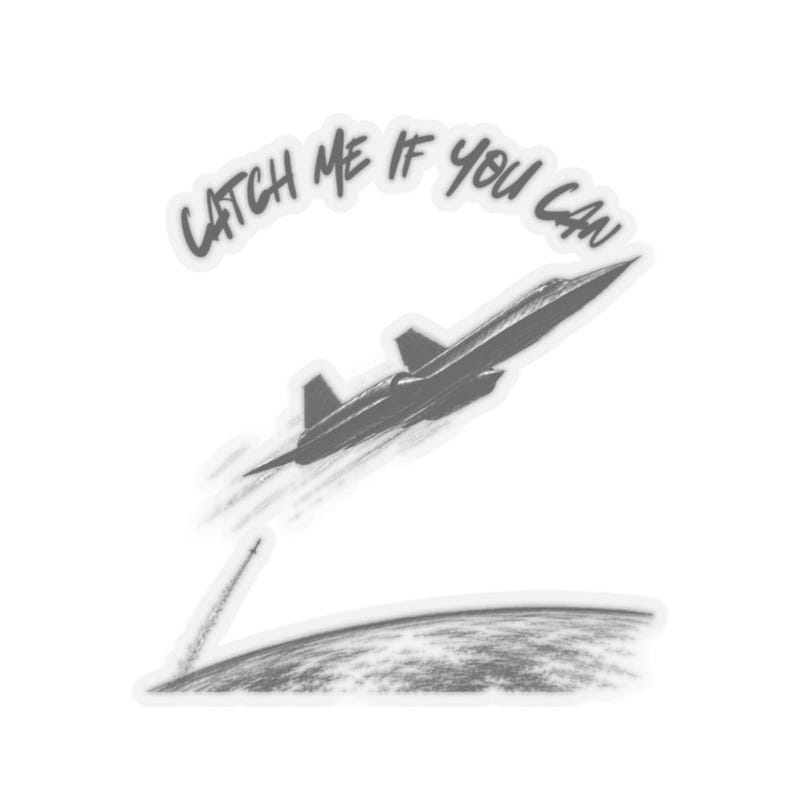
SR-71 Blackbird “Catch Me If You Can” Sticker
The Blackbird’s entire defensive doctrine, printed small enough for a laptop lid or a water bottle. Durable weatherproof vinyl, and the only aircraft in history whose evasive maneuver was simply to leave.
The “LA Speed Check” — every aviation nerd’s favorite story
This story comes from Brian Shul, an SR-71 pilot who later wrote about it in his book Sled Driver, and it’s one of the most famous radio exchanges in aviation history. Shul and his RSO, Walter Watson, were flying an SR-71 over Southern California one afternoon when the radio chatter got interesting.
A Cessna pilot called Los Angeles Center asking for a ground speed check. Center came back: 90 knots. Then a Twin Beech asked the same. Center: 120 knots. Then an F-18 Hornet pilot called in, clearly showing off, asking for a ground speed check. Center: 525 knots. There was a pause on the radio.
Then Watson keyed the mic from the Blackbird and said, “Ah, Center, Aspen 20, you got a ground speed readout for us?” Long pause. Then Center came back, very calmly: “Aspen 20, I show you at 1,742 knots, ground speed.” That’s roughly Mach 3.2, casually, on a Tuesday afternoon, over Los Angeles. Shul described it as the moment the entire Southern California flight frequency went silent. He said you could hear pilots smiling through the static.
Shul has told that story in interviews for years and it remains the cleanest, most uniquely Blackbird flex in aviation. No bragging required. The numbers did the work.

Things even aviation nerds don’t always know
The black paint wasn’t for stealth — it was for cooling. The Blackbird’s iconic black coating was a special iron-ferrite radar-absorbent paint, but its main job was thermal management. Black actually radiates heat better than lighter colors at high temperatures, and at Mach 3 the airframe needed every bit of cooling help it could get. The stealth properties were a bonus.
The plane could outrun its own shadow on the ground in some conditions. Not metaphorically — Brian Shul described moments at altitude where the SR-71’s projected ground shadow couldn’t keep up at certain sun angles. That’s what 2,200 mph looks like when you do the geometry.
The cockpit instruments included a periscope. Because the nose was so long and the angle of attack at takeoff was severe, pilots couldn’t always see the runway directly. A small downward-facing periscope let them check what was happening straight below, especially during the unique pitch attitudes of high-altitude cruise.
It was retired twice. The Air Force first retired the SR-71 in 1990 for budget reasons. Three were brought back into service in 1995 because nothing else could do the job. They were retired again in 1998. NASA flew two more until 1999 for high-speed research. The plane outlived multiple generations of replacements that were supposed to make it obsolete.
The fastest official flight took place during the retirement ferry flight in 1990. Pilot Ed Yeilding flew an SR-71 from Los Angeles to Washington D.C. in 64 minutes and 20 seconds — averaging just under 2,150 mph across the country. It was the plane’s last hurrah, and it set four world speed records on the way to its final resting place at the Smithsonian.
Nothing has officially replaced it. Satellites took over much of the strategic reconnaissance mission, but for tactical, on-demand, high-resolution imagery from a maneuverable platform, the SR-71’s full capability has never been duplicated by an aircraft in U.S. service. The SR-72 has been talked about for years, but no Mach 3+ manned reconnaissance jet has flown to replace the Blackbird.
Why the Blackbird hits different
Most fighters and bombers are about killing things efficiently. The SR-71 was about the pure pursuit of speed and altitude as a survival strategy. It didn’t carry a single weapon. It just went faster and higher than anyone could shoot, and brought back pictures. There’s something deeply elegant about a war machine that wins by refusing to fight.
At Mach 3 the engines were barely turbojets anymore
The two J58s hanging off the Blackbird’s wings are usually described as turbojets, and at low speed that is exactly what they are. Above roughly Mach 2 they stop behaving like it. Air entering the inlet is compressed so violently by the shock system in front of the engine that the compressor stage becomes almost incidental — six bypass tubes shunt air around the core and dump it straight into the afterburner, which is doing most of the work. By Mach 3.2 something like four fifths of the thrust is being produced by the inlet and the afterburner rather than the turbine at the center. The airplane is, functionally, flying on a pair of ramjets that happen to have a turbojet buried inside them for takeoff.
This is what the movable spikes in the nose of each nacelle are for. Those cones slide backward as much as 26 inches as speed builds, walking the shock wave into exactly the right position so the air arriving at the engine face has been slowed to subsonic speed. Get it right and the inlet is a free supercharger. Get it wrong and you get the single most violent thing that could happen to a Blackbird crew.
The unstart: when one engine tried to throw the airplane off the road
An unstart is what happens when the shock wave escapes forward out of the inlet. The engine on that side instantly loses most of its usable airflow, and with it most of its thrust — while the engine on the other side is still producing full power at Mach 3. The result is an asymmetric shove so hard that crews described their helmets slamming into the canopy, cockpit dust filling the air, and instruments becoming briefly unreadable. Pilots did not describe it as a vibration. They described it as being hit.
The fix was as aggressive as the failure. Early aircraft relied on the crew to catch it; later the automatic system would deliberately unstart the good inlet too, sacrificing all thrust on both sides to restore symmetry before recycling both inlets back to normal operation. Choosing to break the working engine on purpose is not a normal engineering decision. At 80,000 feet and three times the speed of sound, a straight airplane with no thrust is survivable and a crooked airplane with half its thrust is not.
The small details are the strangest part
The tires had aluminum in them and were filled with nitrogen. Ordinary rubber could not survive the heat soaking down through the wheel wells, so Blackbird tires used a heat-resistant compound containing aluminum powder. They were inflated with nitrogen rather than compressed air, because air brings moisture and oxygen along with it — and moisture and oxygen at those temperatures are a fire waiting for an excuse.
The airplane could only be lit a certain number of times. JP-7 is so reluctant to burn that a spark plug will not do it, so each engine start and each afterburner relight fired a measured shot of triethylborane, which ignites the instant it meets air and leaves a green flash in the exhaust. The tanks held a finite number of shots. A crew could not sit there cycling the afterburners on and off out of curiosity, because there were only so many matches in the box, and running out a long way from home was not a recoverable situation.
The wrong screwdriver could ruin a part. Titanium turned out to be allergic to the ordinary aircraft factory. Cadmium-plated tools left traces that embrittled the metal at temperature; chlorinated tap water was enough to corrode components during cleaning. Skunk Works had to invent tooling, wash procedures and quality controls from scratch, because decades of accumulated aluminum-airplane craft knowledge was actively harmful here. Lockheed’s own account of the program is fairly blunt that they were learning the material as they built with it.
The United States bought its titanium from the country it was spying on. The airframe needed enormous quantities of a metal the Soviet Union happened to be one of the world’s leading suppliers of. CIA histories describe acquiring it through third countries and front companies, without ever mentioning that the destination was an aircraft designed to photograph the Soviet Union at will.
The inside of the windscreen got too hot to lean on. Outside air at 80,000 feet sits somewhere around −70°F, and none of that helps you, because the heat is coming from compressing and scraping against the air rather than from the sun. Cockpit glass reached temperatures that made crews careful about where they rested a gloved hand or left a chart lying for too long. NASA’s flight research documentation on the aircraft returns to the same theme over and over: everything on board is a heat problem first.
It did not need to fly over you to photograph you. Moving at roughly 3,000 feet per second, the Blackbird crossed country-sized areas in minutes, and its sensors looked down and obliquely out to either side. It could image a target while remaining well outside a border — which is a large part of why so much of its later career was flown along frontiers rather than across them.
The speed limit was a temperature, not a number. The Blackbird was never redlined at a particular Mach number. The limit in the manual was compressor inlet temperature: 427°C. Because that depends on how warm the outside air happens to be, the actual top speed changed with the weather. On a cold day the crew could push the Mach number higher before hitting the same temperature. Pilots have said the airframe as configured would have gone to roughly Mach 3.55 so long as the temperature stayed inside limits.
The thing that ended a mission was nitrogen, not fuel. Because every tank had to stay inerted, the liquid nitrogen supply — not the fuel, which could be replaced by a tanker — set the ceiling on how long a Blackbird could stay out. In April 1971 a crew flew 15,000 miles in 10 hours 30 minutes with five aerial refuelings specifically to find out how many times they could refuel before the nitrogen gave out. It won them the Mackay Trophy.
It burned 44,000 pounds of fuel an hour and only held 80,000. Do that arithmetic and the aircraft has under two hours of endurance on a full load, which is why the tanker fleet mattered as much as the airplane. The Air Force converted 56 KC-135s to a special standard just to carry and transfer JP-7 without contaminating their own fuel.
The engine was originally a Navy project. Pratt & Whitney started what became the J58 in the late 1950s as a high-speed powerplant for the Navy, and the first examples ran in 1958 — before the A-12 existed. The bleed-bypass modification that let it behave like a ramjet at Mach 3 came later, grafted onto an engine designed for something else entirely.
The wings were corrugated, like a 1920s airliner. Major sections of the inboard wing skin were not smooth. Kelly Johnson machined small chordwise corrugations into them so that when the skin got hot it could accordion and deepen rather than buckle unpredictably — an expansion joint built into the panel itself. Engineers reportedly gave him grief for building something that looked like a Ford Trimotor. It worked.
The back-seater could not fly the airplane. The Reconnaissance Systems Officer had no stick, no throttles and no flight instruments. If something happened to the pilot, there was nothing the RSO could do about it from the rear cockpit except eject.
A set of tires lasted fewer than twenty landings. They came off the aircraft after about twenty touchdowns at roughly 170 mph, at something like $2,300 apiece. And when NASA later flew Blackbirds as research aircraft, it had to carry about 20 gallons of water aboard purely to cool the experiment electronics, circulating it at three gallons a minute, because there was no other way to keep instruments alive next to a 600°F skin.
The last one lost was buried at sea. When SR-71A 61-7974 was destroyed in 1989 and its wreckage recovered, the remains sat in a hangar and were so corrosive to morale that once the accident board finished, the Navy took the aircraft out and buried it several hundred miles from Okinawa, 25,597 feet down, on Christmas Eve.
The SR-71 was not actually the first Blackbird
The airplane that started the family was the CIA’s single-seat A-12 OXCART, smaller and lighter, flown by one pilot on behalf of an intelligence agency rather than an air force. The SR-71 came afterward: longer, heavier, two crew, and carrying a far broader reconnaissance suite. The distinction gets flattened in popular retellings, and the CIA has published a side-by-side explainer precisely because people keep confusing the two. If you have ever seen a Blackbird with a single canopy and wondered what was wrong with the picture, that was an A-12.
NASA flew it as a laboratory long after the spying stopped
Retired Blackbirds went to work on high-speed aerodynamics, propulsion and atmospheric research, and on at least one program the airplane became a telescope mount: an ultraviolet instrument was carried to roughly 83,000 feet, above most of the atmosphere that ruins that kind of observation from the ground. NASA’s own reporting from the period describes a Cold War reconnaissance aircraft finishing its career doing astronomy.
None of these were isolated party tricks. The fuel, the paint, the tires, the pressure suits, the sliding panel joints, the inlet spikes and even the navigation system were all answers to one question asked in different accents: how do you keep an aircraft and two human beings functioning while the outside of the machine is being cooked? Every strange thing about the Blackbird is downstream of that single problem.
Did the SR-71 carry any weapons?
No. Not a gun, not a missile, not a bomb, not a single hardpoint. For an aircraft that spent thirty-two years flying into hostile airspace, the SR-71 was completely unarmed, and that was a deliberate design decision rather than an oversight. Weapons mean weight, weight means drag, and drag at Mach 3 means heat the airframe could not shed. Every pound that went into a gun was a pound that came out of fuel, and fuel was what kept the aircraft above and ahead of everything trying to reach it. The speed was the weapon system.
That leads to the other question people ask, which is how many missiles were actually fired at it. You will see the number 4,000 repeated all over the internet, usually stated as fact. It does not appear in any Air Force or CIA document I could find. The figure that is actually sourced is far smaller and far more interesting: roughly 800 surface-to-air missiles were launched at Blackbirds over North Vietnam across the whole war, and not one of them connected. Eight hundred is not a disappointing number. Eight hundred missiles, zero hits, across a decade, is the entire argument for the airplane.
There is one genuine exception to the unarmed rule, and almost nobody outside the aviation world knows about it. Before the SR-71 there was the YF-12A, an interceptor version of the same basic airframe built to carry AIM-47 air-to-air missiles in internal bays where the reconnaissance sensors would later live. It was, briefly, the fastest armed aircraft ever built. It never entered service. The bays got the cameras instead, and the armed Blackbird became a footnote.
Was the SR-71 stealth? Sort of — but not the way people mean it
This one comes up constantly, and the honest answer is that the SR-71 was a stealth pioneer without being a stealth aircraft in the sense we use the word now. The chines running down the fuselage began life as a radar cross-section measure. The rudders were canted inward so they would not present a flat vertical face to a radar beam. The paint was loaded with radar-absorbing material. Kelly Johnson’s team was doing radar-signature work more than a decade before the F-117 existed, and the Blackbird’s return was genuinely smaller than its size suggests.
But a stealth aircraft is one you cannot find. The SR-71 was found constantly. Two afterburners running continuously at Mach 3 produce an infrared signature you could not hide if you tried, and Soviet and North Vietnamese radar operators tracked Blackbirds routinely. The aircraft was not built to be invisible. It was built to be visible and irrelevant — to be seen, plotted, fired at, and simply be somewhere else by the time the missile arrived. Stealth avoids the engagement. The Blackbird accepted the engagement and won it on physics.
The strangest chapter of that story belongs to the SR-71’s predecessor rather than the SR-71 itself. On the A-12, Lockheed tested a fuel additive designated A-50, roughly a third cesium metal, which ionized the exhaust plume in order to shrink the enormous radar return coming off the back of the aircraft. Kelly Johnson’s own declassified program history called it a basic part of their cross-section reduction methods. It was flight-tested by 1965 — plasma stealth, in the middle of the Cold War. Worth being precise here: this is documented for the A-12, and there is no solid evidence the operational SR-71 ever flew with it.
The man who came apart from a Blackbird at Mach 3.18 and walked away
On 25 January 1966, Lockheed test pilot Bill Weaver was at roughly 78,800 feet and Mach 3.18 when the right inlet unstarted during a programmed right bank. The aircraft departed controlled flight and broke up around him. What happened next is the part that gets retold wrong almost every time.
Weaver did not eject. In his own account he never touched the handle — the forces simply tore him out of the disintegrating airplane, still strapped into his seat. He blacked out. What saved him was the thing designed for an entirely different emergency: the full-pressure suit inflated and held together as a miniature escape capsule while he fell, his faceplate icing over so completely that he could not see the ground. The stabilizing chute deployed automatically, then the main canopy at 15,000 feet. He came down on a New Mexico ranch, and the rancher who found him had a helicopter on site almost immediately. He was flying again within two weeks.
His backseater, RSO Jim Zwayer, was killed by a broken neck during the breakup. That matters for a statistic worth sitting with: thirty-two Blackbirds were built and twelve were destroyed, every one of them in an accident rather than to enemy action — and Jim Zwayer is the only crew member the program ever lost. Every other crew, in every other loss, survived.
The Blackbirds that don’t look like the photographs
Three of them are worth knowing about, and none of them look like the silhouette in your head.
The one with the thirteen-foot tail. SR-71A 61-7959, nicknamed Big Tail, was fitted with a 13 ft 9 in tail extension weighing 1,273 pounds, adding 49 cubic feet of payload volume so the aircraft could carry rearward-facing electronic countermeasures and optical cameras at the same time. The extension articulated 8.5 degrees up and down so it would not scrape the runway on rotation. It flew 36 times between 1975 and 1976, reached Mach 3 at 75,000 feet, worked as intended, and the Air Force dropped it anyway. It sits at the Air Force Armament Museum at Eglin today.
The one built out of spare parts. After a trainer was written off in 1968, Lockheed produced a replacement, the only SR-71C ever built, by mating the rear fuselage of the very first YF-12A to a forward fuselage that had been an engineering mockup made for static structural testing — a nose section never intended to leave the ground. The crews called it The Bastard. It flew 556 hours before being retired in 1976, and it is at the Hill Aerospace Museum in Utah.
The one with a rocket engine on its back. In 1997 and 1998, NASA bolted a 41-foot pod to the spine of an SR-71 carrying a half-span model of the X-33 lifting body and eight linear aerospike thrust cells — the Linear Aerospike SR-71 Experiment. The pod added a predicted transonic drag rise of nearly 70 percent, and NASA’s own report notes that on a warm day the aircraft could not complete transonic acceleration at all without running the tanks dry. Seven flights. The rocket was never actually lit in the air.
SR-71A Blackbird Specifications
SR-71 vs. the Aircraft Sent to Catch It
The Soviet answer to the Blackbird was the MiG-25, and on paper the gap looks smaller than it was. The Foxbat could touch Mach 3.2 exactly once: doing so destroyed the engines, and the airframe was placarded to Mach 2.83 for anything a pilot expected to survive. It also could not stay up there. An interceptor with a 1,200-mile range is trying to solve a problem that arrives at 2,100 mph and does not slow down.
Read the top row and the range row together and the entire operational history falls out of it. Nothing in the table can both reach the Blackbird’s altitude and hold speed long enough to arrive with a firing solution. That is why the standard evasive maneuver was to push the throttles up and climb: not bravado, arithmetic.
From the Shop
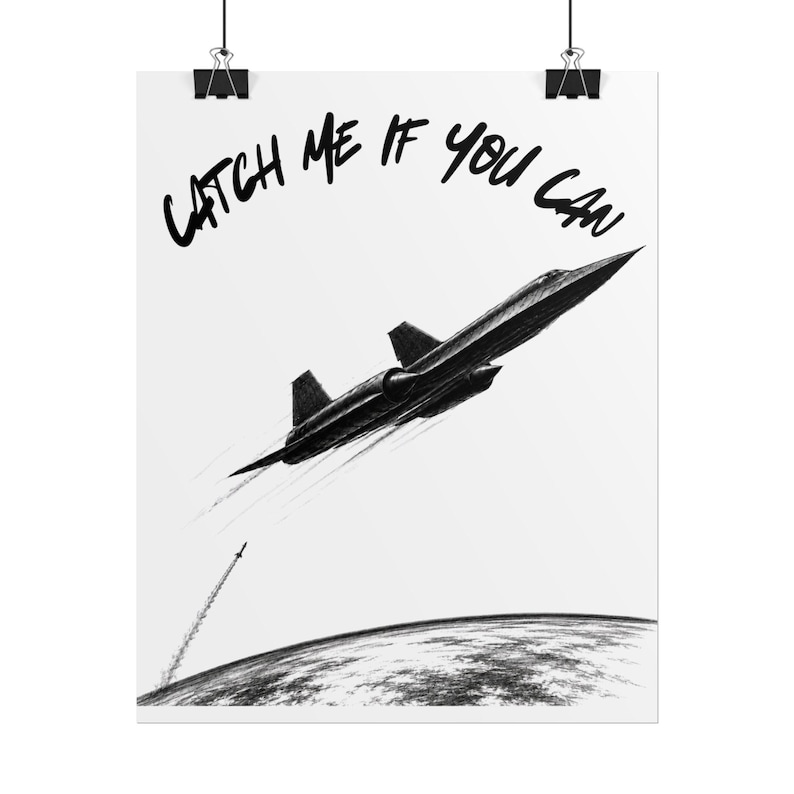
SR-71 Blackbird Aviation Art Print
Cold War spy plane wall art for the hangar, the office or the room where you keep the good books. The profile everybody recognizes, done as a print worth actually framing.

SR-71 Blackbird Recon Jet T-Shirt
Vintage-style military aircraft graphic tee for the aviation enthusiast who knows that “outran the missile” is a flex. Soft cotton, comfortable fit, ready for hangar tours, museum visits, or pretending you have any business at the Skunk Works.
Browse more military aircraft stories in the Aviation section — from WWII fighters to modern air superiority jets.
Frequently asked questions
Did the SR-71 have weapons?
No. The SR-71 was completely unarmed — no guns, no missiles, no bombs and no hardpoints. Speed and altitude were its entire defensive system. The one armed member of the family was the YF-12A interceptor, which carried AIM-47 missiles in the bays that later held cameras, and it never entered service.
Was the SR-71 a stealth aircraft?
Not in the modern sense. It used radar-absorbing paint, inward-canted rudders and fuselage chines to reduce its radar return, and it was a genuine stealth pioneer, but two afterburners at Mach 3 are impossible to hide on infrared. Blackbirds were tracked routinely. The aircraft was designed to be seen and be unreachable, not to go undetected.
How much fuel did the SR-71 burn?
About 44,000 pounds an hour — roughly 6,600 gallons — against a total capacity near 80,000 pounds. That gives under two hours of endurance on a full load, which is why almost every mission involved multiple aerial refuelings from specially converted KC-135Q tankers.
How many SR-71s were built, and how many were lost?
Thirty-two were built and twelve were destroyed. Every single loss was an accident or malfunction; none were shot down. The program lost one crew member in thirty-two years, RSO Jim Zwayer, in the 1966 breakup that pilot Bill Weaver survived.
Is there an SR-72, and what about the SR-73 or SR-75?
SR-72 is real as a program, not as an aircraft you can go look at. Lockheed Martin has publicly discussed a hypersonic successor concept under that designation. The SR-73 and SR-75 you may have seen referenced do not exist — the first is usually a misremembering of the SR-71, and the second comes from a 1990s “Aurora” rumor that was never substantiated.
What is an unstart on the SR-71?
An unstart is a sudden inlet failure in which the shock wave escapes forward out of one engine intake, causing that engine to lose most of its thrust while the other keeps running at full power. At Mach 3 the resulting asymmetric force yawed the aircraft hard enough that crews reported their helmets hitting the canopy. The automatic system’s response was to deliberately unstart the opposite inlet as well, trading all thrust for symmetry, then recycle both inlets back to normal.
Was the SR-71 a jet or a ramjet?
Both, depending on how fast it was going. The Pratt & Whitney J58 operates as a conventional afterburning turbojet at low speed, but above roughly Mach 2 six bypass tubes route most of the incoming air around the compressor and straight into the afterburner. At Mach 3.2 the great majority of thrust is generated by the inlet and afterburner rather than the turbine, which is why the J58 is usually described as a turbo-ramjet.
What came before the SR-71?
The CIA’s A-12 OXCART, which first flew in April 1962, nearly three years ahead of the SR-71. The A-12 was smaller, lighter and flown by a single pilot for an intelligence agency rather than the Air Force. The SR-71 that followed was longer, carried two crew and had a far broader sensor suite. Fifteen A-12s were built against thirty-two SR-71s.
How fast did the SR-71 actually go?
The official top speed was Mach 3.3 — about 2,193 mph. Crews have suggested the airframe was capable of slightly more in short bursts, but Mach 3.2 was the sustained operational cruise. The world record set during the 1990 retirement flight was 2,193 mph.
Was the SR-71 ever shot down?
No. Over 30+ years of operations, with more than 1,000 surface-to-air missiles fired at it, no SR-71 was ever lost to enemy action. Aircraft were lost to mechanical issues and accidents, but never to enemy fire.
Why did the SR-71 leak fuel on the ground?
The titanium airframe was designed to expand and seal once it heated up at high speed. On the ground, panels and tank seams were intentionally loose. The plane took off with a partial fuel load and refueled aerially after the airframe heated and sealed.
Why did pilots wear pressure suits?
At 85,000 feet, ambient pressure is so low that without a sealed full-pressure suit, a pilot losing cabin pressure would experience their bodily fluids beginning to vaporize. The David Clark S1030 suit was effectively a space suit and bought time in the event of a cockpit breach.
What replaced the SR-71?
Officially, nothing has fully replaced its capability. Satellites cover the strategic reconnaissance mission, and various drones cover tactical roles, but no Mach 3+ manned reconnaissance aircraft is in U.S. service. The proposed Lockheed SR-72 has been discussed for years but has not flown.
Is the LA speed check story actually true?
It’s been recounted by SR-71 pilot Brian Shul in his book Sled Driver and in many speaking engagements over the years. Like all great pilot stories, the exact details may have softened over time, but it’s been told consistently by the man who was actually in the cockpit.
The bottom line
The Blackbird is one of those airplanes that gets more impressive the more you learn about it. It wasn’t just fast — it was a flying paradox. Built from the enemy’s titanium. Fueled with stuff that wouldn’t burn. Leaked at rest. Outran missiles by accelerating, not dodging. Flown by pilots dressed for the moon. Retired twice. Replaced by nothing.
It’s been almost three decades since the last SR-71 flew. We’ve put cars in space, landed reusable rockets, and built drones that can loiter for days. But nobody has built another manned aircraft that can do what the Blackbird did, and at this point it’s an open question whether anyone ever will.
Sometimes the best version of a thing is also the only version of that thing. The SR-71 might be the cleanest example in aviation history.
If you liked this one…
If the Blackbird story scratched the itch, you’ll probably love the rest of the aviation rabbit hole on the blog. Try the P-51 Mustang post — the 117-day fighter that won the air war over Europe — or the B-17 Flying Fortress and the brutal math of the 25-mission tour. For modern iron, the F-15E Strike Eagle deep-dive covers how a pure dogfighter became the Air Force’s deadliest bomber, and the A-10 Warthog post explains why ground troops still pray for the BRRRRT. There’s also the Lucky 13 nose art history and the Lil Bastard gremlin origin story if you’re more into the lore than the airframes.
And if you ever get a chance to stand under one in person — Udvar-Hazy in Virginia, the National Museum of the USAF in Dayton, the California Science Center in LA — go. Pictures don’t do it. The Blackbird is one of those planes that has presence. It looks fast even when it’s bolted to the floor.
Follow along on Instagram @bentheretravel for more aviation, travel, and Pittsburgh content.
Read next: P-51 Mustang: The 117-Day Dare That Won the War in the Air
A Note from Ben
I’ve been fascinated by the SR-71 since the first time I saw one — the way it looks is almost alien, like someone sketched what the future would look like in 1960 and then somehow built it. As a private pilot, I understand what Mach 3.2 means in terms of energy management, thermal loads, and the sheer physical discipline required to fly at altitude in a pressure suit. The SR-71 story is also a Cold War story, a story about what America was willing to invest in intelligence capability and the extraordinary people it put inside those aircraft. Writing about this one is always a pleasure.
More from the shopBrowse the full WWII aviation & nose art collection — tees, prints, glassware and gifts, all original designs.

Ben & Nicole Mathews
We’re based in St. Augustine, Florida, sharing the places we’ve actually been — from our home turf to corners of the U.S. and abroad. Ben is an attorney and a retired Air Force JAG (22 years), and a private pilot, which is why aviation and military history shows up here too.