

Philadelphia. Summer, 1776. A man at a writing table dips a quill and signs his name. He’s never seen a glider. He doesn’t know powered flight is possible — nobody in his world does. The idea isn’t part of the conversation yet. It’s mythology, on the same shelf as Icarus and the gods.
Cut to a Navy ramp in Minneapolis. January 1943. An eighteen-year-old kid in a regulation flight jacket walks out to a school-bus-yellow Boeing Stearman idling on the line. He’s about to climb into the back seat and learn how to fly.
The math, fast: three grandfathers between them. The kid’s grandfather, born around 1876 — before the Wrights. His grandfather, born around 1826. His grandfather, born around 1776 — at the signing. Same family tree. 1776 at one end. A combat pilot at the other. Less than 250 years between them.
The airplane the kid is climbing into is a Boeing Stearman. Built in 1934. Painted school-bus yellow on purpose. And — this is the part that always surprises people — it was deliberately harder to fly than the fighters it would eventually feed.
The yellow wasn’t camouflage. It was a “new driver” warning to every other pilot on the field. The Boeing Stearman never fought, never shot anything down, and never appeared on a recruiting poster. It just taught roughly half of every American military pilot who fought in World War II how to leave the ground. They called it the Pilot Maker.
So here’s the math, written out the way it deserves.
The math nobody stops to do
Here’s the timeline, laid out the way they almost never lay it out in the documentaries.
1776. Philadelphia. The Declaration gets signed. The country is brand-new, the population is about 2.5 million, and the fastest thing on land is still a horse. Nobody alive has been in the air under power. The very idea isn’t part of the conversation. Humans flying isn’t science yet. It’s mythology.
1876. America’s centennial. The country throws itself a hundredth-birthday party in Philadelphia, exactly where the Declaration was signed. The Eiffel Tower doesn’t exist. Edison hasn’t built a working light bulb yet. And humans still haven’t flown — not in a powered, controllable, heavier-than-air machine. The Wright brothers are nine and five.
1903. The Wrights get airborne at Kitty Hawk. Twelve seconds. One hundred and twenty feet. The story makes the back of the newspaper, if it makes the newspaper at all.
1934. A workmanlike biplane called the Boeing Model 75 makes its first flight on November 26. Nobody knows it yet, but they’ve just built the airplane that will teach roughly half the pilots of the most consequential air war in history to leave the ground.
1943. George H.W. Bush, eighteen years old, walks out to a yellow Stearman in Minneapolis.
1945. The war ends with the United States operating the largest air force the world has ever seen.
2026. America 250. The country’s two-hundred-fiftieth birthday.
Now line it up as people, not dates. Forget parent-to-child for a second and count it in grandfathers — grandparent to grandchild, the way families actually remember themselves. Each grandfather hop is about fifty years.
Start with the kid in the Stearman, born around 1926. His grandfather was born about fifty years earlier, around 1876 — before the Wrights, before powered flight existed as a thing humans did. That grandfather had a grandfather, born about fifty years earlier still, around 1826. And that man had a grandfather, born around 1776 — at the signing, in the founding generation.
Three grandfather hops. That’s it. Three. From the Declaration of Independence to the back seat of a Boeing Stearman.
In those three hops, the country went from no powered flight, no electricity, no railroads, and no real Army to a global air force flying combat over three continents in cockpits trained by yellow biplanes. The grandfather’s grandfather’s grandfather signing his name in 1776 didn’t know human flight was possible. Three grandfathers later, his great-great-great-great-grandson learned how to do it in a school-bus-yellow biplane.
That’s not a metaphor. That’s the literal math.
And the kid reading this at America 250? Another two grandfather hops downstream — 1976, then 2026. Same family tree. Same country. Same 250 years.
Meet the Boeing Stearman, the Pilot Maker

The Boeing Stearman Model 75 first flew on November 26, 1934, and quickly became the standard primary trainer of the U.S. military. The Army called it the PT-13 and the PT-17. The Navy called it the N2S. The Canadians, the way only Canadians can, called it the Kaydet. Same airplane, four names, one job: take a young person who has never been higher than a Ferris wheel and turn them into someone who can fly.
Between 1934 and 1945, more than 10,000 Stearmans were built. That makes it one of the most-produced biplanes in history. To put a finer point on it: roughly half of every U.S. military pilot who fought in World War II made their first flight in a Stearman. Half. The B-17 pilots, the P-51 pilots, the carrier guys, the bomber-tow guys, the recon guys. Most of them started in the back seat of this airplane.
Which is why the nickname stuck. The Stearman was called “the Pilot Maker.” It wasn’t marketing. It was just true.
It’s a two-seat, open-cockpit, fabric-and-steel-tube biplane. Big radial up front, two wings, struts and wires, no canopy, no electronics worth mentioning. From a 1944 perspective it was already obsolete, and that was on purpose. A primary trainer needs to be cheap, easy to fix, and unforgiving enough to teach you something — not fast.
The Boeing Stearman’s signature yellow
And then there’s the paint.
Did You Know?
The bright school-bus yellow that became the signature Stearman color wasn’t camouflage. It was the exact opposite. It was a “new driver” sticker for the sky — a deliberate, high-visibility warning to every other pilot on the field that a student was at the controls and might do something unexpected. The brighter the paint, the safer the pattern. Every Stearman you’ve ever seen at an airshow is wearing the equivalent of a learner’s permit.
The Boeing Stearman taught everyone

When you tell people the Stearman trained “most” of the WWII pilots, the names that come back are predictable. The aces. The astronauts. The presidents.
On January 28, 1943, an 18-year-old Navy aviation cadet — at the time the youngest in the entire Navy — walked out to a yellow Boeing Stearman parked on the ramp at Wold-Chamberlain Field in Minneapolis. He had a flat-top, a regulation flight jacket, and zero hours of military flying. His name was George Herbert Walker Bush.
A year and change later, he’d be flying TBM Avengers off USS San Jacinto with Torpedo Squadron 51 (VT-51). He’d be shot down. He’d come home. He’d later become a congressman, an ambassador, a CIA director, and a president. But on that January morning in Minneapolis, he was just a kid trying to learn to fly the Pilot Maker.
Richard Bong — the highest-scoring American ace of the entire war, with 40 confirmed kills in a P-38 Lightning — trained on a Stearman. John Glenn, future Marine fighter pilot, future Mercury astronaut, future U.S. senator, trained on a Stearman. The list goes on for pages.
And then there’s Roscoe Brown. Brown was one of the Tuskegee Airmen — the first African-American military aviators in U.S. history, who fought through one of the ugliest political fights of the war just for the right to put on a flight suit. He went on to fly P-51 Mustangs over Europe, became commander of the 100th Fighter Squadron, and after the war became an educator and broadcaster. Decades later, asked about his first flight, he said something I’ve never quite been able to shake: it was, he said, “the first time you really got the feeling of flying.”
That’s the Stearman. Bush. Bong. Glenn. The Tuskegee Airmen. The 22-year-olds who never came home. The instructors who taught five generations of cadets in a row and got more cadets back alive than anyone has ever bothered to count. The plane didn’t ask whether you were going to be a president or a sergeant. It just made you a pilot.
Harder to fly than the war planes

Here’s the paradox that runs all the way through the Stearman story: the slow biplane that taught everyone to fly was, in a real way, more demanding than the high-performance airplanes the students would graduate into.
A Boeing Stearman is a taildragger — the third wheel sits at the back, under the rudder, instead of under the nose. On the ground, the airplane sits with its nose pointed at the sky. The pilot, sitting in the back behind another seat and a giant radial engine, cannot see directly forward. To taxi, you weave left and right in continuous S-turns, leaning your head out the side of the open cockpit. You’re flying the airplane on the ground before you’ve taken off.
In the air, it gets worse. The Stearman has a narrow landing-gear track and is famously squirrelly on takeoff and landing. It wants to ground-loop — that’s the technical term for the airplane suddenly deciding to spin around its own tail wheel — at the smallest provocation. Crosswinds make this worse. So does a heavy boot on the rudder. So does a student.
Why the Boeing Stearman was deliberately hard
All of that was on purpose. The Army Air Forces and the Navy didn’t want a forgiving primary trainer. They wanted an airplane that would either make you a better pilot or make you wash out — and either outcome was fine, because both saved lives later.
By the time a cadet finished Boeing Stearman time and moved up the pipeline — a faster BT-13 basic trainer, then an AT-6 Texan advanced trainer, then a combat type like the P-40, the P-51 Mustang, the F4F Wildcat, or the B-17 — the combat plane usually felt easier than the Boeing Stearman they’d started in. The Mustang practically lands itself by comparison. In other words, the Pilot Maker had already taught them everything that would try to kill them in the warbird.
Did You Know?
The Army didn’t actually run most of its own primary flight training. It couldn’t afford to. There weren’t enough Army instructors who weren’t already in combat, and the few who were qualified to teach were too valuable to lose to a training accident. So the Army Air Forces did something quietly brilliant: it outsourced primary training to a network of civilian flight schools — Spartan, Embry-Riddle, Parks, Ryan, and dozens of others — and used Stearmans as the standard fleet. Civilian instructors, civilian airfields, military cadets, government airplanes. It’s how America scaled from a few thousand pilots in 1939 to nearly 200,000 a few years later.
Why the Boeing Stearman still matters at America 250

There are airplanes that matter because of what they did, and there are airplanes that matter because of who they made. The Stearman is in the second category. Its résumé isn’t combat. Its résumé is people.
When the country puts on its 250th-birthday party in 2026, the airplane that should really be in the parade isn’t a Mustang or a Fortress or a Raptor — although all three deserve their flyovers. It’s the school-bus-yellow biplane that taught a country that had never flown how to dominate the air inside one human lifetime.
Think about it this way. The kid born in the 1920s — Bush, or any one of the other million kids the Stearman trained — had a grandfather who, as a young man, had never seen anything heavier than a hot-air balloon get airborne. That grandfather’s grandfather’s grandfather was sitting at a table in Philadelphia in 1776, signing the country into existence. By the time the kid was twenty-three, he was flying combat missions over the Pacific in an aircraft carrier’s worth of war machinery, with thousands of other twenty-three-year-olds, against an enemy doing the same. The country had gone from a Declaration to global air dominance in three grandfather hops.
That happened because somebody had to teach those kids how to fly. Somebody had to put 200,000 young Americans into open cockpits and turn them into pilots fast enough to keep up with a war we were losing in the Pacific and barely holding in Europe. That somebody was, mostly, a civilian instructor in a Texas summer, in a Stearman with a working radial and a learner’s-permit paint job, walking yet another nineteen-year-old through yet another set of S-turns.
That’s what the Stearman is. It’s the airplane behind the people. It’s the reason the math of “1776 to a global air force in one family tree” actually closes.
From the Shop
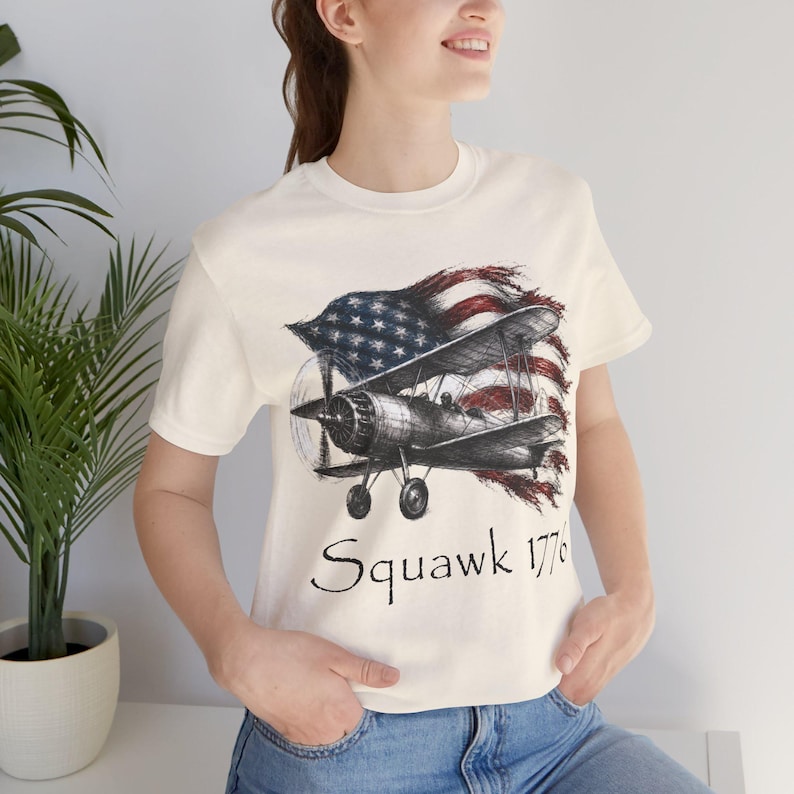
Aviation Heritage Stearman Biplane Pilot Humor T-Shirt — Squawk 1776
A sketched Stearman, an American flag motif, and the four characters that make pilots smile: “Squawk 1776.” It reads like a real transponder code at first glance, then lands as a quiet tip of the cap to the year — perfect for the America 250 ramp shuffle. For the aviation buff, the history nerd, and anyone who appreciates that the country and powered flight nearly grew up together.
Stearman Biplane America 250 Pilot Humor Sticker — Squawk 1776
Same Stearman, same gag — the transponder code that doubles as a tip of the cap to 1776 — sized down to kiss-cut sticker form. Lower commitment than the tee. Slap it on your laptop, your water bottle, your flight bag, the lid of the plane Yeti, or any other surface that needs to declare allegiance to powered flight and a 250-year-old country.
Patriotic Stearman Biplane Can Cooler — Squawk 1776 Koozie
Squawk 1776 and keep it cold. Our Stearman koozie salutes the biplane that made pilots — a fitting toast for America 250.
Frequently asked questions
What plane did most WWII pilots train on?
The Boeing Stearman Model 75 — designated the PT-13 and PT-17 in the Army, the N2S in the Navy, and the Kaydet in Canada. Across all four names, the Boeing Stearman was a single airplane with one job. More than 10,000 were built between 1934 and 1945, and roughly half of all U.S. military pilots who fought in World War II made their first flight in one. That’s where its nickname, “the Pilot Maker,” comes from.
Did George H.W. Bush really fly a Stearman?
Yes. Bush was the youngest aviation cadet in the Navy at the time, and on January 28, 1943 he reported for primary flight training at Wold-Chamberlain Field in Minneapolis, where the Navy used yellow Stearman N2S trainers. He went on to fly TBM Avengers from USS San Jacinto with Torpedo Squadron 51 (VT-51), and one of the actual Stearmans he trained in is on display at the Pacific Aviation Museum at Pearl Harbor.
Why were Stearman trainers painted yellow?
High visibility, not camouflage. The bright yellow paint was a “new driver” warning — a way of telling every other pilot on the field that a student was at the controls and might do something unpredictable. The brighter the paint, the easier it was to see and avoid. Stearmans were primary trainers, never meant for combat, so they didn’t need to blend in. They needed to stand out.
Are Stearman biplanes still flying today?
Hundreds of them. The Stearman is one of the most popular vintage warbirds on the civilian airshow circuit, with a healthy number still airworthy in private hands and museum collections. They show up at Oshkosh, the Reno Air Races, and just about every airshow that takes WWII heritage seriously. If you’ve ever seen a yellow biplane flying loops over a county fair, odds are very good it was a Stearman.
What does “Squawk 1776” mean?
It’s a pilot joke. In real-world aviation, a “squawk” is the four-digit code you set on your transponder so air traffic control can identify you on radar. The codes run from 0000 to 7777 and are always four digits. “Squawk 1776” looks like a perfectly normal ATC instruction at a glance — and then you read it again and realize it’s the year the United States declared independence. It’s the kind of joke that lands instantly for pilots, lands a beat later for everyone else, and looks good on a t-shirt either way.
The bottom line
The Boeing Stearman isn’t the most famous WWII airplane and never will be. It didn’t fight, it didn’t shoot anything down, it didn’t appear on a single recruiting poster. It was slow, it was unforgiving, and it was painted the color of a school bus on purpose.
It was also the airplane that made the people who won the war.
Almost everybody who flew a Mustang into Berlin, a Fortress over Schweinfurt, a Wildcat over Midway, or an Avenger over the Pacific learned what an airplane was in a Stearman first. Almost every name on the bronze plaques started in the back seat of a yellow biplane built in 1934. The country that flew those missions didn’t exist as an air power one generation earlier — and three grandfather hops earlier didn’t exist at all. The Stearman is the bridge across all of it.
That feels worth remembering at 250.
If you liked this one…
If the Pilot Maker story scratched the itch, the rest of the aviation rabbit hole is right here on the blog. The natural next stop is the P-51 Mustang piece — the 117-day fighter that picked up where Stearman cadets left off and ended the Luftwaffe over Europe. From there, the B-17 Flying Fortress post covers the brutal math of the 25-mission tour the Mustang was eventually able to escort all the way home. If you want to fast-forward to the Cold War, the SR-71 Blackbird piece is the story of an airplane that beat surface-to-air missiles by simply running away from them. And the WWII nose art and Lucky 13 story is the lore — the paint that gave the bombers and fighters and trainers their personalities — straight from the flight line tradition that lives on at every Oshkosh.
Come find us on Instagram @bentheretravel for more aviation, travel, and the occasional warbird that didn’t quite make it into a blog post.

Ben & Nicole Mathews
We’re based in St. Augustine, Florida, sharing the places we’ve actually been — from our home turf to corners of the U.S. and abroad. Ben is an attorney and a retired Air Force JAG (22 years), and a private pilot, which is why aviation and military history shows up here too.